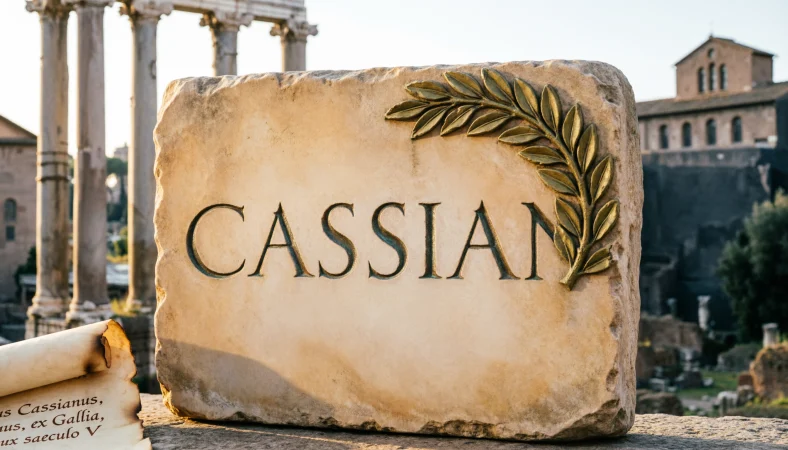
Cassian is a masculine name of Latin origin, derived from the Roman family name Cassianus. It is traditionally connected to the Roman name Cassius. Cassian has a classic, elegant feel and is also associated with early Christian saints.
The Cassian name meaning is closely connected to ancient Rome. Cassian is a masculine given name derived from the Roman Cassianus, which came from the Roman family name Cassius. It has a long historical connection with Latin naming traditions and was also carried by several early Christian saints.
Today, Cassian has an old-world, refined sound while still feeling distinctive as a modern first name. Its history connects Roman names, Latin language, Christian tradition, and early monastic history.
This guide explains the meaning, origin, pronunciation, history, related names, nicknames, and common questions surrounding Cassian.
What Is the Cassian Name?
Cassian is a masculine given name of Ancient Roman origin. The English form comes from the Latin Cassianus, a Roman cognomen derived from the family name Cassius. The name was used by several saints, helping it survive beyond the Roman period and into Christian naming traditions.
In simple terms:
- Name: Cassian
- Gender: Traditionally masculine
- Origin: Ancient Roman
- Language: Latin
- Original form: Cassianus
- Related family name: Cassius
- Related form: Kasjan in Polish
- Common English pronunciations: KASH-ən and KAS-ee-ən
One important point is that Cassian does not have a single universally agreed literal English translation such as “strong” or “brave.” Its documented name history is more specific: Cassian comes from Cassianus, which was derived from Cassius.
Cassian Name Meaning
The most historically responsible explanation of the Cassian name meaning is “of Cassius” or “belonging to Cassius.” This reflects the structure of the Latin name rather than a simple modern dictionary translation.
The name Cassius itself is an old Roman family name. One commonly cited possibility connects Cassius with the Latin word cassus, which can carry meanings such as “empty” or “vain.” However, this etymology is generally presented as possible rather than certain, so it should not be treated as an established literal meaning of Cassian.
That distinction is important when researching baby-name meanings. Online name lists sometimes give Cassian a single literal meaning, but the historical evidence more securely establishes its Roman family-name lineage than a definite one-word translation.
What does Cassian mean in simple terms?
A simple explanation is:
Cassian is an ancient Roman name derived from Cassianus, meaning essentially “of Cassius” or “belonging to the Cassius family.”
If you are choosing the name because you want an ancient, classical name with a strong historical background, Cassian fits that description particularly well.
Cassian Name Origin and Etymology
The etymological path of the name can be shown simply:
Cassius → Cassianus → Cassian
Cassius was a Roman family name. From it came Cassianus, the original Latin form associated with Cassian. The English form Cassian is described as an Anglicized form of the Ancient Roman name.
This also explains why Cassian sounds related to names such as Cassius and Cassia.
The Roman naming system was more complex than the modern first-name system. Romans could use several names, including a family name and a cognomen. A cognomen could identify a branch of a family or become an inherited name. Cassianus belongs to this broader Roman naming tradition.
Is Cassian a Latin name?
Yes. Cassian has a Latin and Ancient Roman background. The documented original form is Cassianus, while Cassian is the Anglicized form used in English.
History and Cultural Context of Cassian
Cassian has an especially interesting history because the name did not remain limited to ancient Roman naming traditions. It became associated with early Christian figures as well.
One important historical figure was John Cassian, a Christian monk and writer who lived approximately from the fourth to the fifth century. He spent significant time studying monastic traditions in Egypt and later helped spread Eastern monastic practices in the Western Christian world. He eventually established monasteries near Marseille in southern Gaul.
John Cassian’s writings included the Institutes and Conferences, which dealt with monastic life, spiritual discipline, and the challenges faced by monks. His works became influential in the development of Western monastic thought.
Cassian was also the name of earlier Christian saints. Behind the Name notes a third-century martyr associated with Tangier as well as the fifth-century mystic associated with Marseille.
This religious and historical association gives Cassian a second layer of identity beyond its Roman origin.
Cassian in Christian history
The name is particularly notable in Christian history because of figures such as John Cassian. The historical John Cassian was associated with monastic teaching and writings about spiritual discipline.
Therefore, someone researching the name may encounter Cassian in both:
- Ancient Roman naming history
- Early Christian and monastic history
These connections make the name feel classical and historically established rather than newly invented.
How Do You Pronounce Cassian?
Cassian has more than one established pronunciation in English.
Two commonly encountered pronunciations are:
- KASH-ən
- KAS-ee-ən
Behind the Name lists both /ˈkæʃ.ən/ and /ˈkæs.i.ən/ as English pronunciations.
The pronunciation may therefore depend on the speaker, region, and personal preference.
If you are choosing Cassian for a baby, it is worth remembering that some people may naturally say KASH-ən, while others may say KAS-ee-ən. You can simply tell people which pronunciation you prefer.
Cassian Name Meaning in Latin
When asking for the Cassian name meaning in Latin, it is better to focus on its etymological form rather than assigning it an unsupported single-word translation.
The Latin form Cassianus is the original form of Cassian. It was derived from the Roman family name Cassius.
The name Cassius has sometimes been connected to the Latin cassus, meaning “empty” or “vain,” but this connection is described as possible rather than certain.
So, a careful explanation would be:
Cassian → Cassianus → Cassius → possibly related to Latin cassus.
This is more accurate than stating that Cassian definitively means “empty” or “vain.”
Cassian Name Variations and Related Names
Cassian belongs to a group of names with related historical forms.
| Name | Connection to Cassian |
|---|---|
| Cassian | English/Anglicized form |
| Cassianus | Original Latin form |
| Cassius | Roman family name from which Cassianus developed |
| Cassia | Feminine form related to Cassius |
| Kasjan | Polish form |
| Cass | Possible modern nickname |
The strongest direct relationship is between Cassian and Cassianus. Cassius is the older Roman family-name source identified in the documented etymology.
Cassian as a Baby Boy Name
Parents may be attracted to Cassian because it combines a classical origin with a distinctive modern sound.
Some qualities people may associate with the name include:
- Classical
- Refined
- Historical
- Masculine
- Uncommon
- Literary
- Traditional
- Sophisticated
These are descriptions of the name’s style rather than qualities guaranteed by the name itself. A person’s personality cannot be determined from their first name.
Cassian also has the advantage of having a recognizable historical foundation. It is not simply a recently created name; its documented roots reach back to Roman naming traditions.
Possible Nicknames for Cassian
Cassian can be shortened in several informal ways, although nickname choice depends entirely on personal preference.
Common possibilities include:
- Cass
- Cas
- Cassie
- Cash
Among these, Cass is especially straightforward because it preserves the beginning of the original name.
Cash can also work with the KASH-ən pronunciation, although it creates a stronger distinction from the KAS-ee-ən pronunciation.
Cassian vs Cassius
Cassian and Cassius are closely related, but they are not the same name.
| Feature | Cassian | Cassius |
|---|---|---|
| Origin | Ancient Roman | Ancient Roman |
| Latin form | Cassianus | Cassius |
| Relationship | Derived from Cassius | Roman family name |
| Style | Longer and softer | Shorter and more classical |
| Pronunciation | KASH-ən or KAS-ee-ən | Several pronunciations exist |
| Modern use | Given name | Given name and historical family name |
Cassian developed from Cassianus, while Cassius is the Roman family name from which Cassianus was derived.
Cassian vs Cassia
Cassia is a feminine name related to Cassius, while Cassian is traditionally masculine.
The two names share a Roman naming connection, but they have different forms and usage. Behind the Name identifies Cassia as the feminine form of Cassius and Cassian as an Ancient Roman name derived from Cassianus.
They may therefore appeal to parents looking for coordinated sibling names with classical roots.
Cassian in Modern Culture
Cassian has also appeared in modern fiction, which has helped make the name more recognizable to contemporary audiences.
A notable example is Cassian Andor, a fictional character from the Star Wars universe. The character appears in Rogue One and the television series Andor. This modern fictional association is separate from the historical origin of the name itself.
The name also appears in other modern literature and entertainment, showing how an ancient name can be reused in contemporary storytelling.
It is useful to distinguish these modern appearances from the actual etymology: fictional characters can increase awareness of a name, but they do not create its historical meaning.
Is Cassian a Rare Name?
Cassian is generally considered less common than many familiar traditional boys’ names, which can make it attractive to parents looking for something distinctive.
However, name popularity changes by country, year, and naming culture. A name that is uncommon in one country may be more familiar in another.
For that reason, it is better not to describe Cassian as universally “rare” without specifying a location and year.
Its historical background, unusual sound, and appearances in modern fiction have all contributed to its contemporary visibility.
What Makes Cassian a Good Name?
Whether Cassian is a good name is ultimately a personal choice, but it has several practical and stylistic strengths.
1. Strong historical roots
Cassian has a documented connection to Ancient Roman naming traditions.
2. Distinctive sound
It is recognizable without being as common as many traditional names.
3. Multiple pronunciation options
Families can use either KASH-ən or KAS-ee-ən, depending on preference and linguistic background.
4. Historical Christian connection
Figures such as John Cassian give the name a significant place in early Christian history.
5. Useful nickname options
Cass, Cas, and Cash can provide shorter alternatives.
Example Sentences Using Cassian
Here are some natural examples showing how the name can appear in everyday writing:
- Cassian is a distinctive name with ancient Roman roots.
- We chose Cassian because we wanted a classical name that was not overly common.
- Cassian’s name has a long history connected with Latin and Roman naming traditions.
- Everyone asked how to pronounce Cassian, so his parents explained that they use KAS-ee-ən.
- Cassian has both historical and modern cultural associations.
These examples demonstrate ordinary use of Cassian as a personal name rather than suggesting that the name itself determines a person’s character.
Is Cassian a Biblical Name?
Cassian is not generally classified as a biblical name. Its documented origin is Ancient Roman, through the Latin Cassianus and Roman family name Cassius.
However, the name has an important Christian historical association because several early Christian saints carried the name, including John Cassian, an influential Christian monastic writer.
Therefore, it is more accurate to describe Cassian as a Roman/Latin name with Christian historical connections, rather than calling it a biblical name.
FAQs
What does Cassian mean?
Cassian is a Latin-derived name associated with Cassius and the Roman family name Cassianus.
What is the origin of Cassian?
Cassian has Latin and Roman origins.
Is Cassian a boy’s name?
Yes, Cassian is traditionally a boy’s name.
How do you pronounce Cassian?
Cassian is commonly pronounced KASH-ee-un or KASS-ee-un, depending on the accent.
Is Cassian a biblical name?
Cassian is not a biblical name, but it has a strong early Christian historical connection.
Is Cassian a rare name?
Cassian is relatively uncommon compared with classic names such as John or James, giving it a distinctive feel.
What names are similar to Cassian?
Similar names include Cassius, Cassianus, Julian, Lucian, Sebastian, and Adrian.
Is Cassian a good name?
Yes. Cassian is a distinctive, sophisticated, and historically rooted name.
Final Thoughts on the Cassian Name Meaning
The Cassian name meaning is best understood through its historical development rather than a single literal translation. Cassian is an Anglicized form of the Ancient Roman Cassianus, which was derived from the Roman family name Cassius.
The name has survived through centuries of Roman and Christian history, with figures such as John Cassian adding an important religious and intellectual connection.
For modern parents, Cassian offers a combination of ancient history, Latin roots, distinctive pronunciation, and contemporary appeal. It is a strong choice for someone looking for a masculine name that feels both classical and uncommon.

3 thoughts on “Cassian Name Meaning: History, Pronunciation & Facts For 2026”