Colette is a feminine name of French origin derived from Nicolette, a diminutive of Nicole. It ultimately comes from the Greek name Nikolaos, meaning “victory of the people.” Colette is pronounced koh-LET and is appreciated for its elegant French style and timeless appeal.
The Colette name meaning is commonly associated with “victory of the people,” a meaning inherited through its connection to Nicole and the ancient Greek name Nikolaos. Colette is a feminine name of French origin known for its elegant sound, literary associations, and timeless appeal. It combines a rich linguistic history with a short, distinctive form that feels suitable for both traditional and modern naming styles.
Parents considering Colette may appreciate its French character, straightforward spelling, and affectionate nickname possibilities. The name also carries a connection to French literature through the celebrated writer Colette. Understanding its meaning, origin, pronunciation, and cultural background can help families decide whether it suits their preferences.
What Is Colette?
Colette is a feminine given name used in French and other languages. It developed as a diminutive of Nicole, the French feminine form of Nicholas. Although Colette is now established as a standalone name, its historical connection to Nicole explains its traditional meaning and linguistic background.
The name has several appealing qualities:
- Origin: French
- Gender: Traditionally feminine
- Traditional meaning: “Victory of the people,” inherited through Nicole and Nicholas
- Pronunciation: koh-LET in a common English pronunciation
- French pronunciation: Approximately koh-LET, with a French vowel and final consonant pronounced according to French speech
- Related names: Nicole, Nicolas, Nicholas, Nicolette, and Collette
- Common nickname: Coco
Colette is especially appealing to people who enjoy names with European roots, literary connections, and a balance of delicacy and strength.
Unlike a descriptive word that directly translates into a particular quality, Colette receives its traditional meaning through a longer chain of related names. Its association with victory and people comes from the Greek roots of Nikolaos rather than from a direct modern French translation of Colette.
Colette Name Meaning and Symbolism
The traditional Colette name meaning is “victory of the people.” This interpretation comes from its connection to Nicole, which derives from the Greek name Nikolaos.
The Greek name is generally analyzed through two elements:
- Nikē — victory
- Laos — people
Together, these elements give Nikolaos its familiar interpretation as “victory of the people.”
Because Colette developed from Nicole, it shares this inherited meaning. However, Colette itself is a French diminutive rather than a direct combination of the original Greek elements.
The meaning behind the name
The name’s traditional interpretation can suggest several positive ideas.
Victory and achievement: The first element connects the name with overcoming challenges, reaching goals, and succeeding through effort.
Community and belonging: The second element refers to people collectively. This can inspire associations with friendship, cooperation, and shared achievement.
Strength with elegance: Colette has a soft, flowing sound, but its inherited meaning carries a sense of determination. This contrast may appeal to parents seeking a name that feels both graceful and confident.
These symbolic interpretations are personal associations, not fixed personality traits. A name cannot determine a person’s character, future, or abilities.
Does Colette literally mean victory?
Not as a direct translation of the French word itself. The meaning “victory of the people” belongs to the name’s etymological family through Nicole and Nicholas. It is therefore more accurate to describe this as Colette’s traditional inherited meaning.
This distinction matters because baby-name sources sometimes simplify a name’s history by presenting an ancient root meaning as though it were the literal definition of the modern name.
Colette Name Origin and Etymology
Colette has a French linguistic origin, but its deeper roots reach back to ancient Greek.
Its development can be understood through the relationship between several names.
Nikolaos
Ancient Greek name
“Victory of the people”
Nicole
French feminine form associated with Nicholas
Colette
French diminutive that became an independent given name
The Greek connection
Nikolaos is an ancient Greek masculine name. Its elements connect the ideas of victory and people, creating the traditional interpretation associated with the Nicholas family of names.
The name spread through European languages and Christian naming traditions. Nicholas became a widely used name in several regions, while feminine forms such as Nicole developed in different languages.
The French connection
Nicole became established as a French feminine name, and Colette developed as an affectionate or diminutive form of it. A diminutive is a name form that can express familiarity, affection, or a smaller or more intimate version of a longer name.
Over time, many diminutives become independent given names. Colette followed this pattern and no longer needs to function as a nickname for Nicole.
How did Colette become a standalone name?
Names frequently change as people use them across generations. A form that begins in family conversation or informal speech may eventually appear on birth records and become familiar in its own right.
Colette illustrates this process. Its connection to Nicole remains important for understanding its etymology, but modern parents can choose Colette as a complete first name without using Nicole at all.
The name’s French spelling and recognizable pronunciation also help distinguish it from its related forms.
History and Cultural Significance of Colette
Colette’s history is closely connected with French naming traditions and the wider European use of names derived from Nicholas.
Colette in French naming traditions
French has a long tradition of developing affectionate forms from established given names. These forms may differ through their endings, pronunciation, or spelling.
Colette fits this linguistic pattern. Its relationship to Nicole gives it a recognizable French background, while its independent use allows it to stand on its own.
Although the name has French roots, it is not restricted to French-speaking families. Names often travel across borders through literature, migration, entertainment, and changing parental preferences.
Colette and French literature
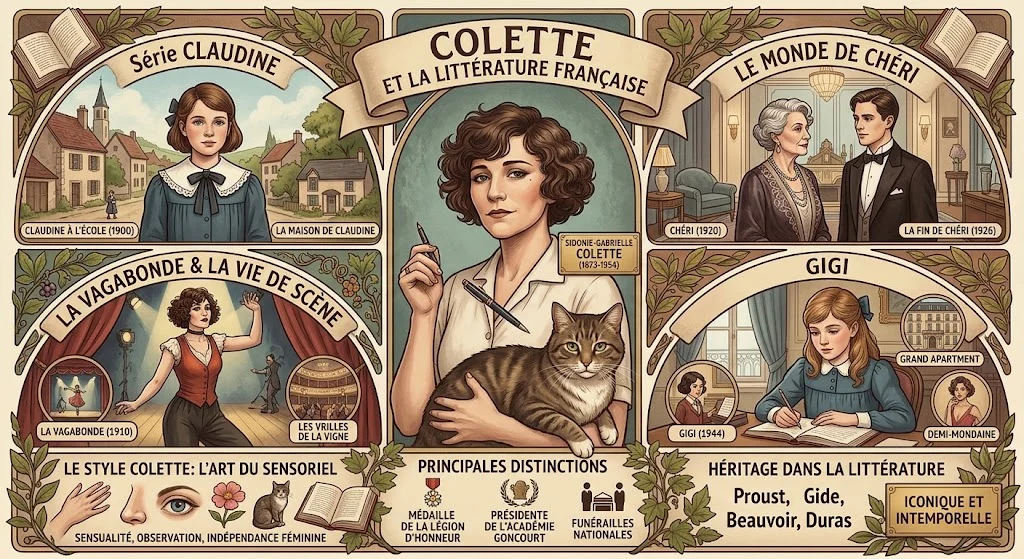
One of the most notable cultural associations is the French novelist and performer known by the name Colette (1873–1954), whose full name was Sidonie-Gabrielle Colette.
She became an important figure in French literature, known for works that explored relationships, social expectations, identity, and women’s experiences. Her literary career gave the name a lasting cultural association with creativity and artistic independence.
The writer did not create the name, but her prominence helped make Colette recognizable beyond ordinary naming traditions. For readers familiar with French literature, the name may evoke sophistication, observation, and a strong literary voice.
These are cultural associations rather than literal components of the name’s definition.
Colette in modern naming
Today, Colette can appeal to parents who want a name with historical depth but without an elaborate spelling. It has a traditional foundation and a clear identity as a first name.
Its appeal may come from several characteristics:
- It is relatively short and easy to write.
- It has a recognizable French identity.
- It connects to a larger family of established names.
- It offers the informal nickname Coco.
- It works with a wide variety of middle-name styles.
Whether Colette feels traditional, fashionable, vintage, or contemporary depends on the family’s language, culture, and personal taste. It is better to judge its popularity using current statistics for the relevant country rather than assume it has the same status everywhere.
How to Pronounce Colette
Colette is commonly pronounced koh-LET in English, with the stress on the second syllable.
A simple pronunciation guide is:
- Co: sounds approximately like “koh.”
- lette: sounds approximately like “let.”
- Full pronunciation: koh-LET.
The French pronunciation is similar in broad outline, although the vowel quality and rhythm reflect French phonology. English speakers may pronounce the first vowel differently depending on their accent.
Because Colette is familiar in French and English, most readers can learn its pronunciation quickly.
Common pronunciation mistakes
People unfamiliar with the name may place the stress on the first syllable or pronounce the ending in an unusual way. The most useful reminder is to emphasize the second syllable.
If you are choosing the name for a child, you can introduce it by saying, “It’s Colette, pronounced koh-LET.” This simple explanation usually resolves initial uncertainty.
Is Colette a Girl’s Name?
Yes. Colette is traditionally used as a feminine given name.
Its connection to Nicole, the French feminine form associated with Nicholas, explains its established use as a girl’s name. It has a long-standing identity in French naming culture and is also used in English-speaking communities.
Naming choices are personal, and contemporary families may use names in ways that differ from historical conventions. However, anyone researching Colette as a baby name will generally encounter it classified as feminine.
Who might like the name Colette?
Colette may appeal to parents who prefer:
- French or European-inspired names
- Traditional names with a relatively short spelling
- Feminine names that sound polished without being overly elaborate
- Names with literary or artistic associations
- Names that provide a playful nickname alongside a formal full name
It can also suit families who like Nicole but want a less familiar variation within the same name family.
Colette Nicknames and Variations
One advantage of Colette is that it offers both a complete formal name and several possibilities for informal use.
Popular nickname ideas
Coco
Coco
A playful, memorable nickname that feels lively and modern.
Co
Co
A very short, casual option that works well within a family.
Lettie
Lettie
A sweet, vintage-style nickname derived from the ending of the name.
Etta
Etta
A more creative option inspired by the final sounds of Colette.
Not every nickname is equally established. Coco is an intuitive choice, while Lettie and Etta are more creative options that depend on family preference.
Colette spelling variations
The following names are related in different ways, but they are not all interchangeable spellings.
| Name | Relationship to Colette |
|---|---|
| Collette | A spelling variant of Colette |
| Nicole | The French feminine name from which Colette developed |
| Nicolette | A related feminine form in the Nicholas name family |
| Nicollette | An alternative spelling related to Nicolette |
| Nicola | A feminine name in some languages and a masculine name in others |
| Nicholas | The English form of the related masculine name |
| Nicolas | A form commonly used in French and other languages |
When selecting a spelling, consider how it looks with the surname, how easily others can recognize it, and whether you prefer the traditional French form or a variant.
Middle Names That Pair Well With Colette
Colette has two syllables and a clear ending, so it pairs with many short, long, traditional, and contemporary middle names.
The best combination often depends on rhythm. A one-syllable middle name can give Colette a compact sound, while a longer middle name can create a more flowing combination.
Classic middle names
- Colette Marie
- Colette Elizabeth
- Colette Grace
- Colette Jane
- Colette Rose
- Colette Louise
These choices create a traditional combination and complement the name’s French background without requiring the middle name to have the same origin.
Elegant and French-inspired middle names
- Colette Elise
- Colette Juliette
- Colette Simone
- Colette Margot
- Colette Vivienne
- Colette Amelie
These combinations share French linguistic or cultural associations, although their origins and histories differ.
Modern middle names
- Colette Avery
- Colette Harper
- Colette Quinn
- Colette Willow
- Colette Sage
- Colette Riley
These combinations give the traditional first name a more contemporary overall style.
Before making a final choice, say the complete name aloud with the surname. Pay attention to repeated sounds, initials, pronunciation, and whether the combination feels natural in everyday conversation.
Colette Compared With Similar Names
Colette belongs to a family of names connected through Nicole and Nicholas. However, each name has its own pronunciation, spelling, and usage.
| Name | Meaning or association | Main difference |
|---|---|---|
| Colette | Traditionally “victory of the people” | French diminutive of Nicole, now used independently |
| Nicole | “Victory of the people” | The name from which Colette developed |
| Collette | Same traditional meaning as Colette | Alternative spelling |
| Nicolette | Connected to the Nicholas name family | Longer form with a similar feminine style |
| Nicholas | “Victory of the people” | Traditional masculine form in English |
| Nicolas | Connected to the Greek Nikolaos | French and other European-language form |
| Juliette | Associated with the name Julie and Julius | A French feminine name with a different etymology |
| Eloise | Often associated with French and Germanic naming traditions | Similar in style, but unrelated etymologically |
Colette and Collette are particularly close because they differ mainly in spelling. Nicole is the most important related name for understanding Colette’s development, while Nicolette offers a longer alternative.
Names such as Juliette and Eloise may appeal to the same families because of their French associations, but their similarities are stylistic rather than evidence of a shared origin.
Is Colette a Good Baby Name?
Colette can be a strong choice for parents seeking a feminine name with a clear pronunciation, established history, and French character. Its connection to Nicole gives it a traditional foundation, while its independent use makes it suitable for a child whose parents prefer a complete name rather than a nickname.
There is no universally perfect baby name, but Colette has several practical advantages.
Easy to spell: The name has a recognizable spelling, although some people may add an extra “l” and write Collette.
Flexible style: Colette can feel traditional, literary, or contemporary depending on the middle name and family context.
Useful nickname options: Coco provides a playful alternative without changing the formal name.
Meaningful background: Its inherited meaning links it to the ideas of victory and people.
Parents should also consider their local language and pronunciation habits. A name that sounds natural in one country may receive slightly different pronunciation in another. Checking how Colette sounds alongside the surname can help ensure the complete name feels comfortable.
What makes Colette distinctive?
Colette stands out through the combination of its French origin, concise form, and literary association. It is recognizable without being identical to Nicole, and its ending gives it a distinct sound.
The name also demonstrates how names evolve. A form that once served as a diminutive can develop into an independent given name while retaining a connection to its linguistic roots.
That combination of history and flexibility is part of Colette’s appeal.
Conclusion
The Colette name meaning is traditionally associated with “victory of the people,” through its French connection to Nicole and the Greek name Nikolaos. Its history, literary associations, graceful pronunciation, and nickname options make it an appealing choice for families seeking a feminine name with European roots. Whether paired with a classic middle name or a modern one, Colette offers a distinctive identity grounded in a long naming tradition.
FAQs
What does the name Colette mean?
Colette is traditionally associated with “victory of the people.” This meaning comes through Nicole, the French feminine name connected to the Greek Nikolaos.
What is the origin of Colette?
Colette originated in French as a diminutive of Nicole. Its deeper linguistic roots trace back to the ancient Greek name Nikolaos.
Is Colette a French name?
Yes. Colette is a French feminine given name. It later became established as an independent first name in French and other naming traditions.
How do you pronounce Colette?
Colette is commonly pronounced koh-LET, with the emphasis on the second syllable. The exact vowel sound may vary slightly between French and English speakers.
Is Colette a girl’s name?
Yes. Colette is traditionally a feminine given name and is generally classified as a girl’s name in baby-name references.
What is a nickname for Colette?
Coco is a popular nickname option. Co, Lettie, and Etta are additional possibilities, although nickname preferences vary between families.
Is Colette the same as Collette?
Colette and Collette are spelling variants of the same name. Colette is the traditional French spelling, while Collette uses an additional “l.”
Is Colette related to Nicole?
Yes. Colette developed as a diminutive of Nicole. Both names belong to the broader Nicholas name family and share the traditional association with “victory of the people.”
What middle names go well with Colette?
Marie, Grace, Rose, Elizabeth, Louise, Elise, and Juliette can pair well with Colette. The best option depends on the surname, preferred rhythm, and family naming traditions.
Is Colette a rare name?
Its popularity varies by country and time period. Without checking current official birth-name statistics for a specific location, it is not possible to classify it reliably as rare or common everywhere.
