
Juno is a feminine name of Latin origin associated with the ancient Roman goddess of marriage, women, and childbirth. The name carries traditional associations with protection, dignity, strength, and womanhood.
The Juno name meaning is closely associated with the Roman goddess Juno, a powerful figure connected with marriage, women, childbirth, and protection. Juno is a feminine given name with ancient Roman roots, a graceful two-syllable pronunciation, and a distinctive mythological background. Today, parents may choose it for its historical depth, strong feminine associations, and short, memorable sound.
Unlike names with a simple, universally agreed-upon dictionary definition, Juno draws much of its significance from mythology and classical tradition. Its precise linguistic etymology remains debated, but its connection to the Roman goddess is well established. Understanding this distinction helps explain why the name carries meanings related to dignity, family, strength, and feminine power.
What Is the Name Juno?
Juno is a feminine given name derived from the name of an important goddess in ancient Roman religion. Roman tradition presented Juno as the wife of Jupiter, king of the gods, and as a divine protector associated with women, marriage, and the Roman community.
The name is especially recognizable because of its connection to classical mythology. It belongs to the same broad category of mythology-inspired names as Athena, Diana, Minerva, and Venus.
Here are the essential facts about Juno:
Name
Juno
Origin
Latin and ancient Roman tradition
Gender
Traditionally feminine
Pronunciation
JOO-noh
Associated qualities
Strength, dignity, protection, marriage, and femininity
Juno works well as a standalone first name. Its compact spelling makes it easy to recognize, while its mythological background gives it more depth than its length might suggest.
Juno Name Meaning and Symbolism
The name Juno is primarily understood through its association with the Roman goddess of the same name. Because scholars have not established one universally accepted literal translation of the name, it is more accurate to explain its traditional symbolism than to assign it a definitive English meaning.
Several themes are closely connected with the name.
Marriage and Commitment
Juno was strongly associated with marriage and the protection of married women in Roman religious tradition. This connection gives the name a symbolic relationship with commitment, partnership, and family life.
Parents who appreciate names with family-centered meanings may find this association appealing. However, the symbolism comes from the goddess’s traditional role, not from a confirmed literal translation of the name itself.
Strength and Authority
Juno was one of the most prominent goddesses in the Roman pantheon. Her position alongside Jupiter gave her a place of considerable religious and symbolic importance.
For modern name interpretation, this background can suggest confidence, authority, dignity, and resilience. These are symbolic associations rather than personality traits guaranteed by the name.
Protection and Care
Roman worship connected Juno with women’s lives, marriage, childbirth, and protection. Her protective role is one reason the name can evoke care, security, and devotion.
Families may appreciate this meaning when choosing a name that represents their hopes for a child’s well-being and future.
Femininity and Independence
Juno is traditionally feminine, but its mythological namesake was not merely a passive figure. She held a significant position within Roman religious life and appeared as an influential goddess in classical stories.
Consequently, modern interpretations of Juno often combine femininity with strength and independence. The name can suit parents who want something graceful without sounding overly delicate.
A Connection to the Classical World
Juno also represents a link to ancient history, literature, art, and mythology. For families interested in classical culture, the name offers a meaningful connection to Roman civilization.
In short, Juno is best understood as a name associated with a powerful Roman goddess, with symbolic meanings of dignity, protection, marriage, and feminine strength.
Origin and Etymology of Juno
Juno comes from the naming tradition of ancient Rome. The goddess’s name was recorded in Latin, the language of Roman government, literature, religion, and daily life.
Although her identity and religious importance are well documented, the precise origin of the word Juno is less certain.
Is Juno a Latin Name?
Yes. Juno is the Latin name of a major Roman goddess, and the modern given name comes from this classical tradition.
It is useful to distinguish between a name’s historical source and the deeper origin of its linguistic form. The historical source of Juno is clear: Roman mythology and religion. Its ultimate etymology, however, remains a subject of scholarly discussion.
Some proposed explanations connect the name with ancient Indo-European or Latin ideas related to youth and vitality. These proposals are not universally accepted, so they should not be presented as a proven translation.
For this reason, claims that Juno definitively means “youth,” “queen,” or another single English word should be treated cautiously unless supported by a specific linguistic argument.
How Did the Name Develop?
The development of Juno as a modern personal name can be understood in three broad stages:
- Ancient religious use: Juno was the name of a major Roman goddess worshipped in public and domestic religious settings.
- Classical and literary preservation: Roman mythology survived through historical accounts, poetry, literature, and later artistic traditions.
- Modern naming use: Juno became available as a personal name for families attracted to classical history, mythological symbolism, and distinctive short names.
These stages describe the name’s cultural continuity rather than a precisely documented timeline of its use as a baby name.
Does Juno Have a Greek Origin?
Juno is Roman, not originally Greek. Her Greek counterpart is generally identified as Hera, the goddess associated with marriage and queenly authority.
The two goddesses share important characteristics, but Roman and Greek religions developed within different cultural settings. Their identities, worship practices, and mythological stories are not interchangeable in every detail.
Therefore, Juno is best described as a name of ancient Roman origin with a significant Greek mythological parallel.
History of Juno in Roman Mythology
To understand the depth of the name Juno, it helps to explore the goddess who made it famous.
Juno, Queen of the Roman Gods
Juno occupied a central position in Roman religion. She was the wife and sister of Jupiter, the principal Roman sky god, and was traditionally regarded as the queen of the gods.
Alongside Jupiter and Minerva, Juno formed part of the Capitoline Triad, a group of three major deities associated with Roman state religion. Their worship held particular importance in Rome’s public religious life.
This association gave Juno a significance beyond marriage or domestic life. She also represented divine authority and the protection of the Roman community.
Juno and the Protection of Women
Juno had several aspects and titles within Roman religious tradition. Different forms of her worship emphasized different responsibilities, including women’s lives, marriage, childbirth, and protection.
One important aspect, Juno Lucina, was associated with childbirth. Her worship reflected the religious importance Romans placed on birth and the well-being of mothers and children.
These associations help explain why the name Juno can carry themes of nurturing, family, and protection in modern interpretations.
It is worth remembering that ancient Roman religion was complex. Juno’s roles varied across traditions, and her significance cannot be reduced to a single modern definition.
Juno and the Month of June
Juno is traditionally associated with the month of June, whose Latin name is Iunius. Ancient Roman traditions linked the month with the goddess, although the exact historical development of the month name is not entirely settled.
June later became strongly associated in some cultures with weddings. This association has encouraged people to connect Juno with romance and marriage.
However, Juno and June are different names. Their historical relationship is relevant to understanding the symbolism, but it does not establish that the name Juno simply means “June” or “born in June.”
Juno in Classical Literature
Juno appears in major works of classical literature, including Virgil’s Aeneid. In this epic, she opposes Aeneas, the Trojan hero whose journey is connected with the legendary origins of Rome.
Literary portrayals of Juno can be complex. She is powerful, proud, protective of her interests, and sometimes antagonistic toward other characters. Such stories reveal the range of qualities associated with her mythological identity.
Modern parents do not need to interpret every ancient story as a reflection of the name’s meaning. Instead, these accounts provide historical context for a name that has remained recognizable through classical literature and art.
Juno Name Meaning for a Girl
Juno is traditionally a girl’s name because its principal namesake is a Roman goddess. It may appeal to parents who want a feminine name that feels distinctive, strong, and rooted in history.
Unlike many longer classical names, Juno has just four letters and two syllables. Its short form gives it a direct, contemporary sound, while its mythological origin supplies a historical dimension.
The name may be especially suitable for parents who appreciate:
- Mythological names with recognizable historical backgrounds.
- Short names that are easy to pronounce in English.
- Feminine names associated with strength and dignity.
- Names that feel distinctive without requiring elaborate spelling.
- Classical references that connect with literature and history.
Juno is also flexible in style. It can sound artistic, traditional, modern, or slightly unconventional depending on the family’s preferences and the middle and last names paired with it.
Is Juno a Unisex Name?
Juno is traditionally feminine. Some parents may choose it outside that convention, but it is not generally established as a common gender-neutral name.
If a family wants a name with a similar concise style but more established unisex usage, options such as Rowan, Robin, or Quinn may be worth considering. Naming conventions can vary by country and community.
How to Pronounce Juno
The standard English pronunciation is JOO-noh.
- JOO: The first syllable rhymes with “too.”
- noh: The second syllable sounds like “no,” with a soft ending vowel.
The name has two syllables and places the stress on the first: JOO-noh.
Its pronunciation is relatively straightforward for English speakers. However, people may pronounce names differently according to their native language or regional accent.
Common Pronunciation Mistakes
Some people may initially pronounce Juno as “Juh-no” or give the first syllable a shorter sound. If you prefer the standard English pronunciation, simply introduce the name as “JOO-noh.”
Because Juno has a familiar spelling and a clear two-syllable structure, it generally does not require an elaborate pronunciation guide.
Is Juno a Popular Baby Name?
Juno is a recognizable but distinctive choice in contemporary naming. Its appeal may come from the wider interest in mythology-inspired names, short first names, and classical references.
However, popularity varies by country and year. Without a specific national birth-registration dataset and year, it would be misleading to assign Juno an exact ranking or claim that it is among the most popular names everywhere.
Several qualities may influence its appeal:
- Memorability: Its four-letter spelling is compact and easy to recognize.
- Historical depth: The Roman goddess gives it a well-established cultural reference.
- Distinctive sound: Juno stands apart from many conventional feminine names without being difficult to say.
- Literary associations: Classical mythology and modern popular culture keep the name familiar to many people.
- Versatility: It works as a first name and can pair with traditional or contemporary middle names.
Parents researching its popularity should check official baby-name statistics for their country or region. A name’s visibility in films, books, and online discussions does not necessarily reflect its frequency among newborns.
Best Middle Names for Juno
Choosing a middle name can help balance Juno’s short, distinctive sound. Traditional, nature-inspired, and longer names can all work well, depending on the style you prefer.
| Style | Middle name ideas | Overall feel |
|---|---|---|
| Classic | Juno Elizabeth, Juno Grace, Juno Claire | Timeless and elegant |
| Mythological | Juno Athena, Juno Selene, Juno Diana | Rich in classical associations |
| Nature-inspired | Juno Willow, Juno Rose, Juno Skye | Gentle and natural |
| Modern | Juno Avery, Juno Harper, Juno Quinn | Contemporary and fresh |
| Romantic | Juno Amelia, Juno Violet, Juno Celeste | Soft and expressive |
| Short | Juno Mae, Juno Eve, Juno Belle | Simple and memorable |
When choosing a combination, say the first, middle, and last names aloud. Pay attention to the rhythm, repeated sounds, initials, and whether the full name is comfortable to use in everyday situations.
For example, Juno Elizabeth balances a short first name with a longer traditional middle name, while Juno Rose creates a simple combination with a nature-inspired touch.
Names Similar to Juno
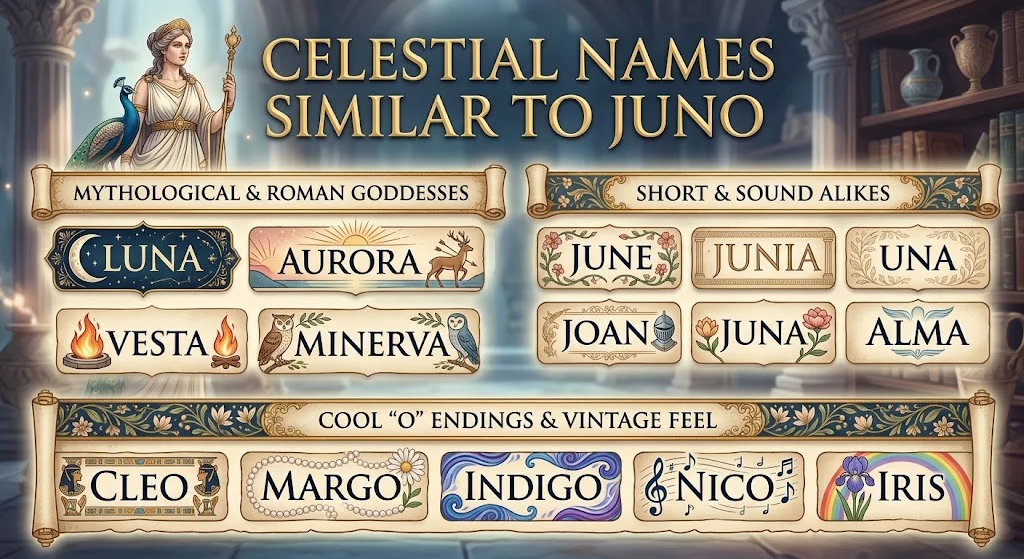
If you like Juno but want to explore other options, several names share its classical roots, concise sound, or feminine symbolism.
Athena
A Greek goddess associated with wisdom, strategic warfare, and skilled craftsmanship. Athena suits parents who appreciate powerful mythological names.
Diana
A Roman goddess associated with the hunt, the moon in later traditions, and the protection of women and childbirth. Diana has a familiar, elegant sound.

Hera
The Greek goddess most closely corresponding to Juno. Hera offers a short, strong name with direct connections to Greek mythology.
Selene

A Greek name associated with the moon and its personification in mythology. It has a lyrical quality that contrasts with Juno’s compact sound.

Minerva
The Roman goddess associated with wisdom, strategic warfare, and crafts. Minerva is a longer option with a similarly strong classical background.
Other possibilities include Cleo, Luna, Flora, Iris, Junia, and Julia. Cleo and Luna share a short, modern feel, while Junia and Julia offer connections to Latin naming traditions.
Although these names have stylistic or historical similarities, they do not all share the same etymology or meaning. Choose one based on the qualities and associations that matter most to your family.
Juno vs. Related Names and Terms
Several names and cultural references are connected to Juno, but their meanings and origins differ.
| Name or term | Meaning or association | Difference from Juno |
|---|---|---|
| Juno | Roman goddess associated with marriage, women, and protection | The main name discussed in this article |
| Hera | Greek goddess associated with marriage and queenly authority | Juno’s closest Greek counterpart |
| Jupiter | Principal Roman god associated with the sky and sovereignty | Juno’s husband and brother in Roman mythology |
| June | English name of a month derived from Latin Iunius | A month name, not another spelling of Juno |
| Junia | Feminine Latin name known from ancient Roman naming traditions | A distinct personal name with its own history |
| Julia | Feminine name derived from the Roman family name Julius | Shares a classical Latin background but has a different naming history |
| Diana | Roman goddess associated with the hunt and other aspects of nature and protection | A separate goddess with a different mythological identity |
The most important distinction is between Juno’s historical identity and the symbolic meanings modern families associate with the name. Its mythology is well documented, while claims about its exact literal meaning require greater caution.
Examples of the Name Juno in Everyday Life
Juno is versatile enough to work in family conversations, formal introductions, creative writing, and personal naming decisions.
Here are a few natural examples:
- Introducing a child: “Our daughter’s name is Juno, inspired by Roman mythology.”
- Explaining the meaning: “We chose Juno because we liked its connection to strength and protection.”
- Discussing its origin: “Juno is a Latin name associated with an important Roman goddess.”
- Writing a character: “Juno was a thoughtful, independent character with a deep interest in ancient history.”
- Choosing a middle name: “We considered Juno Rose because the two names sound balanced together.”
These examples illustrate how the name can be used. They do not suggest that every person named Juno has the characteristics described.
Is Juno Suitable for a Modern Baby?
Juno can be a good option for parents who want a name that combines classical heritage with a short, contemporary sound.
Before making a final decision, consider:
- Whether you like its association with Roman mythology.
- Whether its pronunciation works naturally in your family’s language.
- Whether it sounds harmonious with your surname.
- Whether its historical and cultural associations feel appropriate to you.
- Whether you prefer a familiar name or one that may be less common in your community.
It is also worth considering how the name may be received in the country where the child will grow up. Naming preferences differ across cultures, and a name that feels distinctive in one place may be more familiar in another.
FAQs
What does the name Juno mean?
Juno is associated with the Roman goddess of marriage, women, childbirth, and protection. These traditional associations give the name symbolic meanings related to dignity, strength, family, and femininity. Its exact linguistic etymology remains uncertain.
What is the origin of the name Juno?
Juno comes from ancient Roman tradition and the Latin name of a major Roman goddess. The name has been preserved through Roman religion, classical literature, art, and modern naming practices.
Is Juno a boy’s name or a girl’s name?
Juno is traditionally a girl’s name because it derives from the name of a Roman goddess. Although families may use names outside conventional gender associations, Juno is primarily recognized as feminine.
How do you pronounce Juno?
Juno is pronounced JOO-noh in standard English. It has two syllables, with the stress on the first syllable.
Is Juno a Greek or Roman name?
Juno is Roman. Her closest Greek counterpart is Hera, although the two goddesses belong to distinct religious and cultural traditions.
Does Juno mean queen?
Juno is traditionally regarded as a queen among the Roman gods, but “queen” is not an established, universally accepted literal translation of her name. The title describes her mythological position rather than a confirmed dictionary meaning.
Is Juno connected to the month of June?
Juno is traditionally associated with June, and the month name has historical connections to Latin Iunius. However, Juno and June are distinct names, and the relationship does not prove that Juno literally means “June.”
Is Juno a rare name?
Juno is a distinctive name, but its actual rarity depends on the country, region, and year. Official birth-name statistics are the best way to determine how frequently parents use it in a particular location.
What are good middle names for Juno?
Good options include Juno Grace, Juno Elizabeth, Juno Rose, Juno Claire, Juno Celeste, and Juno Amelia. The best combination depends on the surname, preferred style, and overall rhythm of the full name.
What names are similar to Juno?
Names with similar mythological or classical associations include Athena, Diana, Hera, Minerva, and Selene. For a shorter, contemporary style, Cleo, Luna, and Iris are also worth considering.
Conclusion
The Juno name meaning brings together ancient Roman mythology, feminine strength, and a distinctive modern sound. Its best-established associations are with marriage, women, childbirth, and protection through the goddess Juno. Although the name’s precise etymology remains debated, its historical identity is clear. For parents seeking a short, memorable name with classical depth, Juno offers an appealing balance of history, symbolism, and contemporary style.
