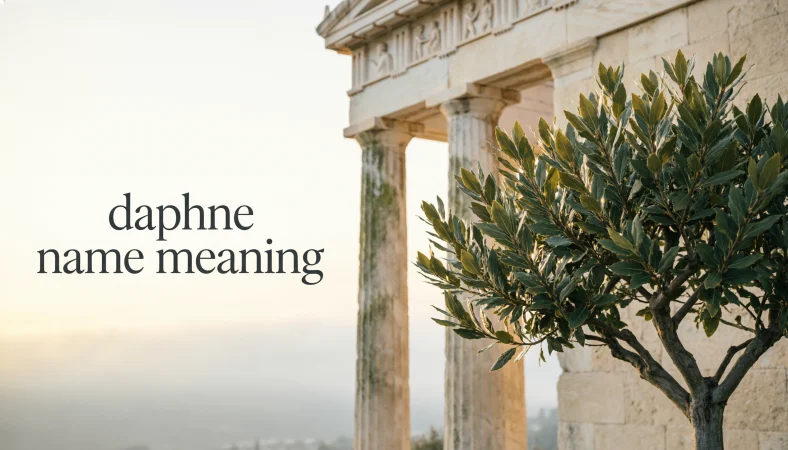
Daphne means “laurel” or “bay tree” and comes from the Greek word δάφνη (dáphnē).
The name is closely connected with Greek mythology, where Daphne becomes a laurel tree while escaping Apollo.
The daphne name meaning is rooted in the Ancient Greek word δάφνη, meaning “laurel” or “bay tree.” As a personal name, Daphne carries both a natural meaning and a strong mythological association through the famous Greek story of Daphne and Apollo. The name has remained recognizable through classical literature, later European naming traditions, and modern popular culture.
Daphne is feminine, distinctive, and closely tied to the imagery of the evergreen laurel. This article explains its linguistic origin, mythological background, pronunciation, variants, examples, and notable people who have carried the name.
Key Facts Box
| Fact | Details |
|---|---|
| Gender | Girl / Feminine |
| Meaning | Laurel; bay tree |
| Origin | Ancient Greek |
| Greek Form | Δάφνη (Dáphnē) |
| Pronunciation | DAF-nee |
| Name Type | Nature and mythological name |
| Main Association | Daphne, the nymph of Greek mythology |
What Is Daphne?
Daphne is a feminine given name of Ancient Greek origin. Its literal meaning is “laurel” or “bay tree,” referring to the evergreen plant traditionally associated with the Greek word δάφνη.
The name differs from many modern nature names because its history is not simply botanical. Daphne also belongs to Greek mythology, where the laurel becomes central to the story of Apollo.
In English, Daphne is generally pronounced DAF-nee. The classical Greek pronunciation was different from the modern English form, reflecting changes in pronunciation over many centuries.
The name entered English usage as a given name in the late 19th century and has also been used in Dutch and other European naming traditions.
Daphne Name Meaning
The central meaning of Daphne is “laurel” or “bay tree.” That literal meaning comes directly from the Greek noun δάφνη.
Laurel and Bay Tree
The laurel has a long history in Greek and Roman culture. Laurel branches became associated with honor, achievement, and Apollo, particularly through traditions surrounding poetry, music, and victory.
That symbolism gives Daphne a richer association than the simple botanical definition suggests. The name can evoke nature, honor, endurance, beauty, and classical tradition.
Mythological Meaning
Daphne’s myth adds another layer to the name. She appears as a nymph who is pursued by Apollo. In Ovid’s version of the story, Daphne asks for protection and is transformed into a laurel tree.
Apollo then adopts the laurel as a sacred symbol. This explains why the name Daphne is so strongly connected with both the tree and Apollo in classical literature.
Origin and Etymology
Daphne comes from Ancient Greek Δάφνη (Dáphnē). The Greek noun δάφνη refers to the laurel or bay tree.
The linguistic connection is unusually direct: the personal name and the botanical word share the same Greek form. There is no need to invent a separate hidden meaning behind the name.
Ancient Greek sources also preserve several traditions about the mythological Daphne. Different writers give her different family backgrounds, including connections with river gods such as Ladon or Peneus. These variations show that Greek mythology often preserved multiple versions of the same character.
The English form Daphne ultimately reflects the Latin and European transmission of the Greek name.
History and Cultural Context
Daphne’s strongest historical association comes from Greek mythology and classical literature. The myth became particularly influential through Ovid’s Metamorphoses, where Daphne transforms into a laurel tree while fleeing Apollo.
The story helped connect the name with the laurel’s symbolism. Apollo’s association with the laurel later became an important feature of classical artistic and literary tradition.
The name also appears in ancient Greek traditions that differ from Ovid’s account. Pausanias, for example, records a version connected with the river Ladon and describes a different sequence of events involving Daphne and Leucippus.
This variety matters because there is no single universally consistent ancient biography of Daphne. The name belongs to a wider body of mythology that changed across regions, poets, and periods.
As a personal name, Daphne became established in English-speaking usage during the late 19th century. It later appeared across European languages in forms such as French Daphné, Greek Dafni, Italian Dafne, and Turkish Defne.
Examples
Daphne works naturally as a first name and pairs easily with both traditional and modern middle names.
Traditional combinations:
- Daphne Elizabeth
- Daphne Rose
- Daphne Louise
- Daphne Claire
Modern combinations:
- Daphne Grace
- Daphne Mae
- Daphne Elise
- Daphne Olivia
The name also appears in ordinary sentences:
- “Daphne is starting school this autumn.”
- “Daphne chose a botanical theme for her garden.”
- “The story of Daphne and Apollo comes from Greek mythology.”
For parents choosing the name, its botanical meaning gives it a connection with nature, while its classical background adds historical depth.
Variants and Spellings
Daphne has several genuine forms across languages and naming traditions.
| Form | Language or Region | Notes |
|---|---|---|
| Daphne | English, Dutch | Standard English form |
| Daphné | French | French form |
| Daphnée | French, especially Quebec | Variant French form |
| Dafni | Greek | Modern Greek form |
| Dafne | Italian, Spanish, Portuguese | European form |
| Defne | Turkish | Turkish form |
| Dafna | Hebrew | Related modern form |
These forms do not all have identical pronunciation. Their spelling reflects the way different languages adapt the original Greek name to their own writing and sound systems.
A particularly notable modern form is Defne, which is used in Turkish. Although the spelling differs from Daphne, it retains the same underlying connection with the laurel.
Famous People Named Daphne
Several notable women named Daphne have worked in literature, science, journalism, and other fields.
- Daphne du Maurier — British author best known for novels including Rebecca and Jamaica Inn. Her writing helped make the name familiar to generations of English-speaking readers.
- Daphne Koller — computer scientist and entrepreneur associated with Stanford University. She co-founded Coursera and later founded the biotechnology company insitro.
- Daphne Caruana Galizia — Maltese investigative journalist known internationally for her reporting on corruption and political affairs. She was assassinated in 2017.
These examples show that Daphne has appeared across very different professional and cultural settings rather than belonging to a single historical era or social group.
Daphne vs. Related Terms
| Term | Meaning | How It Differs |
|---|---|---|
| Daphne | Laurel; bay tree | A feminine given name with Greek mythological roots |
| Laurel | Laurel or bay tree | An English botanical name also used as a given name |
| Dafni | Greek form of Daphne | Modern Greek form of the same name |
| Daphné | French form of Daphne | French spelling and pronunciation |
| Defne | Laurel; related name form | Turkish form connected with the same Greek botanical root |
| Apollo | Greek god associated with music, prophecy, and more | A male mythological name linked to Daphne’s story |
Daphne and Laurel are especially close in meaning. Both refer to the same type of evergreen plant, but Daphne carries a much stronger direct connection to Greek mythology.
Frequently Asked Questions
Is Daphne a Greek name?
Yes. Daphne comes from Ancient Greek Δάφνη (Dáphnē), meaning “laurel” or “bay tree.”
What does Daphne mean in Greek?
In Greek, δάφνη means laurel or bay tree. The same word became the personal name Daphne.
Is Daphne a girl name?
Yes. Daphne is traditionally a feminine given name and is widely recognized as a girl’s name.
How do you pronounce Daphne?
In English, Daphne is usually pronounced DAF-nee, with two syllables.
What is the biblical meaning of Daphne?
Daphne does not originate as a biblical name. Its roots are Greek, and its primary historical association comes from Greek language and mythology.
Who was Daphne in Greek mythology?
Daphne was a mythological figure associated with a story involving Apollo. In the best-known version, she escapes Apollo by being transformed into a laurel tree.
What names are similar to Daphne?
Names with related classical or botanical qualities include Dafni, Daphné, Dafne, Defne, Laurel, Flora, Phoebe, and Delia. Their meanings and origins are not identical.
Is Daphne a rare name?
Its level of popularity depends on the country and period. It has never been limited to one region, and its use can be traced across English-speaking and European naming traditions.
Conclusion
Daphne is a feminine Greek name meaning “laurel” or “bay tree,” with a deep connection to classical mythology. Its botanical meaning, association with Apollo, and long literary history give it a distinctive character that remains recognizable across languages and generations.

4 thoughts on “Daphne Name Meaning and History: From Greek Mythology to Today For 2026”