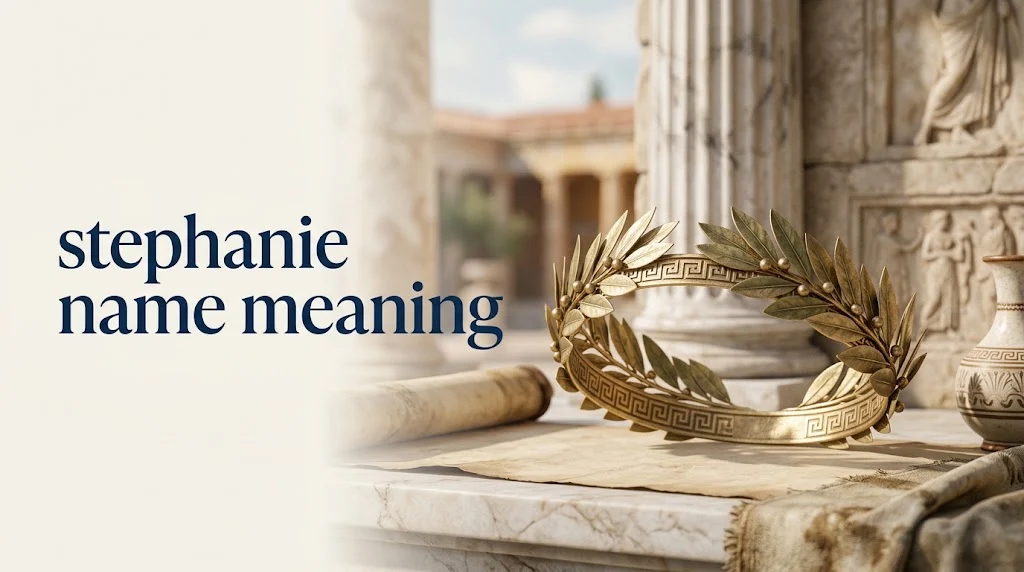
Stephanie means “crown,” “wreath,” or “crown of victory.” It is the feminine form of Stephen, ultimately derived from the Greek name Stephanos, associated with honor, victory, and a ceremonial crown.
The stephanie name meaning comes from the Greek Stephanos, a name associated with a crown, wreath, victory, and honor. Stephanie developed as the feminine form of Stephen and became established in several European languages, particularly English, French, and German.
The name combines an ancient Greek root with a long Christian naming tradition. Its history connects language, religion, and European naming customs, while its modern forms give parents several spelling and pronunciation options.
Key Facts
| Detail | Information |
|---|---|
| Gender | Girl / Feminine |
| Meaning | Crown, wreath, crown of victory |
| Origin | Greek, through Stephen |
| Pronunciation | STEF-uh-nee |
| French Form | Stéphanie |
| German Variant | Stefanie |
| Short Forms | Steph, Stevie |
What Is Stephanie?
Stephanie is a feminine given name and the female counterpart of Stephen. Name references list Stephanie as an English and German feminine form of Stephen, while the French form is written Stéphanie.
The masculine name Stephen ultimately comes from the Greek Stephanos. The core idea behind that Greek word is a crown or wreath, especially one awarded as a mark of achievement or victory.
So, Stephanie is not simply a modern name with an invented symbolic meaning. Its traditional meaning has a clear linguistic connection to an ancient Greek word.
Stephanie Meaning
The central meaning of Stephanie is “crown” or “wreath.” The Greek stephanos could refer to a crown, garland, chaplet, or wreath and could carry the extended sense of victory, honor, or glory.
Crown and Honor
A crown naturally suggests distinction and honor. In the ancient Greek context, a wreath could serve as a prize given to a victorious competitor.
Because of this history, Stephanie is often understood symbolically through ideas such as achievement, recognition, victory, and honor. These are associated meanings rather than separate dictionary definitions of the modern name.
Modern Interpretation
Today, parents generally choose Stephanie because of its established sound, history, and familiar international use rather than because they expect the literal meaning to describe a child’s personality.
Still, the traditional image of a crown gives the name a strong and dignified association.
Origin and Etymology
Stephanie traces back to Stephen, which comes through Latin Stephanus from Greek Stephanos. The Greek noun referred to a crown, wreath, garland, or victory crown.
The Greek verb stephein carried the sense of encircling, crowning, or wreathing. Etymological sources therefore connect the name with the physical act of placing a wreath or crown around something.
One useful distinction matters here: Greek stephanē could mean the brim of a helmet, but that word is not the immediate source of the modern name Stephanie. The direct naming line runs through Stephanos and Stephen.
History and Cultural Context
The name’s history is closely connected with Saint Stephen, a figure in the New Testament. Stephen is traditionally regarded in Christianity as the first Christian martyr. His importance helped the masculine name become established across Christian communities.
From Stephen came feminine forms such as Stephanie and Stéphanie. Over time, the name developed different spellings and pronunciations across Europe.
French uses Stéphanie, while German uses Stefanie as a variant. Italian, Polish, and Greek use Stefania, and Spanish has Estefanía.
This broad family of forms shows how the same ancient name adapted to different writing systems and pronunciation patterns.
Examples
Stephanie works naturally as a traditional first name, a professional name, or a shortened form such as Steph.
- Stephanie Marie — a traditional two-part given name.
- Stephanie Rose — a modern first-and-middle-name combination.
- Steph — a familiar English short form.
- Stéphanie — the French spelling.
- Stefanie — a German, Dutch, or Danish form.
- Stefania — used in Italian, Polish, and Greek contexts.
In a sentence: “Stephanie introduced herself before the ceremony began.”
The name also suits both formal and casual settings because Stephanie can stand on its own while Steph provides an easy informal alternative.
Variants and Spellings
Stephanie belongs to a large international family of related names.
| Form | Language or Usage | Relationship |
|---|---|---|
| Stephanie | English, German | Feminine form of Stephen |
| Stéphanie | French | French feminine form |
| Stefanie | German, Dutch, Danish | Variant |
| Stefania | Italian, Polish, Greek | Feminine form of Stephen |
| Stephania | English | Latinate feminine form |
| Stephany | English | Variant spelling |
| Stefani | English, Bulgarian | Variant / related form |
| Estefanía | Spanish | Spanish form |
| Stefánia | Hungarian | Related national form |
Short forms include Steph and Stevie in English, while German has Steffi and Steffie.
The French Stéphanie is especially close to the English spelling. The accent changes the written form and accompanies a different French pronunciation.
Famous People Named Stephanie
Several notable women have carried the name Stephanie.
- Stephanie McMahon — an American business executive and former professional wrestler associated with WWE. WWE lists her among its Hall of Fame Class of 2026.
- Stephanie Rice — an Australian former competitive swimmer who won three gold medals at the 2008 Beijing Olympics. She later entered the Sport Australia Hall of Fame.
- Stephanie Hsu — an American actress and singer known for her work in film and Broadway, including Everything Everywhere All at Once.
These examples show how the name appears across business, sport, film, and entertainment rather than belonging to one particular profession or culture.
Stephanie vs. Related Terms
| Term | Meaning | How It Differs |
|---|---|---|
| Stephanie | Crown, wreath | Feminine form of Stephen |
| Stephen | Crown, wreath, victory crown | Masculine form from Greek Stephanos |
| Stéphanie | Crown, wreath | French feminine form of Stephen |
| Stefanie | Crown, wreath | Variant used especially in German, Dutch, and Danish |
| Stefania | Crown, wreath | Italian, Polish, and Greek feminine form |
Frequently Asked Questions
What does the name Stephanie mean?
Stephanie traditionally means “crown,” “wreath,” or “crown of victory.” The meaning comes from the Greek Stephanos through the name Stephen.
Is Stephanie a girl’s name?
Yes. Stephanie is a feminine given name and the feminine form of Stephen.
What is the origin of Stephanie?
Stephanie ultimately has Greek origin, developing through the Greek Stephanos and the Latin form Stephanus before becoming associated with Stephen and its feminine forms.
How do you pronounce Stephanie?
In common English pronunciation, Stephanie is pronounced approximately STEF-uh-nee, represented as /ˈstɛf.ə.ni/.
Is Stéphanie the same name as Stephanie?
Yes. Stéphanie is the French feminine form of Stephen and is closely related to the English Stephanie.
What are common nicknames for Stephanie?
Common English short forms include Steph and Stevie. German forms include Steffi and Steffie.
Is Stephanie a biblical name?
Stephanie itself is a feminine form that developed from Stephen. The biblical connection comes through Stephen, who appears in the New Testament and is traditionally regarded as the first Christian martyr.
Conclusion
Stephanie carries the enduring meaning “crown” or “wreath,” with deeper associations of victory and honor from its Greek root Stephanos. As the feminine form of Stephen, it connects ancient Greek language, Christian history, and European naming traditions while remaining familiar in several modern languages.
