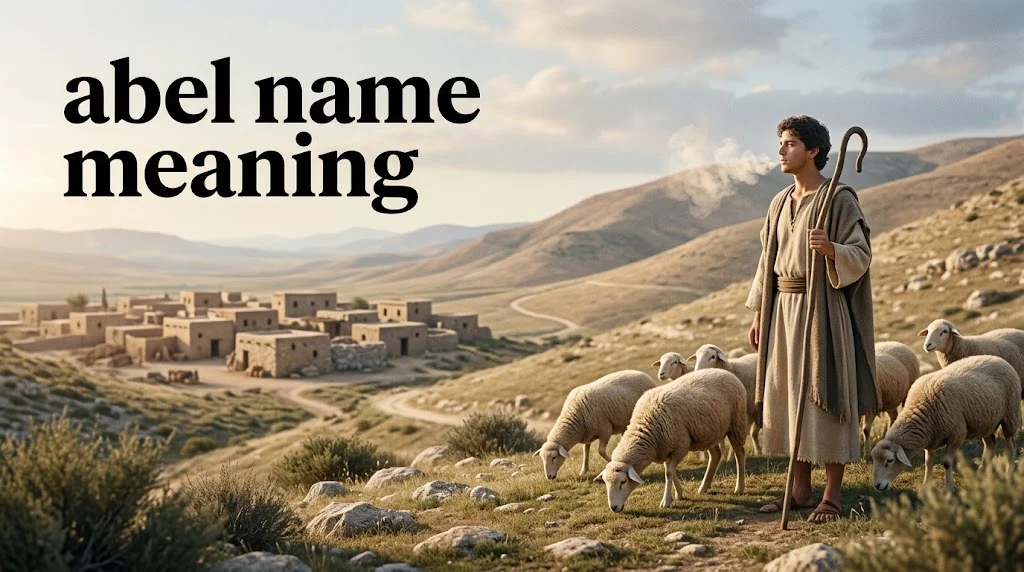
The abel name meaning is traditionally connected to the Hebrew Hevel, meaning “breath,” “vapor,” or “something fleeting.” Abel is a biblical boy’s name best known as the second son of Adam and Eve in Genesis.
A name can carry centuries of history in just four letters, and Abel is a strong example. Known primarily from the biblical story of Cain and Abel, the name has deep religious and historical roots and has remained recognizable across generations.
Abel name meaning is commonly connected with the Hebrew name Hevel (הֶבֶל), often interpreted as “breath,” “vapor,” or “transitory”. Its meaning has been discussed by biblical scholars and language experts in connection with the brief and fragile nature of human life. Beyond its literal interpretation, Abel has developed strong cultural significance through its appearance in the Book of Genesis.
This guide explores the Abel name meaning, origin, biblical history, pronunciation, symbolism, and modern usage. Drawing on established linguistic and biblical traditions, it provides a clear look at where the name comes from and why it continues to attract parents looking for a short name with historical depth.
Key Facts
| Fact | Details |
|---|---|
| Gender | Boy |
| Meaning | Breath, vapor, fleeting |
| Origin | Hebrew |
| Hebrew Form | Hevel (הֶבֶל) |
| Pronunciation | AY-bəl |
| Biblical Connection | Abel, son of Adam and Eve |
| Arabic Form | Hābīl (هابيل) |
What Is Abel?
Abel is a traditional masculine given name with roots in the Hebrew Bible. In Genesis, Abel appears as a shepherd and the younger son of Adam and Eve.
The name comes from the Hebrew Hevel, written הֶבֶל. The word can refer to breath, vapor, mist, or something temporary. Because of this range, scholars often connect the name with the idea of transience or fleeting existence.
Abel differs from many modern names because its significance comes strongly from a specific biblical person as well as from its underlying Hebrew word.
The name later entered Greek and Latin biblical traditions as Abel and spread into many European languages. It remains recognizable across religious, linguistic, and cultural settings.
Abel Meaning
Traditional Meaning
The most widely cited meaning of Abel is “breath” or “vapor.” The Hebrew hevel describes something insubstantial or temporary, such as breath or vapor that quickly disappears.
Some explanations render the meaning as “vanity” or “futility,” especially because hevel carries this sense in other biblical passages. That translation reflects the broader Hebrew word rather than a separate personal-name tradition.
Biblical Meaning
Abel’s biblical identity gives the name another layer of meaning. Genesis presents him as a shepherd who offers an acceptable sacrifice to God.
His story contrasts with that of his older brother Cain. Cain becomes jealous of Abel and kills him, making Abel the first person described as dying through another person’s violence in the biblical narrative.
Because of this story, Abel has become associated in later religious interpretation with innocence, faithfulness, sacrifice, and an unjustly shortened life.
Modern Understanding
Today, parents choosing Abel may focus less on the darker elements of Genesis and more on its short, traditional sound and biblical heritage.
The name has a gentle pronunciation, simple spelling, and long historical record. Those qualities allow Abel to work comfortably in both religious and secular naming contexts.
Origin and Etymology
Abel originates from the Hebrew Bible and derives from the Hebrew word hevel. The Hebrew form appears as הֶבֶל and is commonly transliterated as Hevel or Hebel.
The basic lexical meanings include breath, vapor, mist, and something fleeting. Context determines which English rendering fits best.
The Greek Septuagint uses Abel, and the Latin Vulgate likewise uses Abel. These forms helped establish the spelling that became familiar in European Christian traditions.
Abel’s etymology is therefore relatively clear at the linguistic level. The more interpretive question concerns how much of the Hebrew word’s wider meaning should be applied directly to the personal name. “Breath” and “vapor” are the safest concise explanations, while “vanity” and “futility” reflect broader uses of the Hebrew term.
History and Cultural Context
Abel’s history begins with Genesis, one of the foundational books of the Hebrew Bible and Christian Old Testament. The narrative identifies him as a shepherd, while Cain works the ground.
The brothers bring offerings to God. Genesis describes Abel’s offering as accepted, which contributes to Cain’s anger and eventually leads to Abel’s death.
The story became important in Jewish and Christian traditions, while Islam also preserves Abel under the name Hābīl. The Qur’an recounts the story of Adam’s two sons, although it does not name them directly in the passage; Islamic tradition commonly identifies them as Hābīl and Qābīl.
Christian writings later refer to Abel as an example of righteous faith. Hebrews 11:4, for instance, discusses Abel’s offering and faith. The name consequently gained a strong religious association beyond its original Hebrew vocabulary.
Over time, Abel moved from a biblical name into wider European naming traditions. Its short form and recognizable biblical history helped it remain familiar across different languages.
Examples
Abel works naturally as a first name in both traditional and contemporary settings.
- Abel Johnson — a fictional example of a full personal name.
- Abel is a shepherd — a simple sentence reflecting Abel’s biblical occupation.
- The name Abel appears in Genesis — a factual reference to its biblical setting.
- Abel was chosen for its biblical heritage — a realistic naming explanation.
- Abel and Cain — the best-known pairing associated with the name.
As a naming choice, Abel suits families looking for a short masculine name with ancient Hebrew roots and a well-established religious history.
Variants and Spellings
Abel has remained remarkably stable across several European languages, although other linguistic traditions use different forms.
| Language or Tradition | Form |
|---|---|
| Hebrew | Hevel / Hebel |
| English | Abel |
| French | Abel |
| Spanish | Abel |
| Portuguese | Abel |
| German | Abel |
| Dutch | Abel |
| Arabic tradition | Hābīl |
| Greek biblical tradition | Abel |
| Latin biblical tradition | Abel |
Hevel represents the Hebrew form behind the familiar name. Hābīl represents the Arabic form traditionally used for Abel in Islamic literature.
These should not all be treated as simple spelling variations. Some are language-specific forms shaped by different religious and linguistic traditions.
Famous People Named Abel
Abel Tasman
Abel Tasman was a Dutch seafarer and explorer of the 17th century. Tasmania and the Tasman Sea bear names connected with his historical expeditions.
Abel Ferrara
Abel Ferrara is an American filmmaker known for directing films such as Bad Lieutenant and King of New York. He has worked extensively in independent and crime-focused cinema.
Abel Makkonen Tesfaye
Abel Makkonen Tesfaye, professionally known as The Weeknd, is a Canadian singer, songwriter, and producer. Abel is his given name.
Abel Xavier
Abel Xavier is a former Portuguese professional footballer who played as a defender and represented Portugal internationally.
Related Terms VS Abel
| Term | Meaning | How It Differs |
|---|---|---|
| Abel | Breath, vapor, fleeting | English and European form of the biblical name |
| Hevel | Breath, vapor, fleeting | Hebrew word and underlying biblical form |
| Hābīl | Traditional Arabic form of Abel | Used in Islamic naming and tradition |
| Cain | Biblical personal name | Abel’s older brother in Genesis |
| Seth | Appointed/placed | Another son of Adam and Eve mentioned in Genesis |
Cain is the closest related name in the biblical story because he and Abel are brothers. Seth belongs to the same immediate family narrative but carries a different linguistic meaning and role.
Hevel deserves special attention because it represents the Hebrew word behind the name Abel. Hābīl, meanwhile, belongs to the Arabic-Islamic tradition surrounding the same biblical figure.
Frequently Asked Questions
What does the name Abel mean?
Abel traditionally means “breath,” “vapor,” or “fleeting.” The name comes from the Hebrew Hevel, which has these related meanings.
Is Abel a biblical name?
Yes. Abel is a biblical name found in Genesis. He is the second son of Adam and Eve and the younger brother of Cain.
What is the Hebrew name for Abel?
The Hebrew form is Hevel, written הֶבֶל. English Bibles commonly represent the name as Abel.
Is Abel a boy’s or girl’s name?
Abel is traditionally a boy’s name. Its historical use as a masculine biblical name is well established.
How do you pronounce Abel?
In English, Abel is commonly pronounced AY-bəl, with the first syllable sounding like “able.”
Is Abel an Arabic name?
Abel itself comes from Hebrew, but Hābīl (هابيل) is the traditional Arabic form associated with Abel in Islamic tradition.
What is the biblical story of Abel?
Genesis describes Abel as a shepherd whose offering to God was accepted. His brother Cain became jealous and killed him, making Abel a central figure in the biblical story of Cain and Abel.
Is Abel a good name for a baby boy?
Abel can suit parents who want a short, established masculine name with Hebrew roots and a strong biblical connection. Its meaning, history, and pronunciation are all well documented.
Conclusion
Abel is a timeless name with Hebrew roots, strong biblical associations, and a meaning commonly linked to “breath” or “vapor.” Its short form, distinctive history, and religious significance have helped it remain recognizable across cultures and generations. For parents interested in a classic name with deep historical and spiritual roots, Abel offers a meaningful choice.
