Quick Answer:
The name Sage means “wise person” or “wise one” and also refers to the aromatic herb. It is a modern English unisex name with both wisdom and nature associations.
Some names feel meaningful before you even know their history. Sage is one of them a short, elegant name connected with both nature and wisdom. The word sage refers to an aromatic herb and can also describe a person regarded as wise or knowledgeable, giving the name more than one familiar association.
When researching the Sage name meaning, it helps to separate established word meanings from modern naming interpretations. Sage has been used as a given name in English-speaking communities and is now recognized as a nature-inspired name with a calm, thoughtful character. In this guide, we explore the Sage name meaning, origin, history, pronunciation, symbolism, usage, and related names, while distinguishing documented linguistic roots from later symbolic associations.
Key Facts
| Fact | Details |
|---|---|
| Gender | Unisex — used for both boys and girls |
| Meaning | Wise person, wise one; also the sage herb |
| Origin | English word name |
| Pronunciation | SAYJ |
| Name Style | Nature name and virtue-inspired word name |
| Common Variant | Saige |
What Is the Name Sage?
Sage is an English word name used as a modern given name for both males and females. In ordinary English, a sage can mean a wise person, particularly someone respected for judgment, knowledge, or experience.
The word also names Salvia, a group of aromatic plants commonly known as sage. Because of this double meaning, Sage belongs to two naming traditions at once: virtue-inspired names connected with desirable qualities and nature names drawn from plants.
Unlike names that come exclusively from an ancient personal name, Sage developed from an existing English vocabulary word. That gives it a distinctly contemporary character, even though the word itself has a much older history.
Sage Name Meaning
Wisdom and Good Judgment
The strongest personal meaning of Sage is “wise person” or “wise one.” A sage traditionally represents someone who possesses deep understanding and exercises good judgment.
That association makes Sage similar in spirit to virtue names such as Grace, Hope, or Faith, although its meaning focuses specifically on wisdom and discernment.
The name does not literally promise that someone bearing it will be wise. Instead, it expresses a quality parents may admire and hope to associate with their child.
The Sage Herb
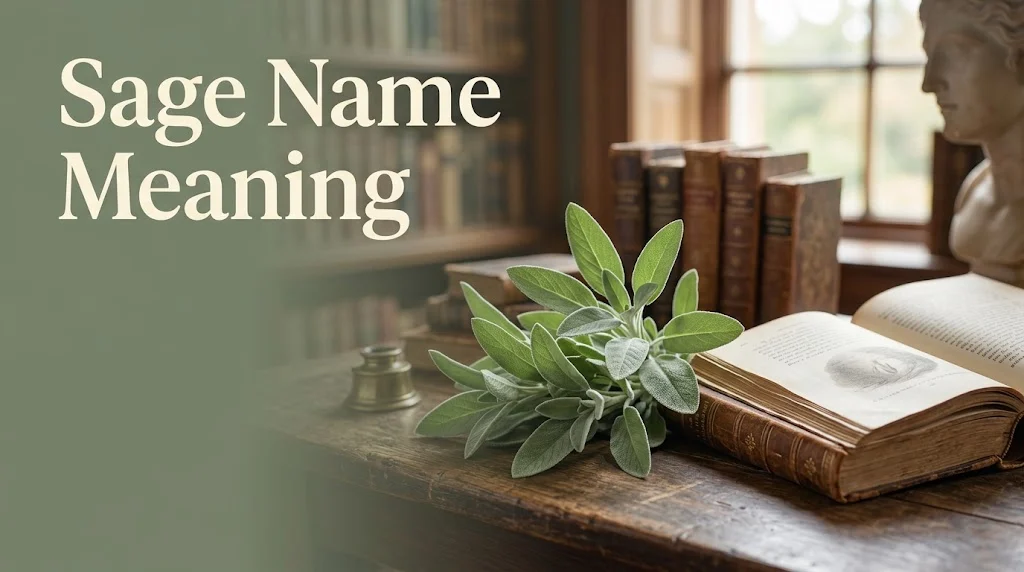
Sage also refers to an aromatic herb from the Salvia genus. This gives the name a clear botanical connection.
The plant has long been valued as a culinary herb and has also appeared in traditional herbal practices. The botanical meaning gives Sage an earthy, natural quality that distinguishes it from purely abstract virtue names.
A Modern Symbolic Meaning
In modern naming, Sage can suggest wisdom, calmness, nature, knowledge, and thoughtfulness. These are associations rather than literal dictionary definitions of a person’s character.
Its one-syllable form also gives the name a clean, contemporary sound.
Origin and Etymology
Sage has an English origin as a word name. The personal-name use comes from the English word sage, which has long referred to a wise or learned person as well as the herb.
The English word for a wise person entered through Old French sage. Historical linguistic sources connect that word with forms derived from Latin sapere, associated with tasting, discerning, and being wise. The semantic connection between discernment and wisdom developed over time.
The botanical sense has a different linguistic background. The herb belongs to the genus Salvia, whose name ultimately comes from Latin salvus, meaning “safe” or “healthy.” That botanical root should not be confused with the etymological history of sage meaning a wise person.
As a result, the modern given name Sage carries two distinct word histories that happen to meet in the same English spelling.
History and Cultural Context
The word sage has a long association with respected wisdom. In English usage, it could describe a person regarded for knowledge, judgment, or philosophical understanding.
The term also appears in discussions of the Seven Sages of Greece, a group of ancient Greek figures traditionally remembered for wisdom and practical sayings. The English word’s history as a noun for a wise person developed well after the ancient Greek period, but the broader cultural idea of the sage is much older.
The botanical side of the name adds another layer. Sage plants have a long history in European cooking and traditional herbal practice. Today, the plant association is especially strong in English-language nature naming.
As a first name, Sage belongs largely to the modern English naming tradition. It is not fundamentally a biblical name, nor does it depend on a particular saint or religious naming calendar.
Examples
Sage can work in several naming contexts:
- Sage William — combines the modern word name with a traditional given name.
- Sage Elizabeth — pairs the short nature name with a classic feminine name.
- Sage Alexander — creates a contemporary first-name and traditional middle-name combination.
- Sage Morgan — keeps the overall combination distinctly gender-neutral.
In a sentence, the name might appear naturally as: “Sage joined the class after lunch.”
The word itself can also appear in its ordinary sense: “The village respected him as a sage because of his knowledge and judgment.”
These uses show the difference between Sage as a personal name and sage as a common noun.
Variants and Spellings
The best-established modern spelling variant is Saige, which keeps the same basic pronunciation and meaning while giving the name a slightly different visual appearance.
| Form | Usage |
|---|---|
| Sage | Standard English spelling and original word form |
| Saige | Modern spelling variant |
| Sagey | Informal nickname-style form rather than a formal variant |
Sage itself is already short, so it generally does not require a traditional diminutive. Invented spellings should not automatically be treated as established linguistic variants.
Famous People Named Sage
Several notable people have used Sage as a given name.
- Sage Stallone (1976–2012) was an American actor and filmmaker. He appeared with his father, Sylvester Stallone, in Rocky V and later worked in independent film.
- Sage Steele is an American television sportscaster and former ESPN anchor known for her work on programs including SportsCenter.
- Sage Kotsenburg is an American snowboarder who won Olympic gold in men’s slopestyle at the 2014 Winter Olympics.
- Sage Northcutt is an American professional mixed martial artist who has competed in major international promotions.
- Sage Francis is an American rapper and spoken-word artist associated with independent hip-hop.
These examples also demonstrate the genuinely unisex use of Sage across different generations and professions.
Sage vs. Related Terms
| Term | Meaning | How It Differs |
|---|---|---|
| Sage | Wise person; sage herb | Combines wisdom and botanical associations |
| Wisdom | Deep understanding and good judgment | An abstract quality rather than normally a personal name |
| Wise | Showing good judgment or knowledge | An adjective, while Sage can function as a noun and given name |
| Salvia | Botanical genus containing sage plants | Scientific plant term with a separate Latin-derived history |
| Saige | Variant spelling of Sage | Same basic name and pronunciation, different spelling |
Frequently Asked Questions
Is Sage a boy or girl name?
Sage is a unisex name. It is used for both boys and girls and does not belong exclusively to either gender.
What does the name Sage mean?
Sage means “wise person” or “wise one.” It also refers to the sage herb, giving the name both a wisdom-related and nature-related meaning.
What is the origin of the name Sage?
Sage is an English word name. The English word has linguistic roots connected with Old French and Latin vocabulary associated with wisdom and discernment.
How do you pronounce Sage?
Sage is pronounced SAYJ, with one syllable. It rhymes closely with words such as “page” and “age.”
Is Sage a nature name?
Yes. Sage qualifies as a nature name because it directly refers to the sage herb. At the same time, it functions as a virtue-inspired name because of its association with wisdom.
Is Sage a biblical name?
Sage is not traditionally a biblical given name. Its use as a first name comes from the English vocabulary word rather than from a biblical personal name.
What is a common spelling variant of Sage?
Saige is a recognized modern spelling variant. The pronunciation and basic meaning remain essentially the same.
Conclusion
The Sage name meaning brings together two familiar ideas: wisdom and nature. As a given name, Sage has a simple, modern appeal, while its connection to the sage herb adds a natural dimension. Its short spelling, distinctive sound, and thoughtful associations make Sage a memorable choice with both contemporary and timeless qualities.

5 thoughts on “Sage Name Meaning: Meaning, Roots, History & Symbolism For 2026”