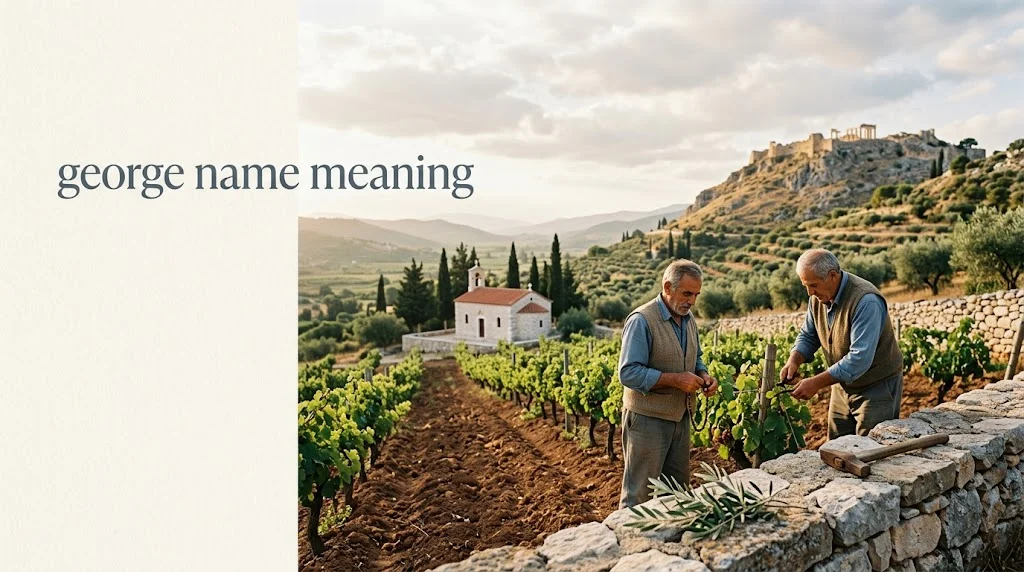
George is a masculine name of Greek origin meaning “farmer” or “earthworker.” It comes from the Greek name Geōrgios, derived from geōrgos, meaning a person who works or cultivates the land. The name has a long history of use across Europe and is associated with strength, tradition, and agricultural roots.
A name can carry centuries of history in just a few letters, and George is a strong example. Familiar across generations, the name has remained recognizable in many parts of the world while retaining its ancient meaning connected to the land and farming.
The George name meaning comes from the Greek geōrgos, referring to a farmer or earthworker. Its history reaches back to ancient Greece, while its later popularity was strongly influenced by Christian tradition and the widespread veneration of Saint George. Because of this long cultural history, George developed from an occupational name into one of the best-known traditional masculine names.
In this guide, we’ll explore the George name meaning, origin, pronunciation, history, symbolism, popularity, and related forms. Drawing on established linguistic and historical sources, this article provides a clear look at why George has remained a respected classic for centuries.
Key Facts
| Fact | Details |
|---|---|
| Gender | Boy / Masculine |
| Meaning | Farmer; earth-worker; cultivator of the land |
| Origin | Ancient Greek |
| Original Form | Geōrgios (Γεώργιος) |
| Pronunciation | JORJ |
| Related Forms | Georges, Giorgio, Jorge, Georgios |
| Cultural Association | Strongly associated with Saint George and Christian history |
What Is George?
George is a traditional masculine given name with ancient Greek roots. Its Greek form is Geōrgios, which developed from geōrgos, meaning a person who works the land.
The name therefore has a practical occupational meaning at its foundation. Rather than describing a personality trait such as strength or wisdom, it originally referred to agricultural work.
George became especially prominent in Europe through the veneration of Saint George, a Christian martyr traditionally associated with the Roman period. His popularity helped the name spread widely beyond its Greek origins.
Today, George is recognized as a classic English name, although it appears in many forms across different languages.
George Name Meaning
The traditional meaning of George is “farmer” or “earth-worker.” The literal idea is someone who cultivates or works the soil.
Literal Meaning
The Greek word geōrgos combines the concepts of earth and work. As a result, George carries an association with cultivation, agriculture, and productive work.
That original meaning remains the clearest explanation of the name. Later cultural associations added layers of symbolism, but they did not replace its Greek etymology.
Traditional Meaning
Historically, George became associated with rural life and agriculture because of its original linguistic sense. In later European culture, the name gained a much stronger connection with Saint George, whose story became influential in Christian communities.
The saint’s legendary association with defeating a dragon also gave George a cultural connection with courage and protection. Those qualities are traditional associations rather than the literal meaning of the name.
Modern Meaning
For modern parents, George often feels classic, dependable, and familiar. Its traditional meaning may be attractive to families interested in names connected with nature, land, work, or heritage.
The name can also carry a distinctly traditional character because generations of historical figures, monarchs, writers, artists, and public figures have used it.
Origin and Etymology
George ultimately comes from the ancient Greek Geōrgios (Γεώργιος). Its deeper root is the Greek noun geōrgos, meaning “farmer” or “one who works the land.”
The word combines gē, meaning “earth” or “land,” with ergon, meaning “work.” This makes the basic etymological idea quite direct: an earth-worker.
The Greek name Geōrgios gave rise to related forms in many languages. Latin used Georgius, which helped the name move through Christian Europe.
English eventually developed the form George. French uses Georges, Italian uses Giorgio, Spanish commonly uses Jorge, and Greek retains Georgios.
These forms differ in pronunciation and spelling, but they share the same historical root.
History and Cultural Context
George gained much of its international importance through Saint George, a Christian martyr traditionally dated to the early centuries of Christianity. His historical details remain uncertain, while later traditions surrounding him became highly influential.
Medieval devotion to Saint George helped spread the name throughout Europe. He became especially prominent in England, where he developed into the country’s patron saint and became strongly associated with English national identity.
The name also became common among European royalty. Several British kings were named George, including George I, George II, George III, George IV, George V, and George VI.
That royal history strengthened the name’s association with tradition and formal heritage.
George also became established outside royal and religious contexts. Writers such as George Orwell, musicians such as George Harrison, and political figures such as George Washington gave the name strong associations with literature, music, leadership, and public life.
Because of this long history, George can feel both ancient and familiar. Its Greek roots are more than two thousand years old, yet the name remains immediately recognizable in modern English.
Examples
George works naturally as both a formal first name and an everyday personal name.
Examples include:
- George Adams — a traditional first-name and surname combination.
- George Michael — a well-known musician’s name.
- George Harrison — a famous musician associated with The Beatles.
- George Orwell — the pen name of English writer Eric Arthur Blair.
- George Washington — the first president of the United States.
The name also appears in ordinary family naming traditions. A child named George may be named after a parent, grandparent, historical figure, or family member.
In a sentence, the name can appear simply: “George is starting school this autumn.”
Variants and Spellings
George has numerous established forms across European languages. They developed through different linguistic traditions while retaining the same Greek ancestry.
| Language | Form |
|---|---|
| English | George |
| Greek | Georgios |
| French | Georges |
| Italian | Giorgio |
| Spanish | Jorge |
| Portuguese | Jorge |
| German | Georg |
| Dutch | Joris / George |
| Romanian | Gheorghe |
| Russian | Georgy / Yegor |
Some forms have developed independently through historical pronunciation changes and local naming traditions. They should not be treated as mere spelling mistakes or informal versions of George.
The feminine forms Georgia and Georgina are also historically related to George. They share the same Greek root, although they function as distinct given names.
Famous People Named George
George has been used by many influential figures across politics, literature, music, science, and royalty.
- George Washington — American statesman and first president of the United States.
- George Orwell — English novelist and essayist best known for 1984 and Animal Farm.
- George Harrison — English musician and member of The Beatles.
- George Michael — English singer, songwriter, and record producer.
- George VI — King of the United Kingdom from 1936 until 1952.
- George Clooney — American actor, filmmaker, and producer.
- George R. R. Martin — American novelist and creator of A Song of Ice and Fire.
Their different careers show how widely the name has been used across cultures and generations.
George vs. Related Terms
| Term | Meaning | How It Differs |
|---|---|---|
| George | Farmer; earth-worker | Standard English form of the name |
| Georgios | Farmer; earth-worker | Original Greek form |
| Georges | Same Greek-derived name | French form |
| Giorgio | Same Greek-derived name | Italian form |
| Jorge | Same Greek-derived name | Spanish and Portuguese form |
| Georgia | Feminine form related to George | Usually used as a feminine given name |
Frequently Asked Questions
What does the name George mean?
George traditionally means “farmer” or “earth-worker.” It comes from the ancient Greek geōrgos, referring to someone who works or cultivates the land.
Is George a Greek name?
Yes. George ultimately comes from the ancient Greek name Geōrgios, which developed from the Greek word geōrgos. The English form George reached the language through later European and Latin forms.
Is George a biblical name?
George is not a biblical name in the sense of appearing as a character in the Bible. Its Christian importance comes largely from Saint George, who became an influential figure in Christian tradition after the biblical period.
What is the pronunciation of George?
George is commonly pronounced “JORJ.” The pronunciation is one syllable in standard English.
What are the different forms of George?
Established forms include Georgios in Greek, Georges in French, Giorgio in Italian, Jorge in Spanish and Portuguese, and Georg in German and several other languages.
Is George a boy’s name?
Yes. George is traditionally a masculine given name. Related feminine forms include Georgia and Georgina.
What does George mean spiritually?
The name itself means “farmer” or “earth-worker,” rather than a specific spiritual quality. Its Christian associations mainly come from Saint George, whose traditions connect the name with courage, faith, and protection.
Conclusion
George is an ancient Greek-derived name with a straightforward meaning: “farmer” or “earth-worker.” Its long history, connection with Saint George, royal use, and presence among famous writers, musicians, and leaders have given it lasting cultural weight. It remains a strong traditional choice with a simple and well-established origin.
