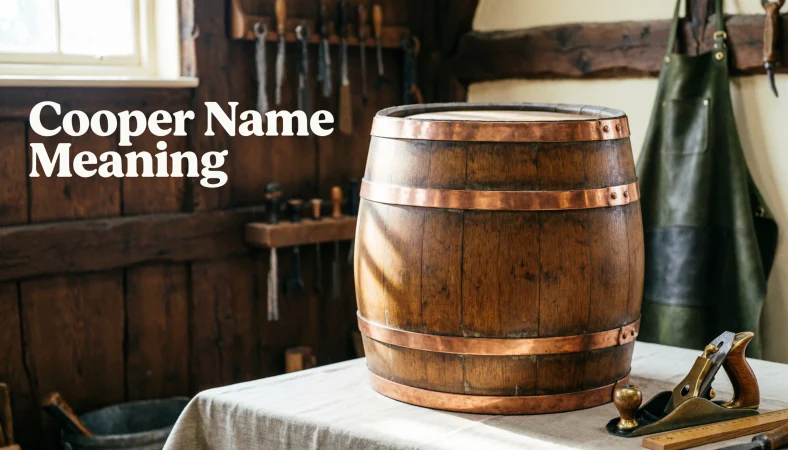
Cooper means “barrel maker” or “maker of wooden vessels.” It began as an English occupational surname and later became a popular masculine given name.
Some names simply sound strong, while others carry a piece of history with them. Cooper is one of those names. Once associated with a traditional occupation, it has grown into a familiar and stylish given name. But what does Cooper actually mean, where did it come from, and why has it remained appealing to modern parents?
Cooper is an English occupational surname that comes from the word cooper, traditionally referring to a person who made and repaired wooden barrels, casks, and other similar containers. The occupational term has deep roots in the history of skilled craftsmanship and trade. Over time, Cooper developed from a surname into a popular given name, particularly in English-speaking countries.
The Cooper name meaning is therefore closely connected to craftsmanship, skilled work, and the traditional barrel-making trade rather than a purely symbolic meaning. In this guide, we’ll explore Cooper’s meaning, etymology, English origin, historical background, pronunciation, variations, cultural associations, and modern use, while distinguishing established historical information from later interpretations.
Key Facts Box
| Fact | Details |
|---|---|
| Gender | Boy / Masculine |
| Meaning | Barrel maker; maker or repairer of wooden vessels |
| Origin | English |
| Historical Root | Middle English couper / cowper |
| Pronunciation | KOO-per |
| Name Type | Occupational surname used as a first name |
What Is Cooper?
Cooper is an English masculine given name derived from an occupational surname. Traditionally, a cooper was a skilled craftsperson who made wooden containers by fitting curved wooden staves together with hoops.
The occupation mattered greatly before modern industrial packaging. Barrels and casks helped people store and transport liquids, food, and other goods.
As a surname, Cooper identified someone whose family worked in this trade. Over time, like many occupational surnames, it crossed into first-name use.
Today, parents generally choose Cooper for its sound, history, and surname-style character rather than because they expect their child to become a barrel maker.
The name is pronounced KOO-per in ordinary English speech. American and British pronunciation differ slightly in vowel length, but the difference is small.
Cooper Name Meaning
The traditional Cooper meaning is “barrel maker.” More broadly, it refers to a person who makes or repairs wooden vessels such as barrels, tubs, vats, and casks.
Traditional Meaning
The literal occupational meaning gives Cooper a strong connection with craftsmanship and skilled work. A cooper had to shape wood carefully and construct containers that could hold liquids or dry goods.
So, while modern name interpretations sometimes attach qualities such as strength or practicality to Cooper, those are modern associations rather than literal translations.
Modern Meaning
As a first name, Cooper does not normally carry a separate modern dictionary meaning. Its established meaning remains connected to the old occupation.
Parents may still like it because it sounds friendly, sturdy, contemporary, and uncomplicated.
Origin and Etymology
Cooper has an English surname origin, with its history reaching back to Middle English couper and cowper. Major surname references connect those forms with Middle Dutch kūper, related to kūp, meaning a tub or container.
Merriam-Webster traces the English word cooper through Middle English couper and Middle Dutch or Middle Low German forms associated with a cask or tub. It records the noun in English from the 15th century, while surname evidence goes back earlier.
That history matters because Cooper is fundamentally an occupational name. It belongs to the same broad naming tradition as surnames that originally described someone’s job.
The spelling Cowper is particularly interesting. Although it looks different from Cooper, the surname has traditionally been pronounced like “Cooper” in English.
History and Cultural Context
The Cooper surname developed during a period when skilled trades often became family identifiers. A person who made barrels might become known as “the cooper,” and eventually that occupational label could become hereditary.
Barrel making was especially useful in societies that relied on wooden containers for storage and transport. Coopers produced casks, tubs, buckets, vats, and similar vessels. The trade therefore connected directly with commerce and household life.
The surname also developed related forms in other European languages. Dutch forms include Kuiper and related spellings, reflecting the widespread nature of the occupation.
Later, Cooper moved beyond surname use. Like names such as Carter, Parker, Hunter, and Mason, it became part of the broader group of occupational surnames used as first names.
In the United States, the name has become particularly familiar as a given name. U.S. Social Security Administration data places Cooper among the 100 most frequently given boys’ names for births from 2020 through 2025.
Examples
Cooper works naturally as both a first name and a surname.
As a first name:
- Cooper James
- Cooper Alexander
- Cooper William
- Cooper Thomas
- Cooper Daniel
In a sentence:
- “Cooper is starting school this fall.”
- “We chose Cooper because we wanted a classic surname-style name.”
- “Cooper has an English occupational origin.”
As a surname:
- James Cooper
- Sarah Cooper
- Daniel Cooper
The distinction is simple: Cooper as a first name refers to the given name, while Cooper as a surname reflects the older family-name tradition.
Variants and Spellings
Cooper has several historically related forms, although not all function as modern first-name alternatives.
| Form | Relationship |
|---|---|
| Cooper | Standard English form |
| Couper | Historical/Scottish variant of the surname |
| Cowper | Historical surname form, traditionally pronounced “Cooper” |
| Kuiper | Dutch occupational relative |
| Cuijper / Cuypers | Related Dutch surname forms |
These forms should not be treated as interchangeable first names. Cooper remains the established English given-name form.
A casual short form sometimes used for Cooper is Coop, especially in informal English-speaking settings.
Famous People Named Cooper
Several notable people use Cooper as their given name.
- Cooper Kupp — American football wide receiver who has played in the NFL and won Super Bowl LVI MVP with the Los Angeles Rams.
- Cooper Andrews — American actor known for roles in Shazam! and The Walking Dead.
- Cooper Cronk — Australian rugby league player and NRL Hall of Fame inductee who enjoyed a long career with Melbourne Storm and Sydney Roosters.
These examples show how Cooper now functions comfortably as a modern personal name rather than only as a family surname.
Cooper vs. Related Terms
| Term | Meaning | How It Differs |
|---|---|---|
| Cooper | Barrel maker | English occupational surname and given name |
| Coop | Short form of Cooper; also a word for an enclosure | Informal nickname when used for the name |
| Mason | Stoneworker or bricklayer | Another occupational surname used as a first name |
| Carter | Cart driver or transporter | Occupational surname with a different historical trade |
| Parker | Keeper of a park | Occupational surname referring to a different role |
The closest historical comparison is Mason, because both names moved from occupational surnames into modern given-name use.
Frequently Asked Questions
Is Cooper a boy’s name?
Yes. Cooper is traditionally used as a masculine given name. It originated as an English occupational surname and is now established as a boys’ first name.
What does the name Cooper mean?
Cooper means “barrel maker” or “maker and repairer of wooden vessels.” The meaning comes directly from the occupation behind the original surname.
What is the origin of the name Cooper?
Cooper has an English origin. Its surname history includes Middle English couper and cowper, with connections to Middle Dutch terminology for a cask or container.
How do you pronounce Cooper?
Cooper is pronounced KOO-per. In phonetic form, common English pronunciations are approximately /ˈkuːpər/ or /ˈkupər/.
Is Cooper a surname or a first name?
It is both. Cooper began primarily as an occupational surname, but it later became a well-established masculine first name.
Is Cooper a biblical name?
No. Cooper is not a biblical name. Its established origin comes from an English occupational surname rather than a biblical personal name.
Is Cooper a good name for a baby?
Cooper can be a strong choice for parents who like English surname names, occupational names, and simple two-syllable names. It also has a clear historical meaning without requiring a religious or mythological background.
What is the nickname for Cooper?
Coop is the most recognizable informal nickname for Cooper. Some families may simply use Cooper without shortening it.
Conclusion
Cooper is an English name with a practical occupational history: it originally referred to a maker and repairer of barrels and other wooden vessels. From medieval trade to modern first-name use, the name has retained that clear meaning while developing a friendly, contemporary sound.

7 thoughts on “Cooper Name Meaning| From Occupational Surname to First Name For 2026”