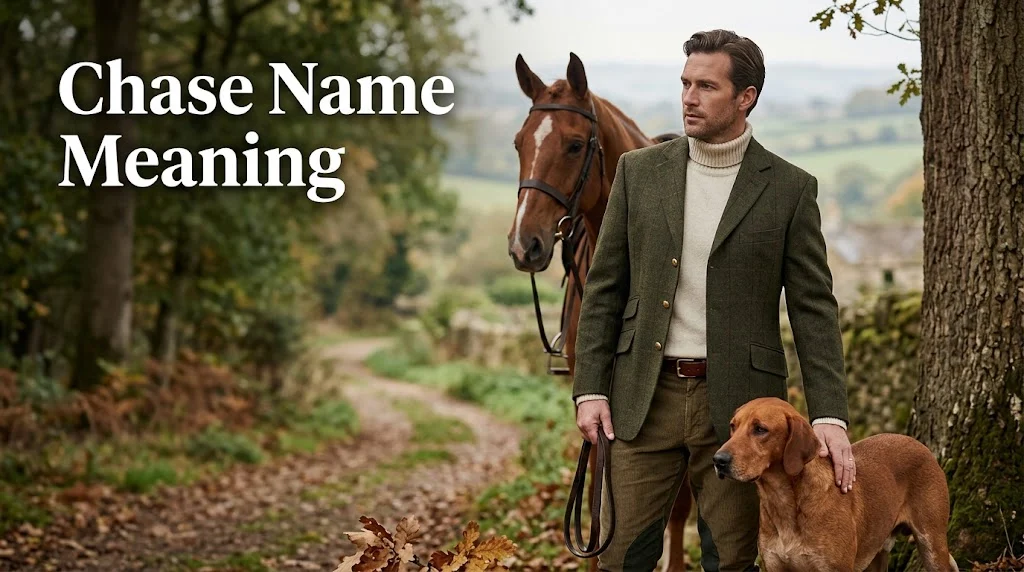
The name Chase means “hunter” or “one who pursues.” It comes from an English surname connected to the Middle English word chase, ultimately derived from Old French terms associated with hunting.
The chase name meaning centers on ideas of hunting, pursuit, and a person who follows or tracks something. Chase began as an English surname connected with hunting and later became an established first name, particularly in English-speaking communities. Its short spelling and energetic sound give it a direct, modern character while preserving a connection to medieval English naming traditions.
This article covers the meaning of Chase, its linguistic roots, surname history, cultural development, pronunciation, spelling variants, notable people, and related names.
Key Facts Box
| Fact | Details |
|---|---|
| Gender | Traditionally masculine; also used as a unisex given name |
| Meaning | Hunter, huntsman, or one who pursues |
| Origin | English, with Old French linguistic roots |
| Pronunciation | CHAYS |
| Name Type | Surname-turned-given-name |
| Variant | Chace |
What Is the Chase Name?
Chase is an English personal name that developed from a surname associated with hunting. The surname had an occupational connection with a huntsman or could describe someone known for skill in hunting.
As a first name, Chase no longer identifies a person’s occupation. Instead, it preserves the older word’s central idea of pursuit. That makes it a name with a literal historical meaning and a broader modern association with determination, movement, and purpose.
Chase also differs from names that began solely as given names. Its path into first-name use reflects the long English tradition of turning family names and occupational surnames into personal names.
Chase Name Meaning
The traditional meaning of Chase is “hunter” or “huntsman.” The meaning comes from the name’s connection with the vocabulary of hunting rather than from a religious or mythological naming tradition.
Literal Meaning
At its most direct level, Chase relates to the act of hunting or pursuing. A huntsman historically tracked or pursued game, so the occupational meaning became attached to people associated with that activity.
The modern English verb “chase” has a wider meaning: to pursue someone or something. That everyday meaning gives the name an additional modern association with movement and pursuit.
Modern Interpretation
Today, parents may appreciate Chase because it sounds active and straightforward. The name can suggest determination, energy, ambition, or persistence, although those qualities represent modern associations rather than the original literal definition.
The historical meaning remains the strongest linguistic foundation: hunter, huntsman, or one who pursues.
Origin and Etymology
Chase has an English naming history with an important Old French connection. Family-name references trace the surname to Middle English chase, meaning “hunt.” That term came from Old French chasse, related to chasser, “to hunt,” with an ultimate connection to Latin captare.
The development reflects the linguistic influence of French on English after the Norman Conquest. Over time, words associated with hunting entered English vocabulary, and chase became established in the language.
The surname developed from this vocabulary as an occupational name for a huntsman or as a nickname for someone particularly skilled at hunting. Later, Chase moved beyond surname use and became a given name.
This distinction matters. The given name Chase does not represent a separate ancient word with an unrelated meaning. Its modern first-name use grew from the same linguistic and surname tradition.
History and Cultural Context
Chase has a strong connection to medieval English naming practices. Occupational surnames became common because communities needed practical ways to distinguish people with the same personal names.
A person associated with hunting could acquire a descriptive surname based on that occupation. Over generations, such surnames became hereditary family names.
The Chase surname also became established in England and later in North America. Family-history sources document Chase families in England and the United States, among other places.
The first-name use represents a later stage in this history. English-speaking naming traditions increasingly adopted surnames as given names, especially in the United States. Chase fits naturally into that pattern because it already sounded like a familiar English word while carrying a strong traditional meaning.
The name therefore connects two naming traditions: an old occupational surname and a modern personal name.
Chase Name Pronunciation
Chase is pronounced CHAYS, rhyming with words such as “face” and “place.”
Its pronunciation remains simple across English-speaking settings, which contributes to its straightforward character. The spelling closely matches the pronunciation, so most English speakers can recognize how to say it immediately.
Examples of Chase in Use
Chase works naturally as a first name:
- Chase Morgan — a conventional first-and-last-name combination.
- Chase William Carter — Chase can work well as a first name with a traditional middle name.
- Chase Daniel — a short, balanced combination.
- Chase and Ethan — the name also fits naturally beside other contemporary English names.
It can also appear in descriptive historical contexts. A medieval record referring to someone as a huntsman could eventually contribute to the development of the surname Chase.
In modern use, though, someone named Chase does not necessarily have any connection with hunting. The historical meaning belongs to the name’s etymology, not to the person’s occupation or personality.
Variants and Spellings
The most clearly related spelling is Chace, which appears as a variant form of Chase.
| Form | Type | Notes |
|---|---|---|
| Chase | Standard form | The most familiar modern spelling |
| Chace | Variant | A genuine alternative spelling associated with the same name tradition |
| Chaser | Informal form | An English word and occasional nickname, but not a standard historical variant |
| Chasey | Nickname | Informal affectionate form rather than a separate traditional name |
Chase remains the clearest and most established spelling for the given name. Chace is recognizable, but it appears less commonly in ordinary English usage.
Famous People Named Chase
Several notable people have carried Chase as a given name.
- Chase Elliott — American professional stock-car racing driver and 2020 NASCAR Cup Series champion. NASCAR identifies him as the driver of the No. 9 Chevrolet for Hendrick Motorsports.
- Chase Rice — American country singer and songwriter known for his recording career and songwriting work. He also gained early public attention through Survivor: Nicaragua.
- Chase Utley — American former professional baseball player who spent much of his Major League Baseball career with the Philadelphia Phillies.
These examples show how Chase functions comfortably as a modern personal name across different professional fields.
Chase vs. Related Terms
| Term | Meaning | How It Differs |
|---|---|---|
| Chase | Hunter; one who pursues | Modern given name derived from an English surname |
| Chace | Variant of Chase | Alternative spelling with the same naming connection |
| Hunter | One who hunts | A separate English occupational name used directly as a given name |
| Huntsman | A person who hunts | Traditional occupational term rather than the usual modern first-name form |
| Pursuit | The act of following or seeking | Related concept, but not a traditional personal name equivalent |
Chase and Hunter share a particularly close semantic relationship. Both connect a personal name with hunting, but their historical naming routes differ.
Frequently Asked Questions
Is Chase a boy’s or girl’s name?
Chase has traditionally been used more often for boys, but it can also function as a unisex given name. Its surname origin allows it to cross conventional gender boundaries.
What does the name Chase mean?
Chase means “hunter,” “huntsman,” or “one who pursues.” The meaning comes from the name’s English surname history and its connection with Middle English vocabulary for hunting.
What is the origin of the name Chase?
Chase has an English origin as a surname, with linguistic roots in Old French. The Middle English word chase meant “hunt” and connects to Old French chasse and chasser.
How do you pronounce Chase?
Chase is pronounced CHAYS. It has one syllable and rhymes with “face.”
Is Chase a biblical name?
No. Chase does not have a biblical origin. Its documented history comes from English surname usage and French-influenced English vocabulary connected with hunting.
Is Chace a different name from Chase?
Chace is generally treated as a spelling variant of Chase rather than a completely unrelated name. The two forms share the same basic naming tradition.
What names have a similar meaning to Chase?
Names with related meanings include Hunter, which directly refers to someone who hunts, and names associated with pursuit or tracking. Hunter is the closest common English given name in meaning.
Conclusion
Chase carries a clear historical meaning rooted in hunting and pursuit. Its path from an English occupational surname to a modern given name gives it both traditional depth and a concise contemporary sound, making Chase a distinctive name with a straightforward etymological story.
