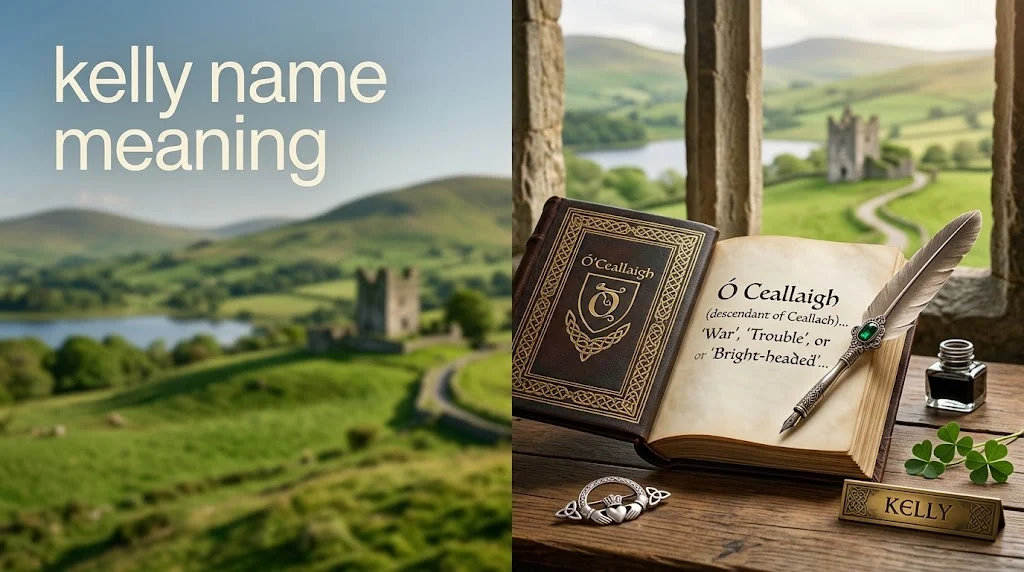
Kelly is an Irish and English given name derived from the Irish Ceallach or the surname Ó Ceallaigh. Its traditional meaning is associated with Ceallach, whose exact original meaning is uncertain, though “bright-headed” is a traditional interpretation.
The kelly name meaning comes from an old Irish naming tradition and has an unusual history because Kelly developed both from the Irish given name Ceallach and from the surname Ó Ceallaigh. Today, English speakers use Kelly as a given name for both boys and girls. Its story connects Irish language, family names, and modern naming customs.
The name is especially interesting because its original root does not have one completely settled translation. Some sources traditionally interpret Ceallach as “bright-headed,” while other explanations connect the Old Irish forms with words associated with war, strife, or church. That uncertainty is part of the name’s genuine linguistic history rather than a gap that needs a made-up answer.
Key Facts
| Feature | Details |
|---|---|
| Gender | Unisex |
| Meaning | Traditionally associated with Ceallach; often interpreted as “bright-headed” |
| Origin | Irish, with English usage |
| Pronunciation | KEL-ee |
| Irish form | Ceallach / Ó Ceallaigh |
| Common variants | Kelley, Kelli, Kellie, Kelleigh |
What Is the Name Kelly?
Kelly is a unisex given name of Irish origin that later became established in English-speaking naming traditions. It can represent an anglicized form of the Irish personal name Ceallach or a given-name use derived from the Irish surname Ó Ceallaigh.
That distinction matters. Kelly is not simply an English word with a fixed dictionary definition. It belongs to a family of names shaped by Irish personal names and hereditary surnames.
As a given name, Kelly is pronounced KEL-ee in ordinary English usage. The same spelling can therefore function as either a first name or a family name, depending on the person and context.
Kelly Name Meaning
Traditional Meaning
The traditional interpretation of Ceallach, the Irish name behind Kelly, is “bright-headed.” The exact etymology remains uncertain, though, so this phrase should be treated as a traditional interpretation rather than an unquestionable literal translation.
Family Meaning
When Kelly comes through Ó Ceallaigh, the structure has a different sense. The Irish surname means “descendant of Ceallach.” In this form, the name identifies family descent rather than directly describing a personal quality.
Modern Meaning
For modern parents, Kelly is usually appreciated for its short sound, Irish background, and established use for both genders. Its meaning may matter less than its cultural connection and familiar pronunciation.
Origin and Etymology
Kelly traces back to Ceallach, an Old Irish masculine name. The older form is recorded as Cellach, while Ceallach represents the Irish form found in later naming traditions.
The surname connection comes through Ó Ceallaigh, an Irish family name meaning “descendant of Ceallach.” English-language forms such as Kelly emerged through anglicization.
The etymology of Ceallach itself is not completely settled. One traditional explanation gives “bright-headed,” while other proposals connect it with Old Irish terms related to “war” or “strife,” or with cell, meaning “church.” Because the evidence allows different interpretations, a responsible explanation should preserve that uncertainty.
History and Cultural Context
Kelly has deep roots in Irish naming history. Ceallach was borne by several early Irish kings, and the name was also associated with a 12th-century saint who became an archbishop of Armagh.
The surname Ó Ceallaigh helped carry the name into later generations. As Irish names were adapted into English spelling, Kelly became the familiar form used outside traditional Irish-language contexts.
Kelly later developed a strong life as an English-language given name. According to historical name research summarized by Behind the Name, it was mostly masculine before the 1940s, then became increasingly used for girls during the 1940s and 1950s. Grace Kelly’s international fame was one factor associated with that shift, alongside popular culture.
The result is a name with two established sides: an older Irish masculine tradition and a modern English-speaking tradition in which Kelly is clearly unisex.
Examples of Kelly in Use
Kelly works naturally as a first name in several contexts:
- Kelly James — a straightforward first-and-middle-name combination.
- Kelly Anne — a familiar feminine-style combination.
- Kelly Patrick — a combination that emphasizes the name’s Irish heritage.
- Kelly Morgan — a contemporary unisex naming style.
- Kelly as a surname — common in family names such as Gene Kelly and Grace Kelly.
The same spelling can therefore appear at the beginning or end of a person’s full name without changing its basic pronunciation.
Variants and Spellings
Several genuine spelling variants exist in English-language usage.
| Form | Relationship |
|---|---|
| Kelly | Standard modern form |
| Kelley | Established spelling variant |
| Kelli | Feminine spelling variant |
| Kellie | Feminine spelling variant |
| Kelleigh | Less common spelling variant |
| Ceallach | Irish form connected to Kelly |
| Cellach | Old Irish form |
The variants Kelley, Kelli, Kellie, and Kelleigh are documented forms related to Kelly.
They should not all be treated as separate names with completely different meanings. Most remain connected through the same naming history.
Famous People Named Kelly
Several well-known people have Kelly as a given name:
- Kelly Clarkson — American singer and television personality.
- Kelly Rowland — American singer, songwriter, and actress.
- Kelly Slater — American professional surfer.
- Kelly McGillis — American actress.
- Kelly Brook — English model, actress, and television personality.
The surname Kelly has its own notable history. Gene Kelly, the American actor and dancer, and Grace Kelly, the American actress who became Princess of Monaco, are among its best-known bearers. Their surname use is historically relevant to the name’s development but should not be confused with Kelly as their given name.
Kelly vs. Related Terms
| Term | Meaning | How It Differs |
|---|---|---|
| Kelly | Anglicized form connected to Ceallach and Ó Ceallaigh | Modern given name and surname |
| Ceallach | Irish personal name | Older Irish source form |
| Cellach | Old Irish form of Ceallach | Earlier linguistic form |
| Ó Ceallaigh | “Descendant of Ceallach” | Irish hereditary surname |
| Kelley | Variant of Kelly | Alternative English spelling |
| Kellie | Variant of Kelly | More commonly used as a feminine spelling |
Frequently Asked Questions
Is Kelly a boy’s or girl’s name?
Kelly is a unisex name. It has historical masculine use and later became widely established as a feminine given name in English-speaking countries.
What does the name Kelly mean in Irish?
Kelly is connected to the Irish name Ceallach. “Bright-headed” is a traditional interpretation, although the deeper etymology of Ceallach remains uncertain.
Is Kelly an Irish name?
Yes. Kelly has a strong Irish origin. It developed from the Irish given name Ceallach and from the Irish surname Ó Ceallaigh.
How do you pronounce Kelly?
Kelly is commonly pronounced KEL-ee, with two syllables.
Is Kelly a surname or a first name?
It is both. Kelly began with Irish personal and family-name traditions and later became an established given name in English-speaking communities.
What are common variations of Kelly?
Common documented variants include Kelley, Kelli, Kellie, and Kelleigh.
Is Kelly a rare name?
Kelly has a long history of use in English-speaking countries, so it is better described as an established name rather than an unusual modern invention. Its level of current popularity varies by country and period.
Conclusion
Kelly combines Irish heritage, an old personal name, and a long surname tradition in one concise form. Its connection to Ceallach gives it a traditional association with “bright-headed,” while its deeper etymology remains uncertain. As a unisex name, Kelly continues to carry both historical Irish roots and familiar modern English usage.
