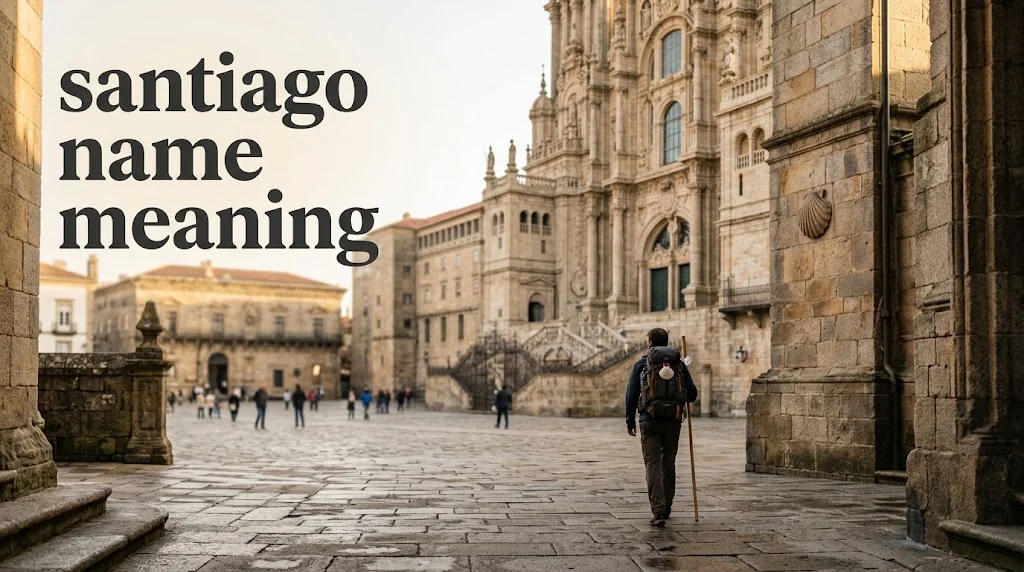
Santiago means “Saint James.” It comes from the Spanish combination of santo (“saint”) and Yago, an old Spanish form of James. The name has deep Spanish and Christian roots and remains widely recognized in Spanish- and Portuguese-speaking cultures.
The Santiago name meaning is “Saint James,” making it a name with a clear religious and historical foundation. It developed in Spanish from santo and Yago, an older Spanish form connected with James. Today, Santiago works as both a traditional given name and a familiar cultural name across Spain, Latin America, and other Spanish-speaking communities.
The name carries more than a literal translation. Its history connects language, Christian tradition, Spanish identity, literature, geography, and personal naming customs. This guide explains where Santiago comes from, how its meaning developed, how it is pronounced, and which related forms appear in different languages.
Key Facts
| Detail | Information |
|---|---|
| Gender | Boy / Masculine |
| Meaning | Saint James |
| Origin | Spanish; also used in Portuguese |
| Pronunciation | san-tee-AH-go |
| Related Forms | Santi, Tiago, Thiago, Yago |
| Religious Connection | Saint James the Greater, traditionally associated with Spain |
What Is Santiago?
Santiago is a masculine given name used especially in Spanish and Portuguese. Its direct meaning is “Saint James,” referring to Saint James the Greater, one of the apostles in the New Testament and a major figure in Spanish Christian tradition.
Unlike James, which functions as the English form of the biblical name, Santiago combines a saintly title with an older form of James. That makes its structure distinctive.
Santiago can also appear as a surname and as a place name. The Chilean capital, Santiago, is one of the best-known geographical uses, while numerous towns and cities in the Spanish- and Portuguese-speaking world carry the name because of its connection with Saint James.
Santiago Meaning
The traditional meaning of Santiago is “Saint James.” The first element relates to Spanish santo, meaning “saint,” while Yago represents an old Spanish form associated with James.
Religious Meaning
Santiago has a strong Christian association because it refers to Saint James the Greater. In Spanish tradition, Saint James became especially connected with Spain and is regarded as the country’s patron saint in the naming tradition surrounding Santiago.
For families choosing the name for religious reasons, Santiago can therefore express devotion, heritage, or a connection with Christian tradition.
Modern Meaning
Modern parents may choose Santiago for its heritage and sound rather than for a strictly religious reason. The name has a distinctive Spanish character while remaining familiar to English speakers.
It can suggest Spanish or Latin American heritage without requiring the child to have a religious background. That broader cultural use helps explain why Santiago works comfortably across different communities.
Origin and Etymology
Santiago has a Spanish linguistic origin, with Portuguese usage as well. Its structure comes from santo + Yago, producing the meaning “Saint James.”
Yago is an old Spanish form related to James. The broader family of forms traces back to the name represented in Latin as Iacobus. Spanish also has other forms of James, including Jaime and Jacobo, but Santiago developed along a different historical path.
The relationship between Santiago and James can seem surprising at first. Yet medieval naming traditions often produced different forms of the same underlying name as names moved between languages and local speech patterns.
The Portuguese language uses Santiago as well, while Tiago and Thiago are closely related Portuguese forms. Santi functions as a short form of Santiago in Spanish and Italian usage.
History and Cultural Context
Santiago became deeply connected with Spanish religious culture through devotion to Saint James. That connection gave the name a place in personal naming, religious traditions, and geographical names.
One major cultural association is Santiago de Compostela in Galicia, Spain. The city became an important Christian pilgrimage destination associated with Saint James. The wider tradition helped strengthen Santiago as a recognizable religious and cultural name.
The name also traveled with Spanish and Portuguese language and culture beyond Europe. As Spanish-speaking communities developed throughout Latin America, Santiago became established across the region.
Its geographical use adds another layer. Santiago is the capital of Chile, and many other settlements bear the same name. The place-name tradition reflects the same Saint James association found in the personal name.
Santiago also has a literary connection. Ernest Hemingway used Santiago as the name of the elderly fisherman and central character in The Old Man and the Sea, published in 1951.
Examples
Santiago works naturally as a first name in several naming styles:
- Santiago García — a traditional Spanish-style combination.
- Santiago José — a two-given-name combination common in Hispanic naming traditions.
- Santiago James — a bilingual combination connecting the Spanish and English forms.
- Santi — a shorter, informal form of Santiago.
- Santiago Miguel — a pairing that retains a strong Spanish-language character.
In everyday speech, Santi can provide a shorter and more casual alternative while preserving Santiago as the formal name.
Variants and Spellings
Santiago has several genuine related forms across languages and naming traditions.
| Form | Language / Usage | Relationship |
|---|---|---|
| Santiago | Spanish, Portuguese | Main form |
| Santi | Spanish, Italian | Short form |
| Yago | Spanish | Older form related to James |
| Tiago | Portuguese | Closely related form |
| Thiago | Portuguese, especially Brazilian | Variant of Tiago |
| Diego | Spanish, Italian | Historically suggested as a possible shortened form of Santiago |
The connection between Santiago and Diego deserves some caution. Sources describe Diego as possibly a shortened form of Santiago, while its deeper etymology remains debated. It should therefore not be presented as an unquestioned equivalent.
Famous People Named Santiago
Several notable people have carried Santiago as a given name.
- Santiago Ramón y Cajal — Spanish physician and neuroscientist who shared the 1906 Nobel Prize in Physiology or Medicine for his work on the structure of the nervous system.
- Santiago Calatrava — Spanish architect, structural engineer, and designer known internationally for major architectural and engineering projects. His official biography records his architectural and engineering training and professional career.
- Santiago Cabrera — Chilean actor known for roles in Heroes, Merlin, The Musketeers, and Star Trek: Picard.
- Santiago Solari — Argentine former professional footballer and manager who played for clubs including River Plate, Atlético Madrid, Real Madrid, and Inter Milan.
Santiago vs. Related Terms
| Term | Meaning | How It Differs |
|---|---|---|
| Santiago | Saint James | Spanish form combining santo with Yago |
| James | English form of the biblical name | Direct English form rather than the Spanish compound |
| Yago | Spanish form related to James | Older form that contributes to Santiago |
| Tiago | Portuguese form related to James | Common Portuguese relative of Santiago |
| Santi | Short form of Santiago | Informal, abbreviated form |
Frequently Asked Questions
Is Santiago a boy’s name?
Yes. Santiago is traditionally a masculine given name. It is used primarily in Spanish and Portuguese naming traditions.
What does the name Santiago mean?
Santiago means “Saint James.” The name combines Spanish santo, meaning “saint,” with Yago, an old Spanish form connected with James.
Is Santiago a biblical name?
Santiago is not the original biblical-language form of the name, but it is a Spanish name associated with James the apostle. Its religious meaning comes directly from the Christian tradition surrounding Saint James.
How do you pronounce Santiago?
In English, Santiago is commonly pronounced san-tee-AH-go. Spanish pronunciation is closer to san-TYAH-go, with regional variation in the final consonant.
What is the short form of Santiago?
Santi is a recognized short form of Santiago. Portuguese-related forms include Tiago and Thiago.
Is Santiago the same as James?
Santiago represents a Spanish form associated with James, but the two names are not identical in form. Santiago specifically carries the additional sense of “Saint,” producing “Saint James.”
Is Santiago a Spanish or Portuguese name?
Santiago is used in both Spanish and Portuguese. Its documented meaning and formation are especially associated with Spanish, while Portuguese shares the form and has related forms such as Tiago and Thiago.
Conclusion
Santiago is a masculine name meaning “Saint James,” with strong Spanish linguistic, Christian, and cultural roots. Its connection with Saint James, Spanish history, Latin American naming traditions, and related forms such as Santi and Tiago gives it both historical depth and modern versatility.

2 thoughts on “Santiago Name Meaning| Origin, History, and Significance For 2026”