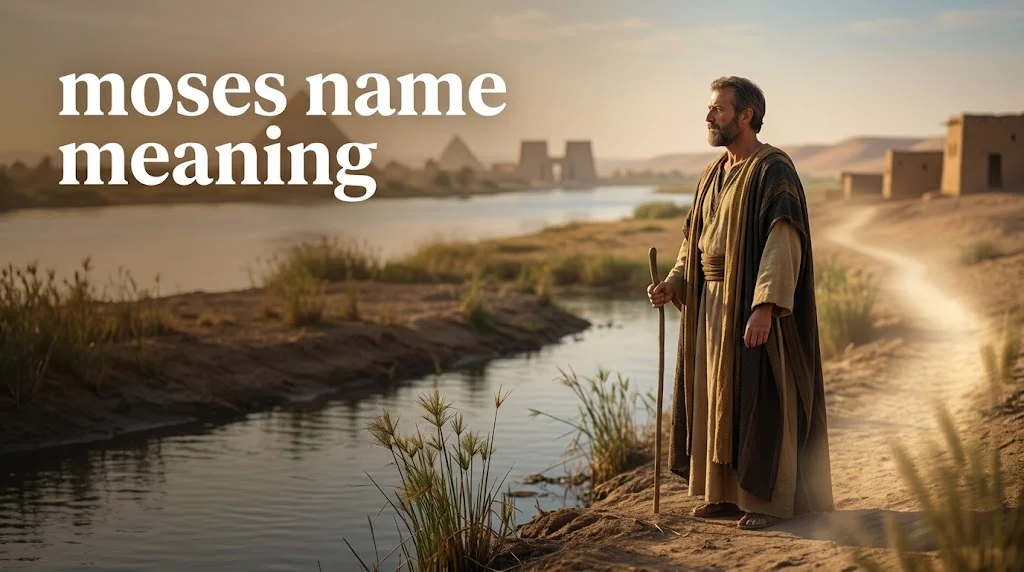
The name Moses is a masculine biblical name traditionally associated with the Hebrew Moshe. Its etymology is often connected with an Egyptian element meaning “son,” while the biblical explanation links it with being “drawn out” of the water.
The Moses name meaning carries both linguistic and religious significance. Moses is the English form of the Hebrew Moshe, a name closely associated with one of the central figures of the Hebrew Bible and a major prophet in Islam.
The name has survived across languages and centuries because of its connection with a foundational biblical story. Its exact etymology deserves some care, though: the biblical explanation connects Moses with being drawn from water, while many name scholars associate the Hebrew form with an Egyptian element meaning “son.”
Key Facts
| Fact | Details |
|---|---|
| Gender | Boy / Masculine |
| Meaning | Traditionally associated with “drawn out”; possibly connected to Egyptian mes, “son” |
| Origin | Hebrew, with a likely Egyptian linguistic connection |
| Hebrew Form | מֹשֶׁה — Moshe |
| Pronunciation | MOH-ziz |
| Religious Usage | Jewish, Christian, Islamic traditions |
| Related Forms | Moshe, Musa, Moïse, Moisés, Mosè |
Introduction
The Moses name meaning carries both linguistic and religious significance. Moses is the English form of the Hebrew Moshe, a name closely associated with one of the central figures of the Hebrew Bible and a major prophet in Islam.
The name has survived across languages and centuries because of its connection with a foundational biblical story. Its exact etymology deserves some care, though: the biblical explanation connects Moses with being drawn from water, while many name scholars associate the Hebrew form with an Egyptian element meaning “son.”
What Is Moses?
Moses is a masculine given name with biblical Hebrew usage. The original Hebrew form is Moshe (מֹשֶׁה), while Moses became the familiar English form through biblical Greek and Latin traditions.
The name differs from a modern invented name because its history reaches back to ancient religious texts. It functions as both a personal name and a major cultural reference connected with Moses the prophet and lawgiver.
In Jewish tradition, Moses is traditionally regarded as the leader who brought the Israelites out of Egyptian slavery and received the commandments at Mount Sinai. Christianity inherited this biblical tradition, while Islam knows Moses as Musa, one of its major prophets.
Moses Name Meaning
The meaning of Moses has two closely connected explanations.
“Drawn Out” in the Biblical Explanation
Exodus 2:10 connects Moses’ name with the Hebrew verb mashah, commonly translated as “to draw out.” The explanation relates to the story of the infant Moses being drawn from the Nile by Pharaoh’s daughter.
This interpretation gives the name a strong symbolic association with rescue, deliverance, and being brought out of danger.
Possible Egyptian Connection
Many modern name references instead connect Moshe with an Egyptian element, mes, meaning “son.” This theory fits the Egyptian setting of the biblical story and has support in historical name scholarship.
The two explanations should not be treated as equally certain linguistic facts. The Egyptian connection is widely discussed by scholars, while the biblical explanation may function as a Hebrew wordplay explaining the name within the narrative.
Origin and Etymology
Moses ultimately comes to English through the Hebrew Moshe. The Hebrew spelling is מֹשֶׁה, and the name has developed different forms as it moved through Greek, Latin, and later European languages.
The Egyptian connection is particularly interesting because the biblical Moses story takes place partly within ancient Egypt. The element mes appears in Egyptian personal names and relates to birth or sonship. Name references therefore commonly describe Moses as a Hebrew name with a probable Egyptian linguistic connection.
The popular explanation “drawn out of the water” comes directly from the biblical narrative. Linguistically, though, scholars distinguish between a text’s internal explanation of a name and its historical etymology.
History and Cultural Context
Moses occupies an unusually important place in Jewish history and religious tradition. The biblical books of Exodus, Leviticus, Numbers, and Deuteronomy present him as the central human leader of the Israelites during their departure from Egypt and wilderness period.
His story includes the crossing of the Red Sea, the encounter at Mount Sinai, and the reception of the Ten Commandments. These episodes made Moses one of the most recognizable figures in biblical culture.
Christian tradition retained Moses as an important Old Testament figure. In Islam, the corresponding name is Musa, and Moses is also a major prophet. The different forms show how one ancient name became established across several religious and linguistic traditions.
The name also became established as a personal name among Jewish communities and later among Christians. In English-speaking Christian communities, its use increased particularly after the Protestant Reformation.
Examples
Moses works naturally as a traditional first name:
- Moses James — a classic first-and-middle-name combination.
- Moses Daniel — combines two biblical names.
- Moses Alexander — pairs the ancient name with a widely used classical name.
- Moses Carter — gives the traditional first name a more modern surname pairing.
The name can also appear in historical, religious, and literary contexts where its biblical associations are immediately recognizable.
For pronunciation, English speakers generally say Moses as MOH-ziz. The Hebrew Moshe has a different pronunciation, closer to moh-SHEH.
Variants and Spellings
Moses has numerous established forms across languages and religious traditions.
| Language / Tradition | Form |
|---|---|
| Hebrew | Moshe |
| Arabic / Quranic | Musa |
| French | Moïse |
| Spanish | Moisés |
| Portuguese | Moisés |
| Italian | Mosè |
| Dutch | Mozes |
| Hungarian | Mózes |
| German | Mose |
| Yiddish | Moishe |
| Biblical Latin | Moyses |
Moss also appears as an English and Jewish related form, while Moishe is a Yiddish form of the name.
Famous People Named Moses
Moses Malone
Moses Malone (1955–2015) was an American professional basketball player who competed in the ABA and NBA. He became a Hall of Fame center, won three NBA MVP awards, and helped the Philadelphia 76ers win the 1983 NBA championship.
Moses Sumney
Moses Sumney is an American singer, songwriter, and musician known for combining art pop, soul, folk, and experimental sounds. His albums include Aromanticism and Græ.
Moses Mendelssohn
Moses Mendelssohn (1729–1786) was an influential Jewish philosopher associated with the intellectual movement of the European Enlightenment. He became one of the most prominent Jewish thinkers of 18th-century Europe.
Moses vs. Related Terms
| Term | Meaning | How It Differs |
|---|---|---|
| Moses | English form of Moshe | Main English spelling |
| Moshe | Hebrew form | Original Hebrew form |
| Musa | Arabic/Quranic form | Form used in Islamic and Arabic contexts |
| Moïse | French form | French-language equivalent |
| Moisés | Spanish and Portuguese form | Used in Iberian languages |
| Moishe | Yiddish form | Jewish/Yiddish variant |
| Mózes | Hungarian form | Hungarian equivalent |
Frequently Asked Questions
Is Moses a boy’s name?
Yes. Moses is traditionally a masculine given name and has long-standing biblical and Jewish usage.
What does the name Moses mean?
Moses is traditionally connected with “drawn out,” referring to the biblical account of Moses being drawn from the Nile. Scholars also connect the name with the Egyptian element mes, meaning “son.”
Is Moses a Hebrew name?
Moses comes through the Hebrew name Moshe, although many scholars believe the name has an Egyptian linguistic connection.
How do you pronounce Moses?
In English, Moses is commonly pronounced MOH-ziz. The Hebrew form, Moshe, has a pronunciation closer to moh-SHEH.
Is Moses the same name as Musa?
Yes. Musa is the Arabic and Quranic form of Moses. The two names refer to the same major prophetic figure in their respective religious traditions.
What is the Hebrew name for Moses?
The Hebrew name is Moshe (מֹשֶׁה). It is the source of the English form Moses.
Is Moses a religious name?
Moses has strong religious associations in Judaism, Christianity, and Islam. The biblical Moses and Quranic Musa are central figures in their respective traditions.
Is Moses an old-fashioned name?
Moses is an ancient name, but that does not make it limited to historical use. Its continued appearance across religious communities and modern public life shows that it remains a recognizable personal name.
Conclusion
The name Moses combines ancient Hebrew usage, probable Egyptian linguistic roots, and an exceptionally strong religious history. Its traditional association with being “drawn out” gives it a memorable symbolic meaning, while forms such as Moshe and Musa connect it with Jewish and Islamic traditions across languages.
