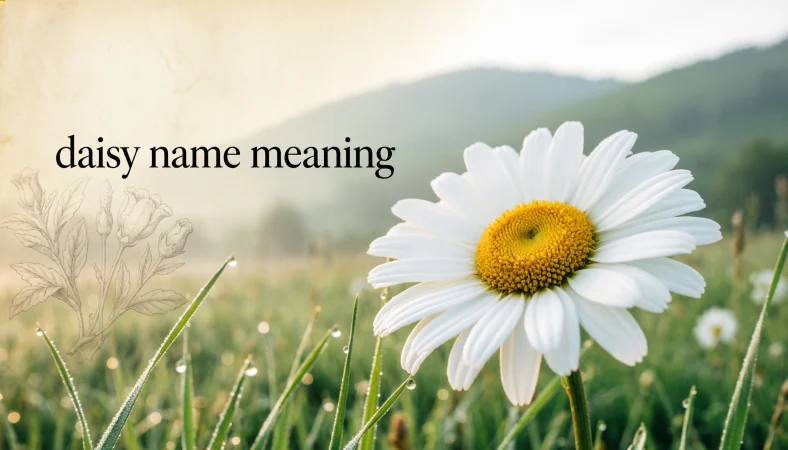
Quick Ans: Daisy is an English feminine name taken directly from the name of the white daisy flower. Its deeper linguistic root is the Old English dægeseage, meaning day’s eye, referring to the flower opening in daylight.
Daisy is more than the name of a cheerful flower. With its connection to nature, freshness, innocence, and beauty, this charming name has remained familiar across generations. But where did the name Daisy come from, and what does it really mean?
Daisy is an English feminine given name that comes directly from the name of the daisy flower. The flower name is historically connected to the Old English expression dægeseage, meaning “day’s eye,” referring to the flower’s habit of opening with daylight and closing at night. Over time, dægeseage developed into the modern word daisy.
In this guide, we’ll explore the Daisy name meaning, origin, etymology, pronunciation, history, symbolism, variations, and cultural associations. We’ll also distinguish the name’s well-established linguistic history from modern symbolic interpretations, so you can understand what the name Daisy truly represents.
Key Facts
| Detail | Information |
|---|---|
| Gender | Girl / Feminine |
| Meaning | Day’s eye; the daisy flower |
| Origin | English, from Old English |
| Pronunciation | DAY-zee |
| Name type | Floral / nature name |
| First used as a given name | 19th century |
| Related forms | Deisy, Deysi, Deise |
Introduction
The daisy name meaning comes from the familiar white flower and ultimately from the Old English word dægeseage, meaning day’s eye. As a personal name, Daisy belongs to the long tradition of English flower and nature names and has been used as a feminine given name since the 19th century.
The name has a simple appeal: it connects a person with a small, bright flower while carrying an unusually old linguistic history. Here, we will look at Daisy’s meaning, pronunciation, origin, history, variants, cultural use, famous bearers, and related names.
What Is Daisy?
Daisy is a feminine English given name derived from the common name of a flower. The name refers most directly to the daisy, a flower commonly associated with its white petals and yellow center.
Unlike names that began as ancient personal names and later developed additional meanings, Daisy has a more straightforward history. The personal name came from an existing English flower word.
The word itself has an older history. Dægeseage, the Old English source, literally combines ideas corresponding to “day” and “eye.” The image reflects the flower’s habit of opening during daylight.
Daisy therefore belongs alongside names such as Rose, Lily, Violet, Poppy, Flora, and Iris, although each has a different linguistic history.
Daisy Name Meaning
The central meaning of Daisy is “day’s eye.” In modern naming, though, most people understand Daisy simply as the name of the flower.
Traditional Meaning: “Day’s Eye”
The older meaning gives Daisy a small piece of natural imagery. The Old English dægeseage referred to the flower as something resembling an eye of the day. Over time, the word developed into the modern English daisy.
So, if you are looking for the literal linguistic meaning, “day’s eye” is the most precise answer.
Modern Meaning
Today, Daisy primarily means the daisy flower as a personal name. Because it comes directly from a flower, people may associate it with ideas such as freshness, simplicity, brightness, and nature.
Those qualities are modern associations rather than separate dictionary meanings of the name.
Origin and Etymology
Daisy has an English origin, with its linguistic roots reaching back to Old English. The earliest source commonly given is dægeseage, meaning “day’s eye.”
The development is essentially:
Old English dægeseage → Middle English forms → English daisy → personal name Daisy
The flower word existed before Daisy became a personal name. According to name-history sources, Daisy began appearing as a given name in the 19th century, during a period when English-speaking communities increasingly adopted plant and flower names for girls.
That distinction matters. Daisy is not an ancient personal name that happens to share a meaning with a flower. It is a flower name that later became a personal name.
History and Cultural Context
Daisy entered personal naming during the 19th-century enthusiasm for botanical and nature-inspired names. It became especially familiar in English-speaking naming traditions.
The name also gained a strong literary association through Daisy Buchanan, a central character in F. Scott Fitzgerald’s The Great Gatsby, published in 1925. The character helped give the name a lasting place in English-language literature.
Popular culture added another memorable Daisy through Daisy Duck, the Disney character introduced in 1940 as Donald Duck’s girlfriend.
Daisy also has an interesting connection with Margaret. In English and French naming traditions, Margaret has long been connected with words for daisies, including French Marguerite, which is both a form of Margaret and a word for a daisy-type flower. This helps explain historical cases where Daisy appeared as a nickname or associated form of Margaret.
Still, Daisy is perfectly capable of functioning as an independent given name. It does not require Margaret as its source.
Examples
Daisy works naturally as a first name and has a distinctly feminine sound.
Here are some realistic examples:
- Daisy Rose Carter — a traditional floral-style combination.
- Daisy Elizabeth Morgan — pairs the informal brightness of Daisy with a classic middle name.
- Daisy Mae Wilson — has a warm, vintage feel.
- Daisy Grace Bennett — combines two short, familiar names.
- Daisy Florence Reed — gives the flower name a more traditional setting.
In everyday speech, Daisy is pronounced DAY-zee, with two syllables.
The name can also appear in literary and fictional contexts. Daisy Buchanan from The Great Gatsby remains one of its best-known literary examples, while Daisy Duck gives it a strong association with children’s entertainment.
Variants and Spellings
Daisy has relatively few established spelling variants in English because the name comes directly from the English flower word.
Some related forms appear in other languages and regional naming traditions:
| Form | Usage |
|---|---|
| Daisy | Standard English form |
| Deisy | Spanish-language usage, particularly in Latin America |
| Deysi | Spanish-language variant |
| Deise | Brazilian Portuguese form |
Behind the Name lists Deise as a Brazilian Portuguese form and Deisy and Deysi as Latin American Spanish forms.
Maisie should not be treated as a spelling variant of Daisy. It has a separate history, although Daisy and Maisie have sometimes become connected through historical nickname traditions involving Margaret.
Famous People Named Daisy
Several notable women have Daisy as their given name.
- Daisy Ridley — English actress best known internationally for playing Rey in the Star Wars sequel trilogy.
- Daisy Lowe — English fashion model who has worked in major fashion campaigns and publications.
- Daisy Fuentes — Cuban-American television host, model, and actress who became known through MTV and Spanish-language television.
These examples show how the name functions comfortably across entertainment, fashion, and international media.
Daisy vs. Related Terms
| Term | Meaning | How It Differs |
|---|---|---|
| Daisy | A flower; “day’s eye” | An English feminine given name taken from the flower |
| Rose | A type of flowering plant | Another English floral name, but from a different flower and linguistic history |
| Lily | A flowering plant | Floral given name with a separate botanical and linguistic origin |
| Margaret | Traditionally “pearl” | A personal name that has historical connections with Marguerite, a daisy-related flower name |
| Maisie | A traditional form/nickname associated with Margaret | Related historically to Margaret, not simply a spelling of Daisy |
| Flora | Flower; also a Roman goddess’s name | A botanical name with Latin and Roman cultural roots |
The comparison with Margaret is particularly interesting. Daisy and Margaret are not synonyms, but historical naming practices created a connection between them through flower terminology.
Frequently Asked Questions
1. What does the name Daisy mean?
Daisy means “day’s eye” in its Old English linguistic origin and refers to the daisy flower in modern English. The name comes directly from the English flower word.
2. Is Daisy a girl’s name?
Yes. Daisy is traditionally a feminine name in English usage. It is generally classified as a girl’s name rather than a unisex name.
3. What is the origin of the name Daisy?
Daisy has an English origin. Its deeper root is the Old English dægeseage, meaning “day’s eye.” It became a personal name during the 19th century.
4. How do you pronounce Daisy?
Daisy is pronounced DAY-zee. It has two syllables: DAY + zee.
5. Is Daisy a biblical name?
No. Daisy is not a biblical name. It comes from the English name of a flower and ultimately from Old English rather than from the Hebrew, Greek, or Aramaic naming traditions of the Bible.
6. Is Daisy a nickname for Margaret?
Historically, Daisy has sometimes been used in connection with Margaret, partly because Marguerite is both a form of Margaret and a French word for a daisy. However, Daisy is also an established independent given name.
7. Is Daisy a flower name?
Yes. Daisy is directly a flower name. It belongs to the same broad category as Rose, Lily, Violet, Poppy, and similar botanical names.
Conclusion
Daisy is a classic English floral name with an unusually vivid linguistic origin: “day’s eye,” from Old English dægeseage. Its direct connection to the daisy flower gives the name a fresh, natural character, while its 19th-century use and appearances in literature and popular culture have helped keep it familiar across generations.

1 thought on “Daisy Name Meaning: Beautiful Flower-Inspired Name For 2026”