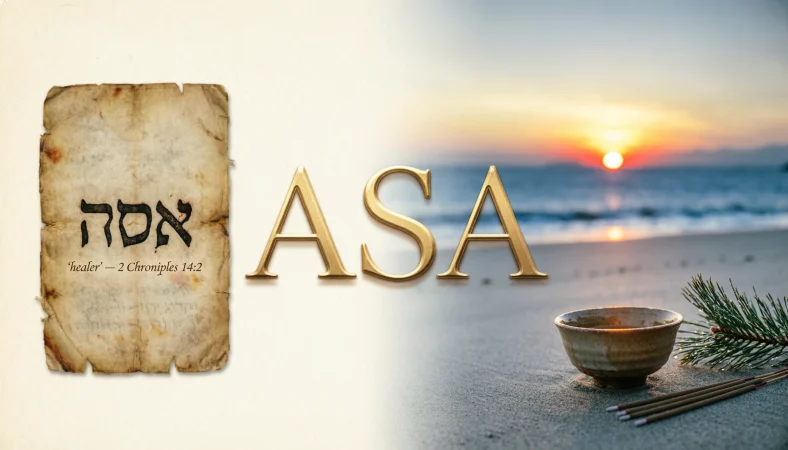
The Asa name meaning is most commonly associated with the Hebrew and Biblical name Asa, which is traditionally interpreted as “healer” or possibly “physician.” In the Old Testament, Asa was the third king of Judah. However, Asa is not limited to one linguistic tradition: the same spelling appears in Japanese and other cultures, where it can have different meanings.
Because the spelling is shared across cultures, the meaning of Asa depends partly on the language and naming tradition being discussed. In Japanese, for example, asa (朝) means “morning,” while the kanji 麻 can refer to hemp or flax.
This guide explores the Asa name meaning, origin, pronunciation, biblical history, Japanese connections, variations, and common questions about the name.
What Is the Asa Name?
Asa is a short personal name used in more than one cultural and linguistic tradition. In the Biblical tradition, Asa is a masculine Hebrew name associated with a king of Judah and is commonly explained as meaning “healer,” although the exact Hebrew etymology is not completely certain.
The name is especially interesting because Asa has different meanings in different languages.
For example:
- Biblical/Hebrew Asa: traditionally interpreted as “healer.”
- Japanese Asa (朝): means “morning.”
- Japanese Asa (麻): can refer to hemp or flax.
- Indonesian Asa: is reported as meaning “hope,” ultimately connected with Sanskrit āśā.
Therefore, there is no single universal meaning for every person named Asa.
Asa Name Meaning
The most commonly searched Asa name meaning is “healer.” This interpretation comes from the Biblical/Hebrew name אָסָא (Asa). However, reputable lexical references note that the name’s ultimate derivation is uncertain, so “healer” should be described as a traditional or probable interpretation rather than an absolutely proven etymology.
The meaning “healer” gives the name a positive association with:
- Healing
- Care
- Restoration
- Health
- Help
- Compassion
- Strength
The Biblical connection adds another layer of meaning. Asa was a king of Judah who is described in the Old Testament as doing what was right in the eyes of God during his reign.
Is Asa a Hebrew name?
Yes. Asa is recognized as a Biblical/Hebrew name, written in Hebrew as אָסָא. Its exact etymology is not completely certain, although “healer” is the commonly cited interpretation.
Asa Name Origin and Etymology
The Biblical form of Asa comes from Hebrew and appears in the Old Testament. Lexical sources classify the origin of the Hebrew name as uncertain while giving “perhaps healer” as its meaning.
This distinction is important when discussing name meanings online. It is tempting to present a simple definition as an absolute fact, but historical names can have uncertain etymologies.
In the case of Asa:
Hebrew name → אָסָא → Asa → traditionally interpreted as “healer.”
The name is connected with Asa, king of Judah, which is its most important Biblical association.
Why is the etymology uncertain?
Ancient names can survive in historical texts even when their original linguistic construction is no longer completely clear. Lexical references therefore distinguish between a documented name and a proposed meaning.
For Asa, sources describe the derivation as uncertain but associate the name with the idea of healing.
So, the most responsible way to state the meaning is:
Asa is a Biblical Hebrew name traditionally interpreted as “healer,” although its precise etymology is uncertain.
Asa in the Bible
The most famous Biblical bearer of the name was Asa, king of Judah.
According to the Old Testament, Asa succeeded his father and became the third king of Judah. Biblical accounts of his reign appear particularly in 1 Kings and 2 Chronicles.
His story is significant because his name is connected with a historical king rather than simply appearing as an isolated personal name.
The Biblical Asa is associated with religious reforms and opposition to idolatrous practices. The account in 1 Kings describes Asa as doing what was right in the eyes of the Lord.
This history gives the name additional associations beyond its proposed literal meaning:
- Leadership
- Faith
- Reform
- Strength
- Healing
- Responsibility
It is important, however, not to claim that every person named Asa is expected to have these personality traits. They are cultural and historical associations, not predictions about an individual’s character.
Asa Pronunciation
The pronunciation of Asa depends on the language.
In English, the Biblical name Asa is commonly pronounced approximately:
AY-suh
IPA: /ˈeɪ.sə/
The Biblical Hebrew pronunciation is different and is represented in lexical sources approximately as ah-SAH.
Japanese asa is pronounced approximately:
AH-sah
This difference matters because the same written name can represent different linguistic names.
Quick pronunciation guide
| Language/Tradition | Approximate Pronunciation |
|---|---|
| English Biblical name | AY-suh |
| Hebrew/Biblical form | ah-SAH |
| Japanese asa | AH-sah |
If someone is using Asa as a personal name, the safest approach is to follow the pronunciation preferred by that person or family.
Asa Name Meaning in Japanese
The spelling Asa also appears in Japanese naming.
In Japanese, asa can be written as 朝, which means “morning.” The Japanese word 朝 refers to the morning or the early part of the day.
This creates a completely different meaning from the Biblical Hebrew interpretation.
Japanese names are also strongly influenced by the kanji characters used to write them. Different kanji can have different meanings even when they share the same pronunciation.
For example:
- 朝 (asa) — morning
- 麻 (asa) — hemp/flax
- Other kanji combinations may also be used depending on the name.
So, if someone asks for the Japanese Asa name meaning, the exact kanji is important.
Why does the kanji matter?
Japanese names do not always have one fixed written form. A pronunciation can correspond to different kanji, and each character contributes its own meaning.
Therefore:
Asa + 朝 = morning
while
Asa + 麻 = hemp/flax
The pronunciation can remain similar while the written meaning changes.
Is Asa a Boy or Girl Name?
The answer depends on the cultural context.
The Biblical/Hebrew Asa is traditionally a masculine name, associated with the king of Judah.
Japanese Asa can be used as a given name for different genders, with available Japanese naming references listing both masculine and feminine usage.
Therefore, it is not accurate to say that Asa is universally a boy’s name or universally a girl’s name.
Asa as a boy’s name
In the Biblical tradition, Asa is masculine and has a strong historical connection to the king of Judah.
Asa as a girl’s name
In Japanese naming, Asa can also be used as a feminine given name.
Asa as a unisex name
Because of its cross-cultural usage, Asa can be considered unisex in some modern naming contexts, although the Biblical tradition is specifically masculine.
Cultural Meaning and Symbolism of Asa
The symbolic meaning of Asa can change depending on its origin.
Healing symbolism
The Biblical interpretation “healer” naturally creates associations with:
- Care
- Restoration
- Compassion
- Strength
- Wellness
Morning symbolism
When associated with the Japanese 朝, Asa can evoke:
- A new beginning
- Morning light
- Freshness
- A new day
- Hope
- Renewal
These are symbolic interpretations, rather than additional dictionary definitions of the name.
This makes Asa appealing to parents who like short names with meaningful associations.
Asa vs. Similar Names
Asa is sometimes confused with names that look or sound similar. However, similar spelling does not necessarily mean the names have the same origin.
| Name | Main Origin | Meaning/Association | Difference |
|---|---|---|---|
| Asa | Biblical Hebrew | Traditionally “healer” | The primary name discussed here |
| Ása | Old Norse | Connected with the Old Norse element áss, “god” | A separate Nordic name |
| Åsa | Swedish | Short form of Old Norse names beginning with áss | Related to Ása, not Biblical Asa |
| Asaph | Hebrew/Biblical | “Collector” | A different Biblical name |
| Asad | Arabic | “Lion” | Different Arabic name |
| Asahi | Japanese | “Morning sun” | A Japanese name related to morning imagery |
The distinction between Asa, Ása, and Åsa is especially important. Diacritics and language of origin can change both pronunciation and etymology.
Famous Historical Association: Asa, King of Judah
The strongest historical association of the name is Asa, king of Judah.
He appears in the Old Testament and is identified as a ruler of Judah. Biblical references to him occur in books including 1 Kings, 2 Chronicles, and 1 Chronicles.
His story helps explain why Asa has remained recognizable as a Biblical name.
Rather than being a modern invented name, Asa has a documented ancient history. Its continued use today reflects the survival of many Biblical names in later naming traditions.
What Makes Asa a Distinctive Name?
Asa has several qualities that make it stand out:
It is short
With only three letters, Asa is easy to spell and remember.
It has ancient roots
The Biblical Asa appears in the Old Testament, giving the name a long documented history.
It has multiple cultural meanings
The same spelling occurs in different naming traditions, including Hebrew/Biblical and Japanese.
It has positive associations
Depending on its origin, Asa can suggest healing or morning and renewal.
It is easy to pronounce
Although pronunciation differs by language, the name is relatively simple and compact.
Examples of the Name Asa in Context
Here are some natural examples:
- Asa is a Biblical name traditionally associated with the meaning “healer.”
- Asa was the name of a king of Judah in the Old Testament.
- In Japanese, 朝 (asa) means “morning.”
- The pronunciation of Asa can change depending on the language.
- Parents interested in short Biblical names may consider Asa.
- The Japanese meaning of Asa depends on the kanji used to write it.
These examples show why context is important when discussing the name.
How to Choose the Meaning of Asa for a Baby Name
If you are considering Asa as a baby name, first decide which cultural meaning is important to you.
Choose the Biblical meaning if you like:
- Biblical names
- Hebrew names
- Short traditional names
- The idea of healing
- Historical names
Choose the Japanese association if you like:
- Japanese names
- Nature-inspired meanings
- Morning imagery
- Names representing a new beginning
If you are specifically choosing a Japanese name, check the exact kanji with a reliable Japanese-language source or native speaker rather than assuming that every spelling of Asa has the same meaning.
Does Asa Mean “Healer”?
Traditionally, yes. The Biblical Hebrew name Asa is commonly explained as meaning “healer,” but the precise etymology is considered uncertain by some lexical references.
For that reason, a careful definition would be:
Asa is a Biblical Hebrew name traditionally interpreted as “healer.”
This wording avoids presenting a debated etymology as absolute fact.
Does Asa Mean “Morning”?
In Japanese, Asa can mean “morning” when written as 朝. This is a Japanese word and can also appear in personal names.
It is important not to combine this meaning with the Biblical Hebrew meaning and claim that the Hebrew name itself means “morning.” They come from different linguistic traditions.
Is Asa a Good Name?
Whether Asa is a good name is ultimately a personal choice, but it has several practical advantages.
It is:
- Short
- Easy to remember
- Historically established
- Used across different cultures
- Associated with positive concepts
- Simple to spell in English
Its biggest consideration is pronunciation and cultural context. Someone familiar with the Biblical English name may pronounce it “AY-suh,” while Japanese asa is pronounced closer to “AH-sah.”
If cultural authenticity matters to you, the intended origin should be made clear.
Conclusion
The Asa name meaning depends on the cultural and linguistic tradition behind the name. In the Biblical/Hebrew tradition, Asa is a masculine name traditionally interpreted as “healer,” although its exact etymology is uncertain. It is best known from Asa, the king of Judah, giving the name a long Biblical history.
In Japanese, asa can mean “morning” when written as 朝, while other kanji can produce different meanings.
So if you are researching Asa for a baby name, genealogy project, writing project, or personal interest, always consider the language and spelling system behind the name. The same three letters can represent different names and meanings across cultures.

11 thoughts on “Asa Name Meaning| Origin, History and Significance For 2026”