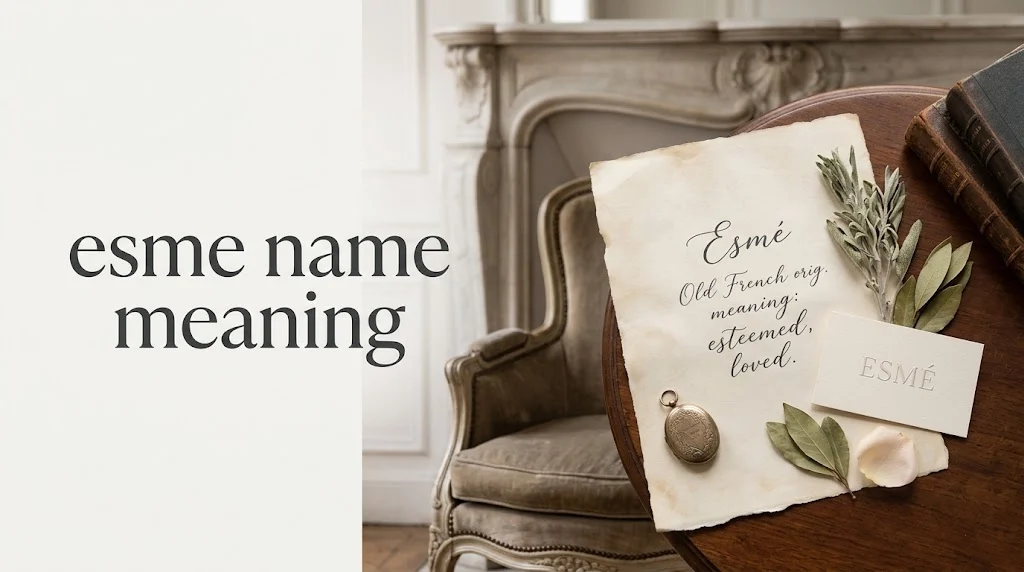
Esme means “esteemed” or “loved.” It comes from Old French esmer, a verb associated with loving or esteeming someone, and ultimately traces to Latin aestimare, meaning “to value” or “esteem.”
The esme name meaning centers on affection, value, and esteem. Esme is an English-used given name derived from Old French, with the accented form Esmé traditionally linked to the meanings “esteemed” and “loved.”
The name has an unusual linguistic history because it began with a French word rather than as a modern invented name. Over time, it moved into English usage and developed several spellings. This article looks at its meaning, roots, pronunciation, history, variants, famous bearers, and related names.
Key Facts
| Detail | Information |
|---|---|
| Gender | Unisex, though now more commonly feminine |
| Meaning | Esteemed, loved |
| Origin | Old French |
| Pronunciation | EZ-may; pronunciation can vary by language and spelling |
| Related Forms | Esmé, Esmée, Esmee, Esmae |
| Historical Use | Recorded in Scotland from the 16th century |
What Is the Esme Name?
Esme is a given name of Old French origin that is now used mainly as a feminine name in English-speaking settings. The traditional form Esmé can be used for both males and females, although modern usage favors girls.
The name differs from similarly spelled names because its meaning comes from the Old French verb esmer. That word carried the sense of loving or esteeming, giving Esme a warm meaning connected with affection and appreciation.
The accent in Esmé is also meaningful in traditional spelling. English speakers often simplify the name to Esme, while Esmée represents another established form.
Esme Name Meaning
The central meaning of Esme is “esteemed” or “loved.” These meanings reflect the name’s connection with the idea of valuing another person.
Traditional Meaning
“Esteemed” highlights respect and high regard. A child named Esme can therefore carry a name associated with being valued and appreciated.
“Loved” gives the name a softer emotional quality. It connects Esme with affection rather than status or material qualities.
Modern Meaning
Modern parents often choose Esme because it sounds elegant, short, and distinctive while retaining a traditional European background. The meaning adds another layer: a name associated with someone cherished and held in high regard.
Origin and Etymology
Esme ultimately comes from Old French esmer, a word meaning “to love,” with a connection to the Latin verb aestimare, meaning “to esteem” or “to value.”
The name form Esmé developed from this linguistic background. Its history therefore belongs to the older French naming tradition rather than to a recently created English word.
One established name reference records Esmé as an Old French name meaning “esteemed” or “loved.” It also identifies Esmé as a name first recorded in Scotland, where it was borne by the first Duke of Lennox in the 16th century.
History and Cultural Context
Esme has an especially interesting connection with Scotland. Historical records associate the name with Esmé Stewart, the first Duke of Lennox, who lived during the 16th century. This early Scottish connection helped establish the name outside its French linguistic roots.
Over later centuries, Esmé and its simplified form Esme became associated more strongly with feminine naming in English. Today, the feminine use is considerably more familiar, although reference works still classify Esmé and Esme as forms that can be used for either gender.
The name has also gained recognition through literature and popular culture, helping preserve its elegant, distinctly European character.
Examples of Esme in Use
Esme works naturally as a first name in several settings:
- Esme Williams — a simple English-language combination.
- Esmé Claire — uses the traditional accented spelling.
- Esme Rose — pairs the short name with a classic middle name.
- Esmée Louise — uses the feminine French/British form.
- Esmae Jane — uses the modern English feminine variant.
The name also works well when parents want something recognizable without choosing an extremely common traditional name.
Variants and Spellings
Several genuine forms appear in English and related naming traditions.
| Form | Usage |
|---|---|
| Esmé | Traditional form; used for human beings |
| Esme | English variant; now commonly feminine |
| Esmée | Feminine form used in British English and Dutch |
| Esmee | Variant without the accent |
| Esmae | Modern English feminine form |
The spelling Esmé is particularly useful when someone wants to preserve the name’s French appearance. Esme is simpler for everyday English-language use because it avoids the accent mark.
Famous People Named Esme
Esmé Bianco
Esmé Bianco is an English actress and performer best known internationally for playing Ros in HBO’s Game of Thrones. She has also worked in film, television, modeling, and performance.
Esmé Creed-Miles
Esmé Creed-Miles is an English actress known for playing the title character in the television series Hanna. She has also appeared in The Doll Factory, The Sandman, and other film and television projects.
Her continued work in film and television has given the name modern visibility, particularly among English-speaking audiences.
Esme vs. Related Terms
| Term | Meaning | How It Differs |
|---|---|---|
| Esme | Esteemed, loved | English variant of Esmé |
| Esmé | Esteemed, loved | Traditional accented form |
| Esmée | Feminine form of Esmé | Feminine spelling used in British English and Dutch |
| Esmae | Feminine form of Esmé | Modern English variant |
| Estelle | Star | Different origin and meaning despite a similar elegant style |
Frequently Asked Questions
What does the name Esme mean?
Esme means “esteemed” or “loved.” Its roots trace to Old French esmer, connected with loving and esteeming.
Is Esme a boy or girl name?
Esme is technically unisex, but it is now more commonly used as a feminine name. The traditional form Esmé has historical use for Human beings.
What is the origin of Esme?
Esme has an Old French origin. Its linguistic root is associated with esmer, meaning “to love,” and ultimately with Latin aestimare, “to esteem.”
How do you pronounce Esme?
The traditional pronunciation of Esmé is commonly represented as EZ-may. Pronunciation can change with language, region, and spelling.
Is Esme a French name?
Esme comes from Old French, although its later history includes English and Scottish usage. The accented form Esmé gives the name its strongest French appearance.
What are the variations of Esme?
Established variants include Esmé, Esmée, Esmee, and Esmae. Esme itself is a recognized English variant of Esmé.
Is Esme a rare name?
Esme is not an obscure invented name, but its frequency varies considerably by country and period. It is recognizable in English-speaking communities without having the feel of a traditional everyday name such as Mary or Elizabeth.
Conclusion
Esme is a graceful name with a clear and meaningful foundation: “esteemed” or “loved.” Its Old French roots, Scottish history, and modern feminine use give it both historical depth and contemporary appeal. For parents seeking a short name with an affectionate meaning, Esme offers a strong choice.
