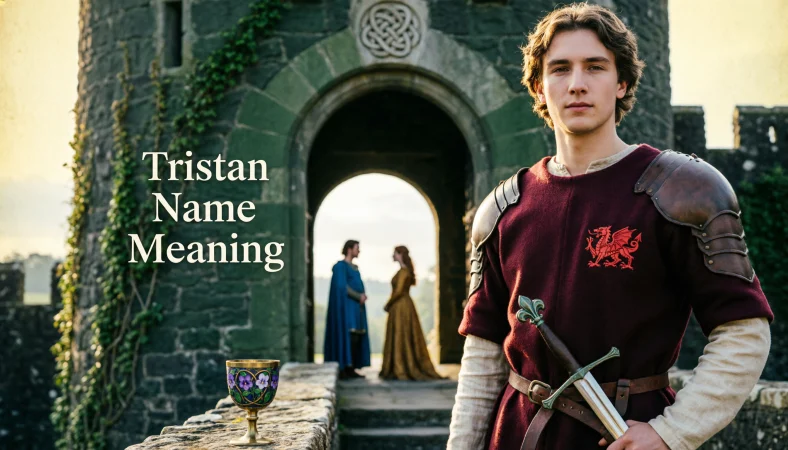
The name Tristan is traditionally linked to the old Pictish name Drustan, probably a diminutive of Drust. Its medieval French form became associated with Old French triste, meaning “sad,” giving Tristan a strong literary association with sorrow and tragic love.
The Tristan name meaning has more than one layer because the name developed through several languages and literary traditions. Tristan is a masculine given name associated with the old Pictish form Drustan, while its medieval French form became connected by sound and spelling with triste, the Old French word for “sad.”
That combination gives Tristan an unusual character. Its oldest linguistic history reaches back before the famous medieval stories, while its strongest cultural identity comes from the tragic love story of Tristan and Iseult. The name later spread through English and French usage and developed several forms in other languages.
Key Facts
| Feature | Details |
|---|---|
| Gender | Boy / masculine |
| Meaning | Traditionally connected with Drust/Drustan; later associated with “sad” through Old French triste |
| Origin | Pictish, transmitted through Welsh and medieval French forms |
| Pronunciation | TRIS-tən |
| French pronunciation | trees-TAHN |
| Cultural association | Tristan and Iseult, Arthurian and medieval romance |
What Is Tristan?
Tristan is a masculine given name used especially in English and French, as well as in connection with the Arthurian literary tradition. The name is best known from the medieval romance of Tristan and Iseult, where Tristan serves as the central male character.
The exact original meaning is not completely certain. Most name references connect Tristan to the old Pictish Drustan, a diminutive of Drust. The form Tristan appears in 12th-century French literature, where writers likely associated it with triste, meaning “sad.”
That distinction matters. Saying simply that Tristan “means sadness” oversimplifies the evidence. “Sad” describes an important medieval literary association, but it may not represent the original meaning of the older name.
Tristan Name Meaning
The name has two closely connected interpretations: an older linguistic origin and a later literary meaning.
The older meaning
The earliest proposed source is the Pictish name Drustan, considered a diminutive of Drust. Pictish was the language associated with the peoples who lived in parts of northern Britain before the medieval period. The exact meaning of Drust itself remains uncertain.
Because of that uncertainty, claims that Tristan has one definite ancient translation should be treated cautiously.
The medieval meaning
When the name appeared as Tristan in medieval French tales, it became closely associated with Old French triste, meaning “sad.” This connection fit the character’s story exceptionally well because Tristan’s romance with Iseult is marked by love, conflict, separation, and tragedy.
As a result, Tristan is often explained today through ideas such as sadness, sorrow, and tragic love, even though those concepts describe the later literary association rather than a certain original Pictish definition.
Origin and Etymology
Tristan’s etymology is more complicated than many modern baby-name descriptions suggest. The strongest commonly cited explanation traces it to Drustan, an old Pictish name related to Drust. From there, the name may have passed through Welsh forms such as Drystan and Trystan before appearing in medieval French literature as Tristan.
The French literary form created an additional association. Medieval writers appear to have connected Tristan with triste, “sad,” helping shape the emotional meaning that later readers attached to the name.
So there are really two stories behind the name: an older linguistic history connected with Drust and a medieval literary history connected with triste. Keeping those strands separate gives a more accurate picture.
History and Cultural Context
Tristan became famous through medieval European literature, especially the story of Tristan and Iseult. In the traditional tale, Tristan serves King Mark of Cornwall and travels to Ireland to bring Iseult back as Mark’s bride.
During the return voyage, Tristan and Iseult accidentally drink a love potion. They fall deeply in love, creating a conflict between personal love and loyalty to King Mark. The story eventually develops into one of medieval Europe’s best-known tragic romances.
The character later became connected with Arthurian tradition. Different versions vary in their details, but Tristan often appears as a knight within the wider Arthurian literary world.
The story’s influence lasted well beyond the Middle Ages. German poet Gottfried von Strassburg wrote a major medieval version, while Richard Wagner later created the famous opera Tristan und Isolde. The enduring story helped keep the name recognizable across European languages and cultures.
Examples
Tristan works naturally as a traditional first name while still sounding contemporary.
- Tristan James — a classic first-and-middle-name combination.
- Tristan Alexander — gives the name a formal, established feel.
- Tristan Cole — a shorter modern combination.
- Tristan William — pairs a medieval literary name with a long-established English name.
In ordinary sentences:
- “Tristan is starting school next year.”
- “We chose Tristan because we liked its literary history.”
- “Tristan is pronounced TRIS-tən in English.”
The name can suit parents who want something recognizable without choosing one of the most conventional biblical or Anglo-Saxon names.
Variants and Spellings
Several genuine forms of Tristan appear across languages and naming traditions.
| Form | Language / Usage |
|---|---|
| Tristan | English, French |
| Trystan | Welsh |
| Drystan | Welsh |
| Tristram | British English, medieval form |
| Tristán | Spanish |
| Tristão | Portuguese |
| Tristen | English variant |
| Tristin | English variant |
| Triston | English variant |
| Trista | English feminine form |
The Welsh forms Trystan and Drystan are especially useful when discussing the name’s older linguistic background. Meanwhile, Tristram represents a historical English form rather than simply a modern spelling variation.
Famous People Named Tristan
Tristan Thompson
Tristan Thompson is a Canadian professional basketball player who has played as a center-forward in the NBA. He was selected fourth overall in the 2011 NBA Draft and became an NBA champion with the Cleveland Cavaliers in 2016.
Tristan Harris
Tristan Harris is a technology ethicist and co-founder and president of the Center for Humane Technology. He previously worked as a Design Ethicist at Google and became widely known for his work on technology, attention, and humane design.
Tristan Tzara
Tristan Tzara was a Romanian-born avant-garde poet and an important figure associated with the Dada movement. His literary career helped establish Tristan as a recognizable name in European artistic culture as well as literature.
Tristan vs. Related Terms
| Term | Meaning | How It Differs |
|---|---|---|
| Tristan | Given name linked to Drustan and medieval triste | The standard modern English and French form |
| Trystan | Welsh form of Tristan | Retains a distinctly Welsh spelling |
| Drystan | Welsh form connected with the older tradition | Closer in form to the proposed early source |
| Tristram | Medieval/British form | Historical English development of Tristan |
| Tristán | Spanish form | Uses the Spanish accent and pronunciation |
| Tristão | Portuguese form | Portuguese equivalent of Tristan |
The related forms share the same broad historical family, but their spellings reflect different languages and periods.
Frequently Asked Questions
What does the name Tristan mean?
Tristan is probably derived from the old Pictish name Drustan, related to Drust. Medieval French writers associated Tristan with triste, meaning “sad,” which gave the name its famous connection with sorrow and tragic love.
Is Tristan a boy’s name or a girl’s name?
Tristan is traditionally a masculine name. Modern naming practices can vary, but its established historical use is masculine.
What is the origin of Tristan?
The name is probably rooted in an old Pictish form, Drustan, and later passed through Welsh and medieval French traditions. The French literary form Tristan became especially influential.
How do you pronounce Tristan?
In English, Tristan is commonly pronounced TRIS-tən, with the stress on the first syllable. In French, the pronunciation is closer to trees-TAHN.
Is Tristan an Irish or Welsh name?
Tristan is not best described as simply Irish or Welsh. Its proposed earliest source is Pictish, while Welsh forms such as Drystan and Trystan played a role in its linguistic and literary development.
Is Tristan a biblical name?
No. Tristan does not originate from the Bible. Its history belongs to Pictish, Welsh, French, and medieval European naming and literary traditions.
What is the feminine form of Tristan?
Trista is an established English feminine form. It developed from Tristan rather than serving as the original form of the name.
Is Tristan a good name?
Tristan is a strong choice for parents who like established names with literary depth. It is recognizable, masculine, and connected with one of Europe’s most enduring medieval romances.
Conclusion
Tristan combines an uncertain but intriguing ancient origin with a powerful medieval literary identity. Its roots probably lead to Drustan and Drust, while its later association with Old French triste gave it the familiar meaning of “sad.” The story of Tristan and Iseult remains the name’s strongest cultural connection.

8 thoughts on “Tristan Name Meaning: Origin, History, and Cultural Significance For 2026”