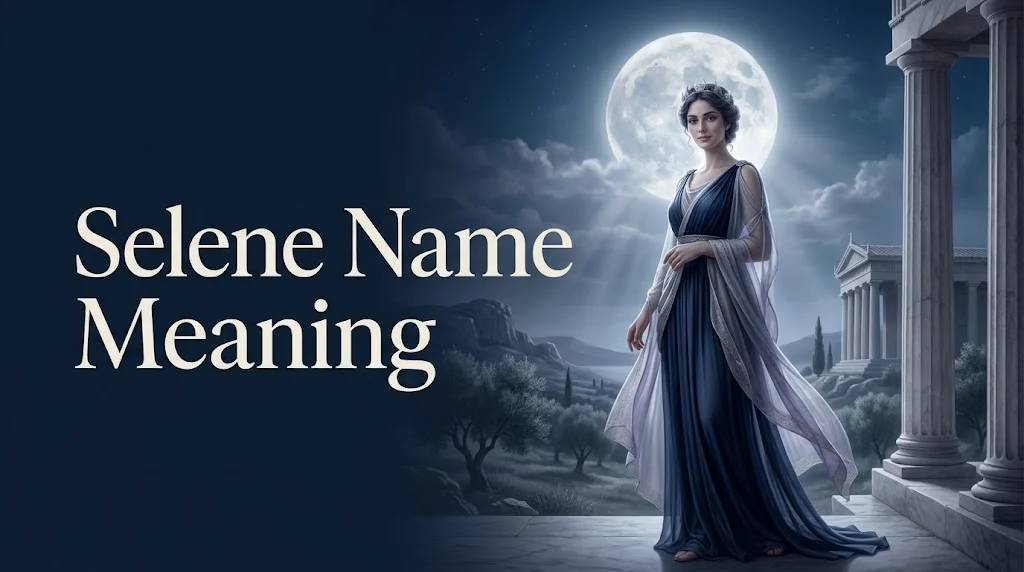
The name Selene means “moon” and comes from the ancient Greek word Selēnē. In Greek mythology, Selene is the goddess who personifies the Moon, giving the name celestial beauty and a strong connection to ancient Greek culture.
The selene name meaning is “moon,” a definition rooted in ancient Greek language and mythology. As a feminine name, Selene connects a child’s name with the night sky, lunar light, and one of the most recognizable figures in Greek mythology.
The name appeals to parents who appreciate classical history and nature-inspired names. Unlike names whose meanings have become uncertain over centuries, Selene retains a clear association with the Moon. Its mythological background adds another layer of meaning, while its elegant spelling gives it a distinctive place among celestial names.
This guide covers Selene’s meaning, linguistic origin, mythological history, pronunciation, spelling variations, famous namesakes, and related names to help you understand the name fully.
Key Facts
| Feature | Details |
|---|---|
| Gender | Girl |
| Meaning | Moon |
| Origin | Ancient Greek |
| Pronunciation | seh-LEE-nee or seh-LEE-nee-like Greek pronunciation; English speakers may also say seh-LEEN |
| Name type | Mythological, celestial |
| Related names | Selena, Luna, Cynthia |
| Main association | Selene, the Greek Moon goddess |
What Is Selene?
Selene is a feminine given name from ancient Greek. It refers both to the Moon and to the goddess who personified it in Greek mythology.
The name has a classical character, yet its meaning remains easy to understand today. Parents may choose Selene because they love astronomy, Greek legends, or names inspired by nature.
Selene is also related to a broader family of lunar names. For example, Luna is the Latin word for the Moon and the name of the Roman lunar goddess. Although the two names share a celestial connection, they come from different languages and mythological traditions.
Selene Meaning
The central meaning of Selene is “moon.” Its interpretation can extend to moonlight, the night sky, and lunar beauty because of its longstanding mythological associations.
Traditional Meaning
In ancient Greek, Selēnē refers to the Moon. Greek mythology personifies the Moon as a divine female figure named Selene, making the name both a natural reference and a mythological identity.
Modern Symbolic Meaning
Today, the name can suggest several qualities, although these are personal interpretations rather than literal dictionary definitions:
- Light in darkness: The Moon illuminates the night, making Selene a fitting symbolic choice for hope or guidance.
- Mystery: The changing lunar phases can evoke curiosity and the unknown.
- Natural beauty: Its association with the night sky appeals to people who appreciate celestial imagery.
- Grace and calm: Some parents associate moon-inspired names with serenity and elegance.
These associations give the name emotional depth. Still, the most firmly established meaning remains “moon,” rather than any particular personality trait.
Origin and Etymology of Selene
Selene comes from the ancient Greek name Σελήνη, transliterated as Selēnē. The Greek word means “moon,” and the name’s connection to the lunar body is central to its linguistic and cultural history.
Ancient Greek speakers used the word for the Moon and personified it through mythology. Over time, Selene became recognized as the proper name of the lunar goddess, linking an everyday natural phenomenon with a divine figure.
The name entered modern naming traditions through the continuing influence of Greek literature, classical education, and mythology. Its use today reflects a wider interest in names drawn from ancient civilizations and the natural world.
Selene is also associated with the modern name Selena. Although the spellings and pronunciations differ, both names have Greek linguistic connections. Selena developed as a related form, while Selene preserves a spelling closely aligned with the ancient Greek name.
History and Cultural Context
Selene’s history begins in ancient Greek religion and mythology, where the Moon held a visible place in people’s understanding of time, nature, and the heavens.
Selene in Greek Mythology
Selene appears in Greek mythology as the divine personification of the Moon. Ancient poets often portrayed her traveling across the night sky in a chariot, bringing lunar light to the world.
Greek myth identifies Selene as the daughter of the Titans Hyperion and Theia in a well-known tradition. Her siblings include Helios, associated with the Sun, and Eos, associated with the dawn.
One of her best-known stories concerns Endymion, a beautiful mortal youth. In a familiar version of the myth, Selene falls in love with him while he lies in eternal sleep. Different ancient accounts vary in their details, but the story has inspired later poetry, paintings, and other artistic works.
Selene and Other Lunar Deities
Greek mythology includes several female figures connected with the Moon, but they do not all represent precisely the same role.
Selene personifies the Moon itself. Artemis, by contrast, is primarily associated with hunting, wilderness, and childbirth, although later traditions also connect her with lunar imagery. Cynthia, a name associated with Artemis through Mount Cynthus on Delos, developed a related celestial association.
The Roman counterpart most directly associated with Selene is Luna. Roman writers sometimes identified Greek and Roman deities with one another, but their names and religious traditions did not begin as identical systems.
The Name in Modern Culture
Today, Selene fits naturally among names inspired by mythology, astronomy, and the night sky. Its ancient background gives it historical substance, while its short form makes it practical for everyday use.
Parents may choose it for its Greek heritage, its lunar meaning, or its connection with classical stories. It can also appeal to families who want a name that feels familiar in sound without being as conventional as many traditional choices.
Examples of Selene in Everyday Use
Selene works in several naming contexts, from a baby’s official name to literary characters and creative projects.
- Baby name: “We chose Selene because we wanted a name inspired by the Moon.”
- Character name: “Selene watched the silver moonlight fall across the ancient temple.”
- Meaning explanation: “Selene is a Greek name that means moon.”
- Sibling-name pairing: Selene can pair well with names such as Orion, Luna, Iris, or Aurora.
- Middle name: Selene can complement a short first name or a longer, traditional surname.
Its spelling is straightforward once learned, although people may pronounce it differently depending on their language and familiarity with Greek names.
Selene Variants and Spellings
Selene has a small group of related names and forms. Some preserve its linguistic connection, while others share its lunar symbolism without being direct spelling variants.
| Name | Background | Relationship to Selene |
|---|---|---|
| Selena | Greek-related form used in several modern languages | Closely related name |
| Selēnē | Scholarly transliteration of ancient Greek Σελήνη | Ancient Greek form |
| Selene | English and international usage | Standard modern spelling |
| Luna | Latin | Shares the meaning “moon” |
| Cynthia | Greek mythological association | Connected with Artemis and later lunar imagery |
Selena is the most recognizable alternative spelling in contemporary naming. It has a slightly different visual style and may have a different pronunciation depending on the language.
Luna is not a variant of Selene in the strict linguistic sense. Instead, the two names share a meaning and a celestial theme through their Greek and Latin backgrounds.
For a family seeking a name that preserves the direct link to the Greek Moon goddess, Selene is the clearest choice.
Famous People Named Selene
Several real people use Selene as a professional or personal name. The following examples illustrate the name’s presence in entertainment and music.
- Selene Luna — A Mexican-American comedian and actress known for her work in live performance and film.
- Selene Vigil — An American musician best known as the vocalist of the punk rock band 7 Year Bitch.
Selene is also widely recognized through mythology and fiction. However, a mythological goddess or fictional character should not be confused with a real person bearing the name.
The list above is illustrative rather than exhaustive; it does not imply that these individuals account for the name’s popularity.
Selene vs. Related Terms
The following comparison clarifies how Selene differs from other names associated with the Moon and Greek mythology.
| Term | Meaning | How It Differs |
|---|---|---|
| Selene | Moon; Greek Moon goddess | The ancient Greek name and its direct lunar association |
| Selena | A related feminine name | A modern form with different spelling and pronunciation patterns |
| Luna | Moon in Latin; Roman lunar goddess | Comes from Latin rather than Greek |
| Artemis | Greek goddess of hunting and wilderness | Has lunar associations in later traditions but a broader original role |
| Cynthia | Associated with Mount Cynthus and Artemis | A mythological name with a secondary lunar connection |
| Helios | Sun; Greek solar deity | A masculine mythological name associated with the Sun |
| Aurora | Dawn; Roman goddess of dawn | Connected with morning light rather than the Moon |
These distinctions matter when choosing a name based on its exact history. Selene and Luna have the most direct connection to the Moon, while Artemis and Cynthia carry wider mythological associations.
Frequently Asked Questions
1. What does the name Selene mean?
Selene means “moon” in ancient Greek. It is also the name of the Greek goddess who personifies the Moon, giving it a strong connection to lunar imagery and classical mythology.
2. Is Selene a boy’s or girl’s name?
Selene is traditionally a feminine given name. Its association with the Greek Moon goddess reinforces its longstanding use as a girl’s name.
3. How do you pronounce Selene?
A common English pronunciation is seh-LEE-nee, although some English speakers use seh-LEEN. Pronunciation can vary by language and region, so families may prefer a particular version.
4. Is Selene a Greek name?
Yes. Selene comes from the ancient Greek name Σελήνη (Selēnē). Its original meaning is “moon,” and its mythological significance comes from ancient Greek tradition.
5. Is Selene the same as Selena?
Selene and Selena are closely related names, but they are not identical spellings. Both have Greek connections and lunar associations. Selena is a common modern form, while Selene closely reflects the ancient Greek name.
6. What is the spiritual meaning of Selene?
Some people associate Selene with intuition, renewal, calm, and feminine energy because of its connection to the Moon. These are symbolic interpretations, not established religious definitions or proven personality traits.
7. Is Selene a rare name?
Selene is recognizable internationally but less conventional than familiar names such as Sarah or Emma in many English-speaking communities. Its actual popularity varies by country and year, so current national birth records are the best source for an exact ranking.
Conclusion
The name Selene means “moon” and carries a rich connection to ancient Greek mythology. Its celestial meaning, feminine character, and classical roots make it a distinctive choice for parents who appreciate names inspired by nature and history. For anyone seeking a name with a clear meaning and an enduring mythological association, Selene offers both.
