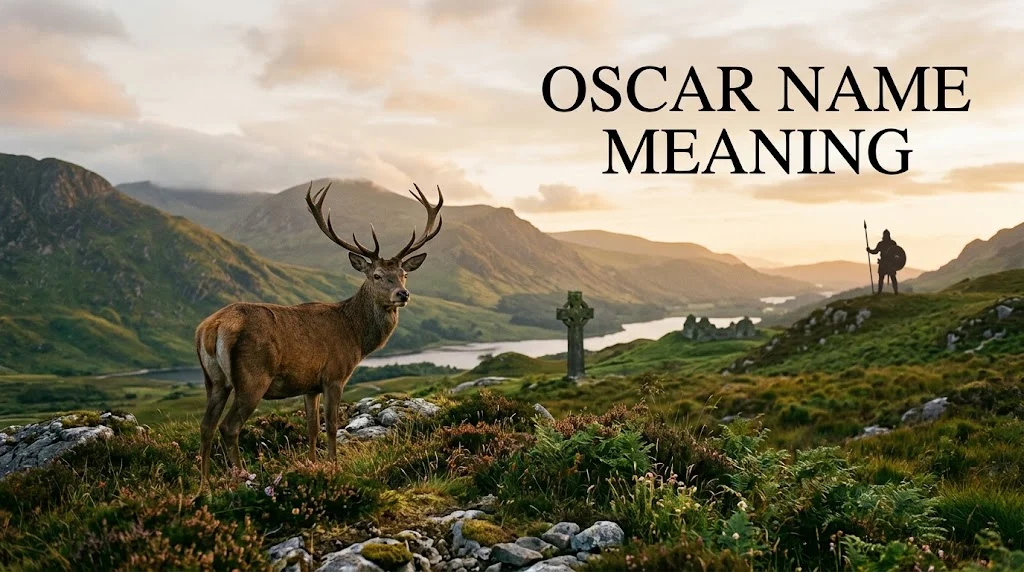
The Oscar name meaning is traditionally explained as “deer friend” or “friend of deer,” from an Irish tradition. It may also connect with the Old English name Osgar, meaning “god’s spear,” so its exact etymology has more than one historical explanation.
Some names feel familiar from the moment you hear them, and Oscar is one of them. It has a distinctive sound, a long history, and a meaning connected with nature and friendship. That combination gives the name a character that feels both traditional and approachable.
The Oscar name meaning is commonly linked to Irish and Gaelic traditions, where it is often explained as “friend of deer” or “deer-lover.” The name is also associated with the legendary Irish hero Oscar, grandson of the famous warrior Fionn mac Cumhaill, giving it an important place in Gaelic literary tradition.
Over the centuries, Oscar has traveled far beyond Ireland and become an established name in many English-speaking countries and European cultures. Its use among notable historical and literary figures has further strengthened its identity as a classic name.
In this guide, we’ll explore the Oscar name meaning, origin, history, pronunciation, cultural associations, personality traits, and popularity so you can understand what makes this name stand out.
Key Facts
| Fact | Details |
|---|---|
| Gender | Boy / Masculine |
| Meaning | Traditionally “deer friend” or “friend of deer”; also linked with “god’s spear” |
| Origin | Irish and Germanic traditions |
| Pronunciation | OSS-kar |
| Irish Connection | Oscar appears in Irish mythology as the grandson of Fionn mac Cumhaill |
| Common Forms | Oskar, Óscar, Óskar, Oskari, Oszkár |
| Short Form | Ossie |
What Is Oscar?
Oscar is a masculine given name used in English and several European languages. It appears in Irish, English, Portuguese, Italian, Scandinavian, Dutch, and French naming traditions, with spelling and pronunciation changing slightly from one language to another.
The name is especially associated with Ireland because of Oscar, the legendary warrior who appears in the Fenian tradition. He was the son of Oisín and grandson of Fionn mac Cumhaill.
At the same time, Oscar resembles older Germanic names such as Old English Osgar and Old Norse Ásgeirr. That resemblance created a second etymological tradition around the name.
So, Oscar should not be treated as having one universally proven meaning. The Irish and Germanic explanations both matter when discussing its history.
Oscar Meaning
The most familiar interpretation of Oscar is “deer friend” or “friend of deer.” This explanation connects the name with an Irish tradition involving the elements os and cara.
That interpretation gives Oscar a gentle natural image. Deer carry strong associations with the Irish mythological landscape, and the name’s connection to Irish heroic tradition gives the meaning more depth than the literal translation alone suggests.
There is another established explanation.
Oscar as “God’s Spear”
The Germanic interpretation links Oscar with Old English Osgar or Ōscār, built from elements associated with “god” and “spear.” Etymological sources therefore give the meaning “god’s spear” or “spear of the gods.”
This meaning has a very different character from “deer friend.” Instead of nature and companionship, it suggests strength, protection, and warrior imagery.
Because the name developed through different linguistic traditions, neither interpretation should simply be presented as the only possible answer.
Origin and Etymology
Oscar has a complicated etymological history because similar forms appear in both Celtic and Germanic naming traditions.
The Irish explanation traces Oscar to the medieval Irish name associated with the legendary character Oscar. Modern references commonly connect it with Irish elements meaning “deer” and “friend.” Irish naming sources continue to describe Oscar as a traditional Irish name with this interpretation.
The Germanic explanation traces Oscar to Osgar, an Old English personal name. Etymonline identifies Osgar as meaning “god’s spear,” from Old English elements connected with “god” and “spear.”
Old Norse Ásgeirr provides another related Germanic form. The name combines elements associated with the gods and a spear. Some sources therefore connect Oscar with this wider Germanic naming family.
The safest conclusion is that Oscar has more than one proposed historical source. Modern usage brings these traditions together, even though their original linguistic roots were not necessarily identical.
History and Cultural Context
Oscar’s Irish history begins with mythology. In the Fenian tradition, Oscar is the son of Oisín and grandson of Fionn mac Cumhaill. He belongs to the Fianna, the legendary warrior group associated with Fionn.
Oscar’s mythological character helped preserve the name within Irish cultural memory. He is portrayed as a formidable warrior, so the name carries both the natural image of “deer friend” and the heroic associations of its legendary bearer.
The name later reached a much wider European audience through James Macpherson’s Ossian poems in the 18th century. Those poems drew heavily on supposed ancient Gaelic traditions and became influential across Europe.
Napoleon was an admirer of the Ossianic material and selected Oscar for his godson, the future King Oscar I of Sweden. That royal connection helped the name gain a lasting place in Scandinavian naming culture.
From there, Oscar became familiar far beyond Ireland. Forms such as Oskar developed in several northern and central European languages, while Óscar became established in Spanish and Portuguese.
Examples of Oscar in Use
Oscar works naturally as both a traditional first name and a modern everyday name.
For example:
- Oscar James has a classic English-language feel.
- Oscar Liam combines an established first name with another short, familiar name.
- Oscar Wilde demonstrates the name’s long-standing use in literary culture.
- Oskar gives the name a distinctly Scandinavian or central European appearance.
- Óscar reflects Spanish and Portuguese spelling conventions.
The name also fits comfortably across generations. It can sound traditional on an older man while still feeling suitable for a child today.
Variants and Spellings
Oscar has several genuine forms across languages and naming traditions.
| Variant | Language or Region | Note |
|---|---|---|
| Oscar | English, Irish and several European languages | Standard international form |
| Oskar | German, Swedish, Norwegian, Danish and others | Common European variant |
| Óscar | Spanish, Portuguese | Form with an acute accent |
| Òscar | Catalan | Catalan form |
| Óskar | Icelandic | Icelandic form |
| Oskari | Finnish | Finnish form |
| Oszkár | Hungarian | Hungarian form |
| Ossie | English | Diminutive used for Oscar and some other Os- names |
These forms are not all pronounced identically. For instance, English usually gives Oscar a two-syllable pronunciation, while some European languages place a slightly different sound and stress pattern on the name.
Famous People Named Oscar
Several well-known figures have carried Oscar or a close spelling of the name.
- Oscar Wilde — Irish writer, poet, and playwright best known for works including The Picture of Dorian Gray and The Importance of Being Earnest.
- Oscar Peterson — Canadian jazz pianist and composer whose career made him one of the best-known musicians associated with the name.
- Oscar de la Hoya — American professional boxer and Olympic gold medalist.
- Oskar Schindler — German industrialist remembered for helping save Jewish people during the Holocaust.
- Oscar Pistorius — South African Paralympic athlete who also competed at the 2012 Olympic Games.
The range is striking: literature, music, boxing, wartime history, and athletics have all contributed famous bearers to the name.
Oscar vs. Related Terms
| Term | Meaning | How It Differs |
|---|---|---|
| Oscar | Traditionally “deer friend”; also linked to “god’s spear” | Main form discussed here |
| Oskar | European form of Oscar | Common in Germanic and Scandinavian languages |
| Óscar | Spanish and Portuguese form | Uses an accented spelling |
| Oskari | Finnish form related to Oscar | Distinct Finnish form |
| Oisín | Irish name associated with “little deer” | Related to Irish mythology but not a variant of Oscar |
| Osgar | Old English name associated with “god’s spear” | Germanic name linked etymologically with Oscar |
Frequently Asked Questions
Is Oscar an Irish name?
Yes. Oscar has a strong Irish connection through the legendary warrior Oscar, grandson of Fionn mac Cumhaill. Its traditional Irish interpretation is commonly given as “deer friend.”
What does the name Oscar mean?
Oscar is traditionally interpreted as “deer friend” or “friend of deer.” Another established etymological explanation connects it with Old English Osgar and the meaning “god’s spear.”
Is Oscar a boy or girl name?
Oscar is traditionally a boy’s name and is classified as masculine in major name references.
How do you pronounce Oscar?
In standard English, Oscar is usually pronounced OSS-kar, with two syllables. British and American English have slightly different vowel sounds, while other languages may pronounce it differently.
What is the Irish meaning of Oscar?
The traditional Irish interpretation is “deer friend” or “friend of deer.” The name also belongs to Irish heroic mythology through Oscar, the grandson of Fionn mac Cumhaill.
Is Oskar the same name as Oscar?
Yes. Oskar is a genuine form of Oscar used in several European languages, particularly Germanic and Scandinavian naming traditions.
Is Oscar a biblical name?
No. Oscar is not a biblical name. Its history comes from Irish and Germanic naming traditions rather than the Hebrew, Greek, or Aramaic names found in the Bible.
Conclusion
Oscar is a strong, established boy’s name with an unusually layered history. Its best-known meaning is “deer friend,” while its Germanic connection gives it the alternative sense “god’s spear.” Irish mythology, European literature, and centuries of international use have all helped make Oscar a name that feels both traditional and timeless.

1 thought on “Oscar Name Meaning| Origin, History, Pronunciation, and Significance For 2026”