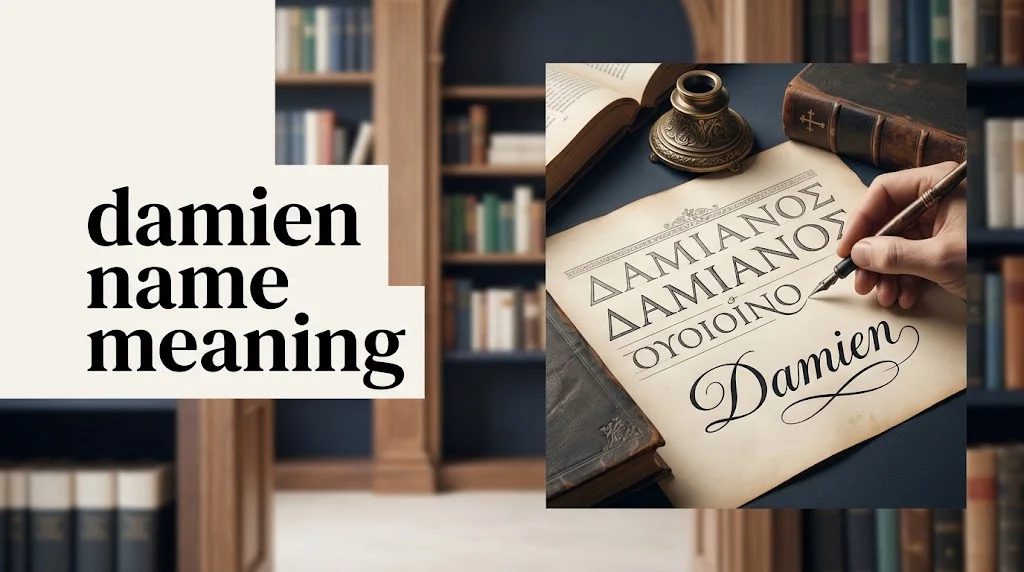
Damien means “to tame” or “to subdue” and comes from the Ancient Greek name Damianos, derived from damazō, meaning “to tame.” Damien is the French form of Damian and is traditionally a masculine given name.
The Damien name meaning comes from the Ancient Greek Damianos (Δαμιανός), a name connected with the Greek verb damazō, meaning “to tame.” The French form Damien developed from the same naming tradition as Damian.
The name has a long history behind its modern appearance. Its strongest historical association comes from Saint Damian, the Christian martyr remembered alongside his twin brother, Saint Cosmas. Over time, the name developed into several forms across European languages, with Damien becoming especially associated with French usage.
Key Facts
| Fact | Details |
|---|---|
| Gender | Boy / Masculine |
| Meaning | “To tame” or “to subdue” |
| Origin | Ancient Greek |
| Original Form | Damianos (Δαμιανός) |
| Pronunciation | DAY-mee-ən |
| French Form | Damien |
| Related Name | Damian |
| Religious Connection | Saints Cosmas and Damian |
What Is the Name Damien?
Damien is a masculine given name and the French form of Damian. Its original linguistic source is the Greek Damianos, which traces back to damazō, meaning “to tame.”
In practical terms, the name is often interpreted through ideas such as self-control, strength, discipline, and the ability to bring something under control. Those qualities are modern interpretations, though; they should not be confused with the literal historical meaning.
Damien is closely related to Damian, but the spellings reflect different language traditions. French uses Damien, while English commonly uses Damian and also uses Damien as an established given name.
Damien Name Meaning
The central meaning of Damien is “to tame” or “to subdue.” The meaning comes from the Greek verb damazō.
That original verb carries a stronger sense than the modern English word “tame” might suggest. It can relate to bringing something under control or overcoming resistance. As a personal name, therefore, Damien can be understood symbolically as a name associated with control, firmness, and strength.
Traditional Meaning
The traditional linguistic meaning is simply “to tame.” Some sources express it as “to subdue.” Both descriptions point back to the same Greek root.
Modern Interpretation
Parents may choose Damien because it sounds strong, refined, and established while still feeling distinctive. The literal meaning can lend the name a sense of determination and composure.
That symbolic interpretation belongs to modern naming culture rather than the original Greek definition.
Origin and Etymology
Damien ultimately comes from the Ancient Greek Δαμιανός (Damianos). Linguistic references connect Damianos with the Greek verb δαμάζω (damazō), meaning “to tame.”
The Greek form later appeared in Latinized forms such as Damianus. From there, related versions developed across European languages.
The name’s family includes Damian, Damiano, Damián, Damjan, and Damion. The exact spelling changes according to language and regional naming traditions, but these forms belong to the same broader name family.
Damien specifically is identified as the French form of Damian.
History and Cultural Context
Damien gained historical importance through early Christian tradition. Saint Damian and his twin brother Saint Cosmas were Christian martyrs associated with Syria in the early fourth century. Christian tradition remembers them together, and they became patron saints of physicians.
Their story helped the Damian name family spread beyond its Greek linguistic roots. As Christianity expanded through Europe, names connected with saints often moved between languages and regions.
Another historically significant bearer was Peter Damian, an 11th-century Italian cardinal and theologian. His prominence gave the name family another important connection within medieval Christian history.
The French spelling Damien reflects the later development of the name within French-speaking naming traditions. It therefore carries both an ancient Greek linguistic origin and a distinctly European history of use.
How Do You Pronounce Damien?
Damien is commonly pronounced: DAY-mee-ən
In phonetic form, an English pronunciation can be represented approximately as /ˈdeɪ.mi.ən/. The emphasis falls on the first syllable.
The pronunciation may vary slightly depending on the speaker’s accent and language. In French, the pronunciation naturally follows French phonetic patterns rather than the English pronunciation.
Examples of Damien in Use
Damien works naturally as a first name in both formal and everyday settings.
Examples include:
- Damien is starting university this year.
- Mr. Damien Carter spoke at the event.
- Damien and his brother play football together.
- The family chose Damien because they liked its traditional Greek origin.
The name also appears in literature, entertainment, music, and popular culture. That exposure has helped keep Damien recognizable across different English-speaking and European contexts.
Variants and Spellings
Damien belongs to a broad family of related names. The spelling often reveals the language or naming tradition behind it.
| Form | Language or Usage | Relationship |
|---|---|---|
| Damien | French | French form of Damian |
| Damian | English and several European languages | Main related form |
| Damianos | Ancient Greek | Original Greek form |
| Damianus | Latinized | Latin form |
| Damiano | Italian | Italian form |
| Damián | Spanish, Czech | Regional form |
| Damjan | Slovene, Croatian, Serbian, Macedonian | Regional form |
| Damion | English | Variant of Damian |
| Damião | Portuguese | Portuguese form |
These forms are documented as members of the same broader name family rather than unrelated names that merely happen to sound alike.
Famous People Named Damien
Several notable people have carried the exact spelling Damien, giving the name strong associations with music, film, and contemporary art.
- Damien Rice — Irish singer-songwriter and musician known for his solo work and albums including O and 9.
- Damien Chazelle — American-French filmmaker, screenwriter, and director of Whiplash and La La Land. He won the Academy Award for Best Director for La La Land.
- Damien Hirst — English contemporary artist and a prominent figure associated with the Young British Artists movement. He received the Turner Prize in 1995.
The spelling distinction matters here. Damian Lewis, for example, is a famous actor, but he uses the spelling Damian, not Damien.
Damien vs. Related Terms
| Term | Meaning | How It Differs |
|---|---|---|
| Damien | “To tame” or “to subdue” | French form of the Damian name family |
| Damian | “To tame” or “to subdue” | Common related form with wider English usage |
| Damianos | Greek form related to “to tame” | Ancient Greek source form |
| Damiano | Italian form of Damian | Italian-language variant |
| Damion | Variant of Damian | English spelling variation |
The relationship between these names is primarily linguistic. They developed through different languages and spelling conventions from the same historical name family.
Frequently Asked Questions
Is Damien a boy’s name?
Yes. Damien is traditionally a masculine or boy’s name. Reference sources classify the name as masculine and identify it as the French form of Damian.
What does the name Damien mean?
Damien means “to tame” or “to subdue.” The meaning comes from the Ancient Greek verb damazō, through the name Damianos.
Is Damien a French name?
Damien is the French form of Damian. Its deeper origin is Ancient Greek, so calling it simply “French in origin” would miss the earlier Greek source.
What is the Greek origin of Damien?
The Greek source is Damianos (Δαμιανός). Linguistic references connect Damianos with damazō, the Greek verb meaning “to tame.”
Is Damien the same name as Damian?
Yes, they belong to the same name family. Damien is specifically the French form of Damian, while Damian is used in English and several other languages.
Is Damien a biblical name?
Damien is not a biblical name in the sense of appearing as a personal name in the Bible. Its Christian importance comes primarily from saints such as Saint Damian, whose story became influential in Christian Europe.
What is the pronunciation of Damien?
In English, Damien is commonly pronounced DAY-mee-ən, with emphasis on the first syllable.
Is Damien a good name?
Damien is a strong choice for parents who want a traditional European name with an ancient Greek background. It has a clear pronunciation, several established international forms, and a long historical record.
Conclusion
Damien is a masculine name with an Ancient Greek root and a French form that developed from the name Damian. Its literal meaning, “to tame” or “to subdue,” gives it a strong traditional character, while its history connects it with Greek language, Christian saints, and several European naming traditions.
