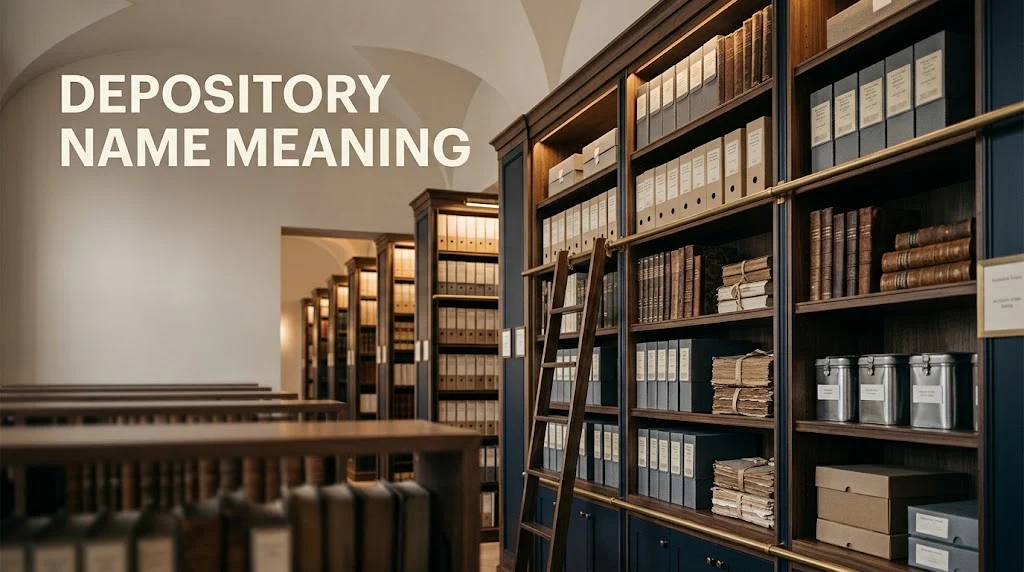
Depository means a place or system where things are kept safely, especially money, documents, goods, or other valuable materials. It comes from Latin roots connected with the idea of putting something down for safekeeping.
The depository name meaning points to a word rather than a traditional personal name. In standard English, depository means a place where something is stored or kept safely, such as documents, money, goods, or valuable materials. Cambridge defines it as a place, especially a large building, used for storing things.
That distinction matters when researching it as a possible name. A family could theoretically use Depository as an unusual personal name, character name, business name, or creative name, but dictionaries do not establish it as a conventional masculine, feminine, or unisex given name. Its established meaning comes from the language of storage and safekeeping.
Key Facts Box
| Fact | Details |
|---|---|
| Gender | Not applicable — Depository is not a conventional personal given name |
| Meaning | A place for storing or keeping something safely |
| Origin | English, from Medieval Latin depositorium |
| Pronunciation | dih-POZ-uh-tor-ee |
| Word Type | Common noun |
| Related Words | Deposit, depositary, repository, depositor |
What Is Depository?
A depository is a place designed to hold something securely. The word commonly describes buildings, facilities, institutions, or systems that store objects, records, money, goods, or information.
For example, a library archive can serve as a depository for historical documents. A secure facility can act as a depository for valuable materials. In financial language, a depository can refer to a place where money or official documents remain safely stored.
The word closely resembles repository, and the two can overlap in meaning. A repository generally emphasizes a place where information, objects, or materials are collected and kept. Depository emphasizes the act or purpose of depositing something for storage.
So, if someone encounters Depository as a personal name, they should understand that this is an unconventional use of an established English noun.
Depository Name Meaning
The central meaning of Depository is “a place for safekeeping” or “a place where things are stored.”
As a symbolic name, that meaning can suggest ideas such as protection, preservation, security, trust, and keeping something valuable safe. Those associations come from the ordinary meaning of the word rather than from an established naming tradition.
Literal Meaning
The literal meaning concerns storage. A depository receives something and keeps it in a particular place, often for protection or later use.
The word can apply to physical objects, records, money, goods, or other materials. Cambridge gives examples involving official documents, goods, and specialized storage facilities.
Symbolic Meaning
If someone deliberately chooses Depository as a creative name, the strongest symbolic association would be “keeper of valuable things.”
That interpretation works especially well for fictional characters, organizations, projects, or creative works. It should not be presented as an ancient personal-name meaning, because historical evidence does not establish such a naming tradition.
Origin and Etymology
Depository has a well-documented Latin-based history. Etymological sources trace the English noun to Medieval Latin depositorium, meaning a place where things are lodged or kept safely. It ultimately connects with Latin deponere, meaning “to lay aside,” “put down,” or “deposit.”
The Latin verb combines de- with ponere, meaning “to put” or “place.” The same linguistic root appears in several English words associated with putting, placing, or setting something somewhere.
The English noun depository is recorded from around 1750 in the sense of a place used for safekeeping.
This history gives the word a straightforward semantic development: something is placed somewhere safely, and the place that receives it becomes a depository.
History and Cultural Context
Depository developed primarily as a practical English word rather than a personal naming tradition. Its history belongs to the vocabulary of storage, property, records, commerce, finance, and safekeeping.
Over time, its use expanded beyond simple physical storage. Modern English can use depository for places holding documents, goods, money, official records, or specialized materials. Cambridge also records the business use of the term for places where money or official documents can be stored securely.
The related phrase depository institution has a specific financial meaning. It describes a bank or other financial organization that accepts customers’ money and pays interest on funds kept there.
Therefore, the cultural associations of the word tend to center on security, preservation, responsibility, and storage, rather than on a particular ethnic, religious, or naming tradition.
Examples
The word appears naturally in several contexts:
- Historical records: “The museum became a depository for rare documents.”
- Government records: “The files were transferred to a secure depository.”
- Goods: “The facility operates as a depository for stored merchandise.”
- Finance: “The institution serves as a depository for customer funds.”
- Creative naming: An author might use Depository as the name of a fictional archive or secure facility.
As a personal name, it would be highly unusual. Parents looking for a traditional given name would normally encounter related names rather than Depository itself.
Variants and Spellings
Depository does not have a well-established set of personal-name variants because it is primarily a common noun.
However, several genuine related forms exist:
- Depositary — a closely related form that can refer to a place or, in some contexts, an entity entrusted with something. Cambridge treats depositary as a related form of depository.
- Deposit — the root-related word describing something placed or left for safekeeping, including money placed in a bank.
- Depositor — a person or company that puts money into a bank account or makes a deposit.
- Repository — a closely related word for a place where things, particularly information or materials, are kept.
- Depot — a different but related storage term for a building where supplies or vehicles are kept.
These words should not be treated as alternate spellings of the personal name Depository.
Famous People Named Depository
There are no well-established famous people known by Depository as a personal given name.
That absence fits the linguistic evidence. Depository functions as an English common noun, not as a recognized traditional personal name. If a fictional character or modern individual receives the word as a personal name, that would represent an unusual individual naming choice rather than an established naming tradition.
Depository vs. Related Terms
| Term | Meaning | How It Differs |
|---|---|---|
| Depository | A place for storing things safely | Emphasizes storage or safekeeping |
| Repository | A place where things or information are kept | Often associated with collections, records, or information |
| Depositary | A person or place entrusted with something | Can describe the holder or custodian, depending on context |
| Depot | A building where supplies or vehicles are kept | More commonly associated with supplies, transport, or distribution |
| Depositor | A person or organization that makes a deposit | Refers to the person making the deposit, not the storage place |
The distinction between depository and depositor is particularly useful. A depository is the place or institution holding something, while a depositor is the person or organization that puts something there.
Frequently Asked Questions
Is Depository a real name?
Depository is a real English word, but it is not a conventional personal given name. Its established dictionary meaning refers to a place where things are stored safely.
What does Depository mean as a name?
If someone uses Depository creatively as a name, it can symbolize a keeper of valuable things, protection, preservation, or safekeeping. Those are symbolic interpretations rather than traditional personal-name meanings.
What is the origin of Depository?
Depository entered English through Medieval Latin depositorium. The word ultimately connects with Latin deponere, meaning “to put down,” “lay aside,” or “deposit.”
How do you pronounce Depository?
A common English pronunciation is dih-POZ-uh-tor-ee. Cambridge gives UK and US pronunciation variants reflecting differences in English pronunciation.
Is Depository a boy’s or girl’s name?
Neither classification applies in the traditional sense. Depository is not an established masculine or feminine given name, so it is more accurate to describe its gender as not applicable.
Is Depository a biblical or religious name?
There is no established biblical personal name called Depository. The word belongs to English vocabulary concerning storage and safekeeping rather than to a biblical naming tradition.
What names are related to Depository?
The closest linguistic relatives include deposit, depositor, depositary, and repository. These words share concepts connected with placing, keeping, storing, or entrusting something.
Can Depository be used as a baby name?
A family could technically choose it as an unconventional name, but it would be highly unusual. Its ordinary English meaning refers to a storage place, so parents considering it should understand that people are likely to recognize the word before interpreting it as a personal name.
Conclusion
Depository is fundamentally an English word meaning a place or system for keeping something safely, with roots reaching back to Latin deponere. It is not a traditional boy’s or girl’s name, and there is no established cultural naming tradition behind it. As a creative name, though, it can suggest protection, preservation, trust, and the keeping of something valuable.

1 thought on “Depository Name Meaning Explained: Origin, Definition & Examples For 2026”