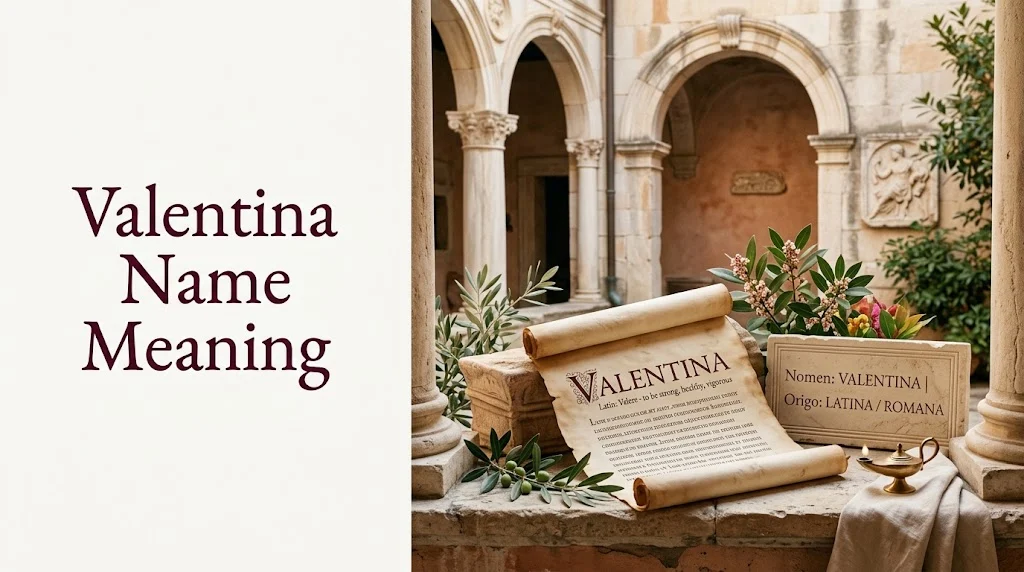
Valentina is a feminine name of Latin origin meaning “strong,” “healthy,” or “vigorous.” It comes from the Roman name Valentinus, which derives from the Latin valens.
The Valentina name meaning comes from the Latin valens, a word associated with being strong, healthy, and vigorous. Valentina developed as the feminine form of the Roman name Valentinus and later became established across several European languages and naming traditions.
The name combines an ancient Roman foundation with a distinctly feminine form that remains familiar in Italian, Spanish, Russian, Greek, Balkan, and other European communities. Its meaning gives it a natural association with strength and vitality rather than a narrowly religious or occupational idea.
Key Facts
| Fact | Details |
|---|---|
| Gender | Girl / Feminine |
| Meaning | Strong, healthy, vigorous |
| Origin | Latin / Ancient Roman |
| Pronunciation | va-len-TEE-na |
| Related Names | Valentine, Valentin, Valentino, Valentinus |
| Common Usage | Italian, Spanish, Russian, Greek, and several European languages |
What Is the Name Valentina?
Valentina is a feminine given name derived from Valentinus, an Ancient Roman name. Linguistically, it belongs to the same name family as Valentine, Valentin, and Valentino.
The underlying Latin element valens carries the sense of being strong, healthy, or vigorous. That makes the name’s traditional meaning fairly direct: Valentina expresses the idea of strength and good health rather than a symbolic meaning invented in modern naming culture.
Valentina is not simply another spelling of Valentine. Valentine functions as a separate given name in English and can be masculine or feminine, while Valentina specifically serves as a feminine form in many languages.
Valentina Name Meaning
The central meaning of Valentina is “strong” or “healthy.” The Latin root also supports the broader sense of vigorous, robust, or possessing strength.
Traditional Meaning
In its historical linguistic setting, the name connects with the Latin valens. The word relates to the verb valeo, associated with being strong or well. Consequently, Valentina carries an old meaning connected with physical strength, health, and vitality.
Modern Meaning
Modern parents may interpret Valentina more broadly. Strength can suggest resilience, confidence, courage, and inner character. Those qualities represent modern associations, though they should not replace the name’s documented Latin meaning.
The name therefore works on two levels: its historical meaning is strength and health, while its contemporary appeal often comes from the graceful sound and positive qualities people associate with those ideas.
Origin and Etymology
Valentina has an Ancient Roman and Latin origin. It is the feminine form of Valentinus, a Roman name that later became connected with the wider Valentine family of names.
The linguistic chain can be summarized simply:
valens → Valentinus → Valentina
The Latin valens supplies the core sense of strength or health. Valentinus developed as a Roman personal name, and Valentina emerged as its feminine counterpart.
The same family produced forms such as Valentin, Valentine, and Valentino in different linguistic traditions. The forms differ in pronunciation and grammatical gender, but they share the same historical family.
History and Cultural Context
Valentina has a long connection with European naming traditions because the Valentinus family became established in Christian-era Europe. The name family also connects with Saint Valentine, a Christian martyr traditionally associated with February 14.
That connection helped make Valentine-related names culturally recognizable, although the original Latin meaning of strength predates the modern romantic associations surrounding Valentine’s Day.
Valentina appears in a wide range of European languages and cultures. Recorded usage includes Italian, Russian, Lithuanian, German, Croatian, Bulgarian, Macedonian, Slovenian, Albanian, Romanian, Spanish, and Greek, among others.
The name’s geographical range is one reason it feels familiar across different parts of Europe while retaining a recognizable classical character.
Examples
Valentina works naturally as a first name in several naming styles.
- Valentina Maria — a traditional combination with a graceful rhythm.
- Valentina Rose — pairs the classical first name with a floral middle name.
- Valentina Grace — combines the Latin name with a virtue-style middle name.
- Valentina Sofia — creates a distinctly European-sounding combination.
In everyday conversation, a person named Valentina might use a shortened form such as Vale in some cultures. Nickname practices vary by language and family, so not every Valentina will use a short form.
The name also fits well beside related names such as Valentina and Elena, Valentina and Lucia, or Valentina and Sofia, particularly in European-inspired sibling naming.
Variants and Spellings
Valentina belongs to a broad family of related names rather than existing in isolation.
| Form | Language / Tradition | Relationship |
|---|---|---|
| Valentina | Italian, Spanish, Russian, Greek, and others | Feminine form |
| Valentinus | Ancient Roman | Historical masculine source |
| Valentine | English and other traditions | Related form |
| Valentin | Several European languages | Masculine related form |
| Valentino | Italian | Masculine related form |
| Valentín | Spanish and some other traditions | Related form |
| Walentyna | Polish | Regional feminine form |
| Valentīna | Latvian | Regional feminine form |
The exact spelling and pronunciation change according to local language rules. Behind the Name records Valentina across numerous European naming traditions and identifies it specifically as the feminine form of Valentinus.
Famous People Named Valentina
Several notable women have carried the name Valentina.
- Valentina Tereshkova — Soviet cosmonaut who became the first woman to travel into space when she flew aboard Vostok 6 in June 1963. NASA records that her mission completed 48 orbits of Earth.
- Valentina Lisitsa — Ukrainian-born classical pianist known internationally for her concert career and extensive online performances. Decca Classics documents her work with major concert venues and recordings.
- Valentina Cervi — Italian film and television actress known for productions including Jane Eyre and True Blood.
These examples show how the name appears across very different fields, from space exploration and classical music to acting.
Valentina vs. Related Terms
| Term | Meaning | How It Differs |
|---|---|---|
| Valentina | Strong, healthy, vigorous | Feminine form of Valentinus |
| Valentine | Related to strength and health | English form; can be masculine or feminine |
| Valentin | Related to strength and health | Masculine form used in several languages |
| Valentino | Related to Valentinus | Italian masculine form |
| Valentinus | Roman name connected with valens | Historical Latin source of Valentina |
Frequently Asked Questions
What does the name Valentina mean?
Valentina means “strong,” “healthy,” or “vigorous.” Its meaning comes from the Latin valens through the Roman name Valentinus.
Is Valentina a girl’s name?
Yes. Valentina is a feminine given name and is used as the feminine form of Valentinus in numerous languages.
What is the origin of Valentina?
Valentina has Latin and Ancient Roman origins. It developed from Valentinus, which belongs to the Latin valens name family.
How do you pronounce Valentina?
A simple English pronunciation is va-len-TEE-na. Pronunciation changes somewhat between languages; for example, Italian and Russian pronunciations differ.
Is Valentina related to Valentine?
Yes. Valentina and Valentine belong to the same historical name family. Both trace back to Valentinus and ultimately to the Latin valens.
Is Valentina an Italian name?
Valentina is strongly established in Italian, but it is not exclusively Italian. Historical and modern usage extends across Spanish, Russian, Greek, Slavic, Balkan, and other European naming traditions.
What is a nickname for Valentina?
Vale is a common short form in some naming traditions. Other nicknames depend on the language, family, and personal preference.
Is Valentina a biblical name?
Valentina is not a biblical name. It comes from the Latin Roman name Valentinus. Its later cultural association with Saint Valentine comes from Christian history rather than from the Bible itself.
Conclusion
Valentina has a clear classical foundation: its Latin roots connect the name with strength, health, and vitality, while its long use across Europe gives it a rich cultural presence. For parents seeking a feminine name with an established history and a positive meaning, Valentina offers both classical depth and modern elegance.
