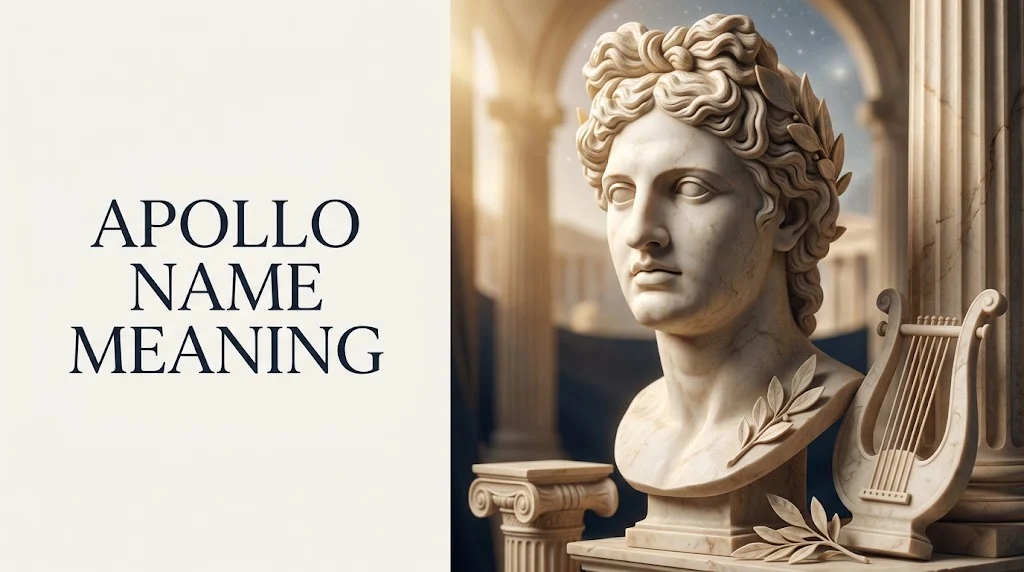
Apollo is a masculine name of Greek origin associated with the Greek god Apollo, who represented music, poetry, prophecy, healing, and the sun in ancient Greek tradition. The name carries associations with light, creativity, knowledge, and artistic talent. Parents often choose Apollo for its strong mythological roots and distinctive sound.
The Apollo name meaning is closely associated with ancient Greek mythology, where Apollo was a major god linked to music, poetry, prophecy, healing, and light. The name has a powerful classical identity and often evokes intelligence, creativity, beauty, and strength. Although people frequently connect Apollo with the sun, his mythology includes many other important roles, making the name richer than a simple reference to sunlight.
Apollo is traditionally used as a masculine given name. Parents may choose it because of its Greek heritage, distinctive sound, mythological associations, or connection to exploration through NASA’s Apollo space program. Its combination of ancient history and modern recognition gives it a timeless, memorable quality.
This guide explores the meaning of Apollo, its linguistic background, its place in Greek and Roman mythology, its cultural symbolism, pronunciation, nicknames, related names, and practical considerations for choosing it for a child.
What Is Apollo?
Apollo is a masculine name best known as the name of an important deity in ancient Greek religion and mythology. The Greeks associated Apollo with music, poetry, prophecy, healing, archery, and the protection of certain communities. His Roman counterpart was also called Apollo, an unusual case in which Rome retained the Greek god’s name.
As a personal name, Apollo carries associations with artistic ability, knowledge, harmony, vitality, and divine inspiration. These are symbolic associations drawn from mythology rather than guaranteed characteristics of someone who bears the name.
The name is recognizable across many modern cultures because of its mythological heritage and its appearance in literature, art, astronomy, and space exploration.
Apollo may appeal to parents who want a name that feels:
- Classical: It comes from a tradition that has influenced Western literature and art for centuries.
- Powerful: Its connection to a prominent mythological deity gives it a strong identity.
- Creative: Apollo’s association with music and poetry adds an artistic dimension.
- Distinctive: It is more unusual in everyday conversation than many traditional names such as James or William.
- Meaningful: Its history offers several themes parents can connect with their hopes for a child.
However, Apollo does not have one universally accepted literal English translation. Its historical meaning is closely connected to the deity, and the deeper etymology of the Greek name remains uncertain.
Apollo Name Meaning and Symbolism
The Apollo name meaning is best understood through the qualities and responsibilities ancient Greeks associated with the god. Rather than representing one simple dictionary definition, Apollo’s name evokes a collection of mythological ideas.
1. Light and radiance
Apollo became strongly associated with light, brightness, and the ability to reveal what is hidden. These associations make the name appealing to people who connect it with clarity, hope, wisdom, and a bright future.
Apollo is also frequently called a sun god in modern descriptions. However, Greek mythology distinguished him from Helios, the personification of the sun. Apollo’s identification with the sun became especially prominent over time, and the two figures should not be treated as identical in every early tradition.
For a baby name, light provides a positive symbolic interpretation without establishing a definitive literal translation.
2. Wisdom and prophecy
Apollo was a god of prophecy, and his sanctuary at Delphi became one of the most influential religious centers in ancient Greece. People consulted the Delphic Oracle about matters ranging from personal decisions to political affairs.
This connection gives Apollo an association with insight, foresight, and the pursuit of knowledge. Parents who value learning or thoughtful decision-making may find this aspect of the name particularly appealing.
3. Music and artistic expression
Apollo was closely associated with music, poetry, and the arts. Ancient Greek traditions often depicted him holding a lyre, a stringed musical instrument.
He also became a leader or patron of the Muses, divine figures associated with artistic and intellectual inspiration. Through these relationships, Apollo developed a lasting connection with musical harmony, creative expression, and refined artistic skill.
This symbolism makes Apollo a natural choice for families who appreciate music, literature, and the creative arts.
4. Healing and protection
Apollo had an important role in healing and purification. Ancient Greeks invoked him in religious contexts connected with health, recovery, and protection from disease.
His identity also included a more formidable side: myths portray him as an archer capable of bringing punishment as well as protection. His character therefore combines healing with divine power rather than presenting him as a purely gentle figure.
For modern naming purposes, these traditions can suggest resilience, restoration, and strength.
5. Strength and excellence
Apollo’s myths often portray him as skilled, disciplined, beautiful, and powerful. He was an accomplished musician and archer, and his divine status made him an important figure among the Olympian gods.
Consequently, modern interpretations of the name may include excellence, confidence, ambition, and leadership. These are contemporary symbolic readings of the mythology, not formal translations of the name itself.
Apollo Name Origin and Etymology
Apollo comes from the Greek name Apollōn (Ἀπόλλων). Ancient Greek mythology and religious practice provide the name’s best-established historical context, but scholars have not reached a definitive conclusion about its ultimate linguistic origin.
Some ancient writers and later interpreters connected Apollo with Greek words or concepts associated with destruction, assembly, or unity. These explanations reflect historical attempts to interpret the name; they do not establish a universally accepted etymology.
The safest explanation is that Apollo is an ancient Greek divine name whose original linguistic meaning remains uncertain.
Greek roots and ancient usage
Apollo was worshipped in various parts of the Greek world, and his name appears in ancient religious, literary, and artistic traditions. His importance extended beyond a single city or region.
As Greek culture spread and influenced other societies, stories about Apollo traveled through poetry, drama, sculpture, philosophy, and religious practice. The name consequently became familiar beyond its original linguistic setting.
Greek and Roman forms
The Greek form is Apollōn, while Latin uses Apollo. Roman religion incorporated the deity and retained the name Apollo, alongside adapting some aspects of his worship to Roman cultural settings.
English uses the familiar Latin form, Apollo, which is also the standard spelling commonly encountered in modern baby-name references.
Does Apollo literally mean “sun”?
Not precisely. Apollo is strongly associated with sunlight in later mythology and modern popular culture, but scholars do not generally treat “sun” as an established literal translation of the name.
The distinction matters because a name’s symbolic associations can develop over centuries without becoming its original linguistic definition.
For parents seeking a name associated with sunlight, Apollo remains a reasonable symbolic choice. For those who specifically require a name that literally means “sun,” it is worth comparing names whose etymologies more directly support that meaning.
Apollo in Greek Mythology

Apollo was one of the major Olympian gods in Greek mythology. His stories shaped ancient Greek religious life and later influenced Roman culture, European literature, Renaissance painting, sculpture, and modern storytelling.
Apollo’s family
In the best-known Greek traditions, Apollo was the son of Zeus, king of the gods, and Leto, a goddess associated with motherhood. His twin sister was Artemis, who was associated with hunting, wilderness, and childbirth.
The myths surrounding Apollo and Artemis connect the siblings with divine skill, protection, and powerful roles in the natural and human worlds.
Apollo’s family relationships also link him to other central figures in Greek mythology, including Zeus, Hera, and the wider community of Olympian deities.
Apollo and the Delphic Oracle
One of Apollo’s most important religious associations was Delphi, where his oracle became famous throughout the ancient Greek world.
People traveled to consult the oracle on important questions, although the responses were often open to interpretation. Delphi was not simply a location in a myth; it was a real sanctuary that played a significant role in ancient Greek religion.
This history reinforces Apollo’s connection with prophecy, guidance, and the search for knowledge.
Apollo and the arts
Ancient art often portrays Apollo with a lyre or a laurel wreath. The lyre represents his musical associations, while the laurel became connected with victory and poetic achievement.
The god’s association with the Muses further strengthened his place in artistic culture. Later generations adopted Apollo as a symbol of artistic refinement, intellectual achievement, and classical beauty.
Apollo and the sun
Apollo is frequently described as the Greek sun god today, but the relationship between Apollo and solar imagery developed over time. Helios had a more direct early association with the sun itself.
As Greek religious and literary traditions evolved, Apollo increasingly acquired solar characteristics. This later identification became influential in Roman and subsequent European representations.
Understanding this development helps explain why modern depictions of Apollo often emphasize sunlight, golden colors, and radiant imagery.
History and Cultural Significance of the Name Apollo
Apollo’s history reaches far beyond baby naming. His name has appeared in religious traditions, classical literature, visual art, scientific terminology, and modern popular culture.
Ancient Greek society
In ancient Greece, Apollo was worshipped through sanctuaries, festivals, offerings, and other religious practices. His cults varied by location, and his responsibilities were not identical in every tradition.
The Pythian Games at Delphi were held in Apollo’s honor and became an important athletic and cultural event. They included musical and artistic competitions alongside athletic contests in different historical periods.
Through these traditions, Apollo became associated with excellence, performance, and public recognition.
Roman culture
Roman society adopted Apollo into its religious world. The god retained his Greek name and many of his established associations, including music, prophecy, and healing.
Roman writers and artists helped preserve Apollo’s stories and imagery. Their works later contributed to the renewed interest in classical mythology during the Renaissance.
Art, literature, and architecture
Apollo became a recurring subject in European art and literature. Artists portrayed him as a youthful, idealized male figure, often with a lyre, bow, or laurel wreath.
His image came to represent artistic achievement, order, beauty, and classical ideals. These associations remain visible in museums, public monuments, books, and modern visual design.
The NASA Apollo program
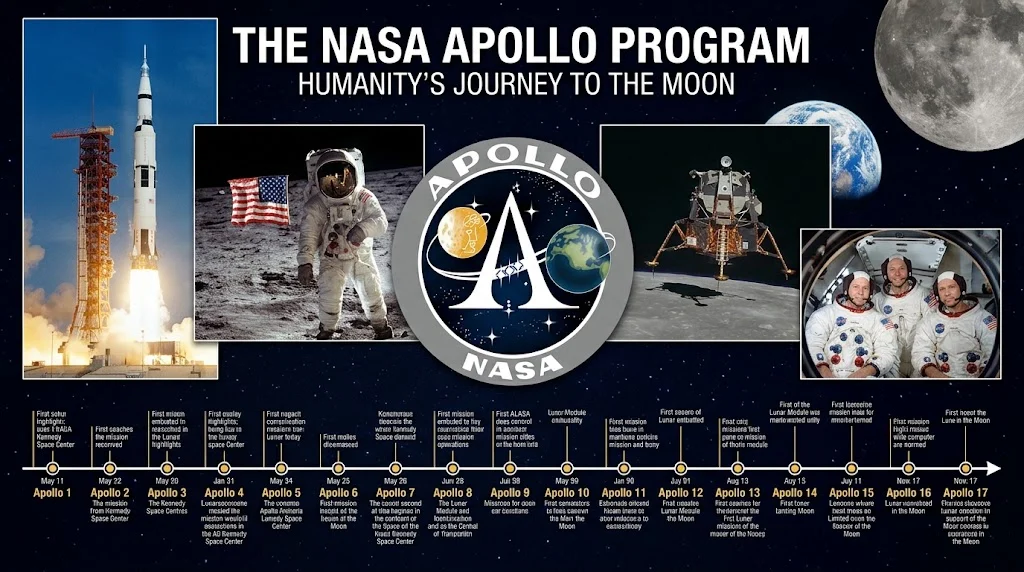
The name gained additional international recognition through NASA’s Apollo program, the American human spaceflight initiative that included the first crewed Moon landing in 1969.
NASA selected the name Apollo in 1960. According to historical accounts of the program’s naming, the choice drew on the god’s associations with majestic journeys and his role as a figure linked to light across the heavens.
The Apollo program gave the name a modern association with exploration, discovery, engineering, and human achievement. For some parents, these connections are just as appealing as its ancient mythology.
Apollo as a modern given name
Today, Apollo is used as a personal name in English-speaking countries and beyond. It can feel traditional because of its classical roots while also sounding distinctive in a modern setting.
Parents may choose it for its sound, its mythological heritage, or its associations with creativity and exploration. Others may simply like its memorable spelling and pronunciation.
Its cultural recognition can be an advantage, although some people may immediately associate the name with the Greek god or the Moon missions.
Apollo Name Pronunciation and Spelling
Apollo is generally pronounced uh-POL-oh in English, with the emphasis on the second syllable.
Name
Apollo
Pronunciation
/əˈpɒl.oʊ/
Syllables
A-pol-lo (3)
Name type
Masculine given name
Language association
Greek
Pronunciation can vary slightly across English-speaking regions. In American English, the middle syllable often sounds like “pahl,” while other accents may pronounce its vowel differently.
The spelling is straightforward and widely recognizable. Most English speakers will identify Apollo with the mythological figure, although the name’s use in space exploration provides another familiar association.
Apollo Name Meaning for a Boy
Apollo is traditionally a masculine name, and its mythological background gives it several positive symbolic associations for a boy.
Parents may interpret the name as representing:
- Wisdom: Inspired by Apollo’s association with prophecy and knowledge.
- Creativity: Connected with music, poetry, and artistic expression.
- Courage: Inspired by his powerful role among the Olympian gods.
- Healing: Reflecting his traditional role as a deity associated with health and purification.
- Exploration: Inspired by the NASA Apollo missions and their historic achievements.
- Brightness: Connected with Apollo’s later association with the sun and light.
These meanings are interpretive rather than literal definitions. The name does not determine a child’s personality, talents, or future.
Is Apollo a strong baby name?
Apollo can be a strong choice for parents who appreciate names with a clear historical identity. It has three syllables, a recognizable spelling, and a distinctive sound.
It also offers several possible naming themes. A family may focus on mythology, artistic creativity, intellectual curiosity, or space exploration, depending on what makes the name meaningful to them.
One consideration is that Apollo has a pronounced mythological identity. Some parents love this association, while others prefer a name with a less prominent historical reference.
Apollo Nicknames and Variations
Apollo already has a distinctive sound, so some families prefer to use the full name. However, informal nicknames can make it feel more relaxed in everyday conversation.
| Nickname | Style or impression |
|---|---|
| Ap | Very short and casual |
| Apo | Friendly and simple |
| Pol | Distinctive and brief |
| Polly | Playful; may not suit every preference |
| Polo | Modern-sounding and informal |
These are possible family-created nicknames rather than universally established traditional diminutives.
Related forms and spellings
Apollo does not have a widely established English equivalent that preserves exactly the same meaning. Its historical forms include Greek Apollōn and Latin Apollo.
Parents may also encounter the name in other languages through adaptations of Greek and Latin classical names. Spelling and pronunciation can differ according to local conventions.
When choosing a form, consider whether you want to preserve the classical spelling or prefer a variation that fits your family’s language and naming traditions.
Names Similar to Apollo
If Apollo appeals to you, other mythological and classical names may offer a similar sense of history or symbolism.
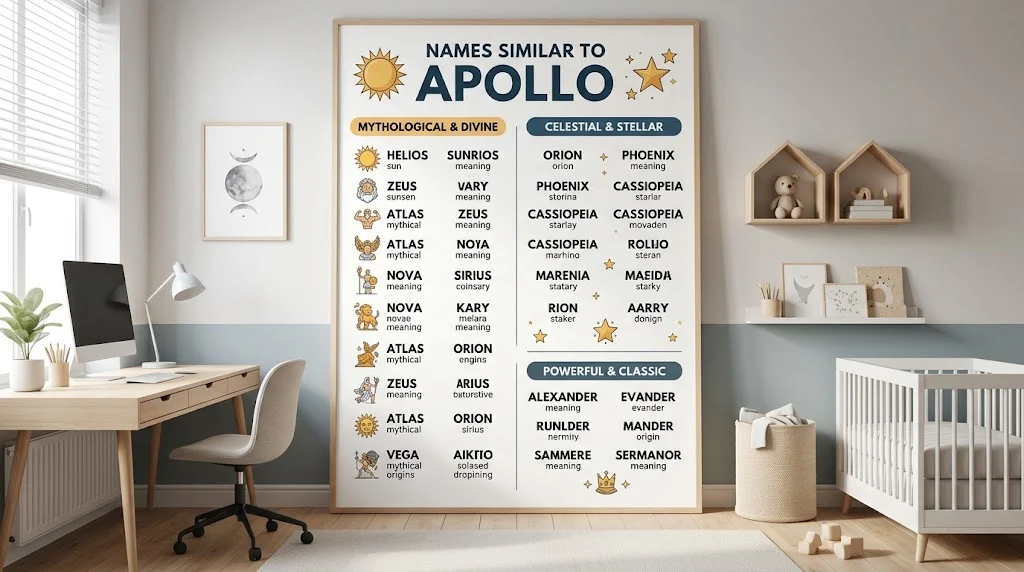
Atlas
A Greek mythological name associated with the Titan who was condemned to bear the heavens in well-known classical traditions. It can evoke endurance and strength.
Orion
A name associated with a hunter in Greek mythology and with a prominent constellation. It shares Apollo’s connection to the classical world and the night sky.
Helios
The Greek personification of the sun. This is a particularly relevant alternative for parents who prefer a name with a more direct solar association.
Hermes
The Greek god associated with communication, travel, commerce, and messages. Like Apollo, Hermes has a rich mythological background.
Alexander
A historically established Greek-origin name meaning “defender of men.” It offers classical roots with a long history of use as a personal name.
The best alternative depends on the quality you value most. Atlas emphasizes mythological strength, Orion evokes the stars, Helios has a direct solar connection, Hermes represents communication, and Alexander has a well-established historical meaning.
Apollo vs. Related Names and Terms
The name Apollo is sometimes confused with other mythological names or descriptions of the god. These distinctions clarify their meanings.
| Name or term | Meaning or association | Difference from Apollo |
|---|---|---|
| Apollo | Greek god associated with music, prophecy, healing, and more | The central name discussed in this article |
| Apollōn | Ancient Greek form of Apollo’s name | The Greek-language form |
| Helios | Personification of the sun in Greek mythology | More directly represents the sun |
| Sol | Roman personification of the sun | A distinct Roman solar deity |
| Artemis | Greek goddess associated with hunting and wilderness, among other roles | Apollo’s twin sister in major mythological traditions |
| Atlas | Titan associated with bearing the heavens | A different mythological figure |
| Orion | Mythological hunter and constellation | A figure connected with a separate set of myths |
These names share classical or mythological connections, but they are not interchangeable. Their origins, roles, and symbolic meanings differ.
Is Apollo a Popular Baby Name?
Apollo is recognizable in contemporary naming, but its popularity depends on the country, year, and data source. It would be misleading to describe it as universally common or rare without specifying the relevant location and period.
In the United States, the Social Security Administration publishes annual baby-name rankings based on Social Security card applications. Those records provide a useful way to check Apollo’s popularity for a particular year.
Popularity is only one consideration when choosing a name. Some parents prefer a name that many people recognize, while others want something distinctive without being difficult to spell or pronounce.
Apollo occupies an interesting position because its classical history is familiar to many people, even if they do not frequently encounter it as a personal name.
Things to Consider Before Choosing Apollo
Before giving a child the name Apollo, consider how it fits your family’s preferences and everyday life.
- Meaning: Its associations with creativity, wisdom, healing, and light can make it appealing.
- Pronunciation: Most English speakers can learn the pronunciation quickly, although accents differ.
- Spelling: Apollo has a recognizable and relatively simple spelling.
- Cultural associations: The Greek god and NASA’s Moon missions are likely reference points for many people.
- Nicknames: Informal forms such as Apo or Polo are available, although preferences vary.
- Middle-name combinations: Apollo pairs naturally with shorter middle names, but the best combination depends on the surname and the family’s style.
- Long-term suitability: Consider whether you like the full name for a child, teenager, and adult, rather than only as a baby name.
For example, Apollo James combines a mythological first name with a familiar middle name, while Apollo Alexander creates a longer combination with classical roots in both names.
There is no single correct pairing. Reading the full name aloud and considering initials can help you decide whether it works well in practice.
Final Thoughts
The Apollo name meaning draws its depth from ancient Greek mythology, where Apollo was associated with music, poetry, prophecy, healing, archery, and eventually strong solar imagery. Its original linguistic meaning remains uncertain, but its cultural history is well established.
As a modern masculine given name, Apollo combines classical heritage with contemporary associations of creativity, discovery, and achievement. Its connection to NASA’s Apollo program adds another layer of significance for families who value exploration and scientific progress.
Ultimately, Apollo is a distinctive choice for parents who appreciate mythology, history, and a name with several meaningful associations. Understanding both its historical background and its modern use can help families decide whether it suits their child.
FAQs
1. What does the name Apollo mean?
Apollo is an ancient Greek name associated with a major god of music, poetry, prophecy, healing, and light. Its ultimate linguistic meaning remains uncertain, although its mythological symbolism is well documented.
2. What is the origin of the name Apollo?
Apollo comes from the ancient Greek name Apollōn. The Romans also used the name Apollo and adopted many aspects of the god’s Greek mythology and worship.
3. Is Apollo a Greek name?
Yes. Apollo has ancient Greek origins and is best known as the name of a major Greek deity. The name also became established in Roman culture and remains recognizable internationally.
4. Is Apollo a boy’s name?
Apollo is traditionally a masculine given name. Modern parents may choose it for its mythological background, distinctive sound, and associations with creativity, knowledge, and exploration.
5. Does Apollo mean sun?
Not as an established literal translation. Apollo became strongly associated with the sun and light, particularly in later traditions, but his original name has no universally accepted etymological meaning of “sun.”
6. How do you pronounce Apollo?
In English, Apollo is generally pronounced uh-POL-oh, with the emphasis on the second syllable. Regional accents may produce slight differences in the vowel sounds.
7. Who were Apollo’s parents?
In the best-known Greek mythological traditions, Apollo was the son of Zeus and Leto. His twin sister was Artemis, the goddess associated with hunting and wilderness.
8. What are some nicknames for Apollo?
Possible nicknames include Apo, Ap, Pol, Polo, and Polly. These are informal options rather than a fixed set of traditional diminutives.
9. Is Apollo a good name for a baby?
Apollo may suit parents looking for a distinctive masculine name with classical roots and rich symbolism. Its associations with art, wisdom, healing, and exploration give it several possible interpretations.
10. What names are similar to Apollo?
Names with related classical or mythological appeal include Atlas, Orion, Helios, Hermes, and Alexander. Each has a different origin or set of associations, so the best choice depends on the meaning and style you prefer.
