Yuki is a Japanese given name that can mean “snow,” “happiness,” or “good fortune,” depending on the Japanese characters used to write it. It is a gender-neutral name associated with beauty, purity, joy, and positive wishes.
The Yuki name meaning depends on the Japanese characters used to write it. Yuki is a Japanese given name commonly associated with meanings such as “snow,” “happiness,” “good fortune,” or “hope,” depending on its kanji. It can be used for girls and boys, making it a versatile choice for parents who appreciate short Japanese names with meaningful interpretations.
Yuki has a gentle sound and a simple spelling, but its meaning can be surprisingly varied. One version may evoke freshly fallen snow, while another may express happiness or good fortune. Understanding the Japanese writing system helps explain why the same name can carry different meanings.
This guide explores Yuki’s meaning, linguistic origins, pronunciation, cultural background, gender usage, spelling variations, and related Japanese names. It also explains what to consider when choosing Yuki for a baby.
What Is Yuki?
Yuki is a Japanese given name written in Roman letters. Its meaning is determined largely by the Japanese characters selected to represent it, rather than by the sound alone.
In Japanese, a name may be written using kanji, hiragana, or katakana. Kanji are characters associated with meanings, while hiragana and katakana are phonetic writing systems. Consequently, two people named Yuki may have different written names and different intended meanings.
For example:
- 雪 (yuki): Snow.
- 幸 (yuki): Happiness or good fortune, when used with the reading yuki.
- 由紀 (Yuki): A combination of kanji whose interpretation depends on the meanings and naming conventions associated with the individual characters.
These examples illustrate an important distinction: a Japanese name’s pronunciation does not automatically determine its exact written meaning.
Yuki is also found as a family name, although this article focuses primarily on its use as a given name. Its short length, straightforward pronunciation, and range of possible meanings make it recognizable to people beyond Japan.
Yuki Name Meaning: What Does Yuki Mean?
The meaning of Yuki varies with its spelling in Japanese. Snow, happiness, and good fortune are among the interpretations most closely associated with the name.
Yuki Meaning “Snow”
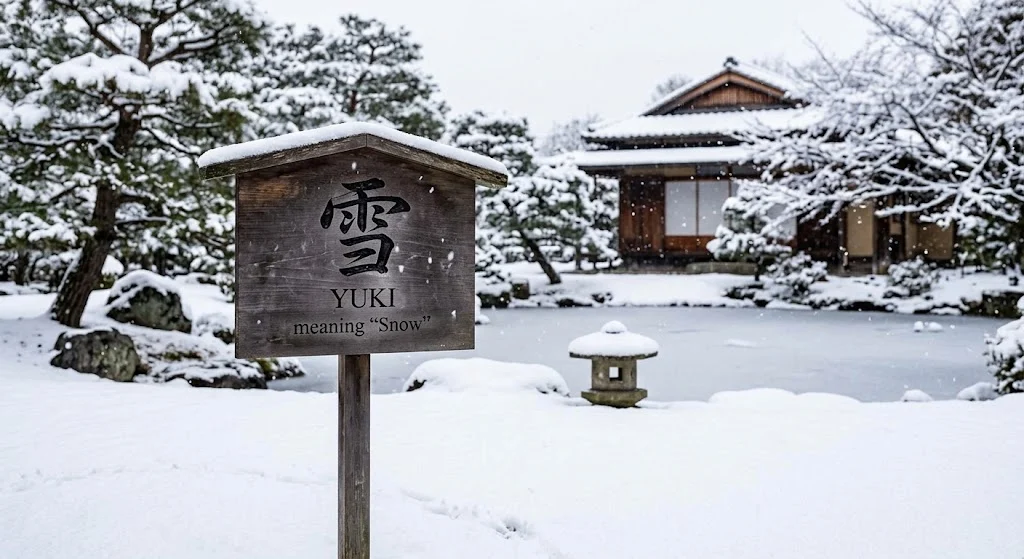
雪 — Snow
The kanji 雪 means “snow,” and its Japanese reading includes yuki. This version of the name may appeal to parents who love winter, quiet landscapes, and the clean, delicate appearance of snow.
Snow can suggest several personal associations, including calmness, purity, freshness, and a peaceful beginning. These are symbolic interpretations rather than fixed definitions of the name.
The image of snow also fits the name’s soft, understated sound. For parents seeking a nature-inspired Japanese name, this is one of Yuki’s most recognizable interpretations.
Yuki Meaning “Happiness” or “Good Fortune”

幸 — Happiness or good fortune
The kanji 幸 is associated with happiness, good fortune, and being fortunate. When it is used with the reading Yuki, the name can express a wish for a joyful and fortunate life.
This interpretation gives the name a warm and positive meaning. Parents who value happiness, well-being, and good fortune may find this version especially appealing.
However, the character’s meaning should not be treated as a guarantee of personality or future success. It represents a meaning chosen or associated with the name, not a prediction about the person who bears it.
Yuki Meaning “Hope”
Hope is sometimes associated with Yuki in baby-name explanations, but it is not the direct dictionary meaning of every Japanese spelling of the name.
The exact interpretation depends on the characters selected. Some name combinations may convey ideas that parents interpret as hopeful or uplifting, but the kanji should be checked individually before assigning this meaning.
If “hope” is the most important meaning for your family, choosing the Japanese characters deliberately is more reliable than relying on a general English-language baby-name listing.
Yuki as a Symbolic Name
Beyond its literal meaning, Yuki can carry personal significance through the associations a family attaches to it.
Depending on the intended spelling, parents might associate the name with:
- The peaceful beauty of snow.
- Happiness and good fortune.
- Simplicity and elegance.
- A connection to Japanese language or culture.
- A fresh start or a cherished family memory.
These associations are personal interpretations, not universal Japanese beliefs about everyone named Yuki.
Yuki Name Origin and Etymology
Yuki originates as a Japanese name and is closely connected to the Japanese language. Its etymology is best understood through the writing system and the individual characters used in a particular person’s name.
Japanese Linguistic Roots
Japanese names often combine sounds with kanji selected for their meanings, established readings, or both. Yuki is a good example of why the written form matters.
The pronunciation yuki can correspond to the Japanese word for snow, written 雪. It can also represent a given name written with other kanji, including characters associated with happiness or with other meanings.
The name therefore does not have one universal translation that applies to every person called Yuki.
Why Kanji Changes the Meaning
Kanji are logographic characters used in Japanese writing. Many have multiple readings, and a character’s reading can depend on the word, name, and context in which it appears.
Consider the following examples:
| Japanese spelling | Reading | Meaning or interpretation |
|---|---|---|
| 雪 | Yuki | Snow |
| 幸 | Yuki, in an appropriate name reading | Happiness or good fortune |
| 由紀 | Yuki, as a name reading | Depends on the individual character meanings and intended interpretation |
| ゆき | Yuki | Phonetic spelling in hiragana |
| ユキ | Yuki | Phonetic spelling in katakana |
The table illustrates possible forms, not a claim that every combination is equally common or appropriate for every naming situation.
For a person whose name is written in hiragana or katakana, the spelling conveys the pronunciation without specifying the same kind of kanji-based meaning.
Is Yuki Related to Yuuki?
Yuki and Yuuki are related in sound and can overlap in Japanese naming, but they are not necessarily interchangeable spellings.
Yuuki is another romanization used for Japanese names, often reflecting a longer vowel sound. Depending on the kanji, Yuuki may carry meanings associated with courage, gentleness, happiness, or other concepts.
The distinction matters because Japanese vowel length can affect pronunciation and word identity. When writing someone’s name, it is best to follow their preferred Roman spelling rather than assuming Yuki and Yuuki are identical.
History and Cultural Context of the Name Yuki
Yuki belongs to a broader Japanese naming tradition in which sound, written characters, family preferences, and personal symbolism can all influence a name’s selection.
Yuki in Japanese Naming Traditions
Japanese given names do not always have a single meaning attached to their pronunciation. Parents may choose characters for their meanings, sounds, aesthetic qualities, or a combination of these factors.
For example, one family might choose 雪 because they love the winter season. Another might choose 幸 because happiness and good fortune are important to them. Both may use the reading Yuki, yet the written names communicate different ideas.
This flexibility is one of the distinctive features of Japanese personal names. It also means that a name’s meaning should be interpreted through its actual spelling whenever possible.
The Cultural Association With Snow
When written as 雪, Yuki directly connects to snow, a familiar feature of winter in many parts of Japan. Snow-covered mountains, winter gardens, and seasonal landscapes are part of the country’s varied natural environment.
The aesthetic associations of snow can include quietness, delicacy, and beauty. These impressions may influence how a parent understands the name, although they should not be mistaken for a universal cultural interpretation.
A person named Yuki does not necessarily have a connection to winter, and the name does not automatically communicate a particular personality. Its significance depends on the individual, the family, and the chosen spelling.
Yuki in Contemporary Japanese Culture
Yuki is recognizable as a Japanese personal name and appears in contemporary settings, including literature, entertainment, and fictional storytelling. It is also familiar to international audiences through Japanese films, animation, games, and popular culture.
However, a name’s visibility in media is not the same as evidence of its popularity among babies. Character names may influence international recognition, but current naming trends need to be evaluated separately using reliable registration data.
For families outside Japan, Yuki may offer a way to appreciate Japanese language and naming aesthetics. When selecting it for a child, it is worth learning how the name is written and pronounced rather than relying only on its appearance in English.
Is Yuki a Boy’s Name or a Girl’s Name?
Yuki can be a boy’s name or a girl’s name in Japanese. It is not exclusively masculine or feminine.
The gender association can depend on the kanji, the person’s generation, family preferences, and the broader naming context. Different spellings may also create different impressions, so it is best not to assume that every person named Yuki has the same gender.
Yuki as a Girl’s Name
Parents considering Yuki for a girl may appreciate its short length, soft sound, and associations with snow, happiness, or good fortune.
The spelling 雪 is particularly appealing to people looking for a nature-inspired name. A spelling using 幸 may suit families who prefer a name associated with happiness.
Yuki can also work well internationally because it is relatively compact and does not require a complicated English spelling.
Yuki as a Boy’s Name
Yuki is also used as a masculine given name. Its suitability for a boy depends on the family’s preferences and the specific Japanese spelling chosen.
Parents should be cautious about assuming that the name must mean “courage” or “bravery.” Those meanings are more directly associated with certain other kanji combinations and readings, including some names romanized as Yuuki. They are not the universal meaning of Yuki.
Is Yuki Gender-Neutral?
Yes. In general English-language naming discussions, Yuki can reasonably be described as gender-neutral because it is used for both boys and girls.
That description does not mean the name has precisely the same gender associations in every Japanese community or naming context. If you are choosing it for a child, checking the intended characters and consulting a knowledgeable Japanese speaker can help you make a more informed decision.
How to Pronounce Yuki
Yuki is generally pronounced YOO-kee, with two syllables.
Yuki
Phonetic guide: YOO-kee
- Yu: Sounds approximately like “you.”
- Ki: Sounds like “key.”
- Syllables: Two — Yu-ki.
Japanese pronunciation differs slightly from English because Japanese vowels are generally pronounced more consistently than their English equivalents. The sounds are usually short and clear, without strong stress on one syllable.
For an English speaker, “YOO-kee” is a useful approximation. The precise pronunciation may vary slightly with an individual’s accent or language background.
Common Pronunciation Mistakes
- Pronouncing the first syllable like the English word “yuck.”
- Giving the name three syllables instead of two.
- Adding an unnecessary final vowel after the “i.”
- Pronouncing Yuki as if it were automatically identical to Yuuki.
If you are using the name for a real person, their own pronunciation is the best guide.
Yuki Name Variations and Spellings
Yuki has several written forms, but it is important to distinguish between a different script, a different kanji spelling, and a genuinely different name.
| Form | Type | Explanation |
|---|---|---|
| Yuki | Romanization | The standard Roman-letter form discussed in this article |
| 雪 | Kanji | Means “snow” and can be read Yuki |
| 幸 | Kanji | Associated with happiness and good fortune; reading depends on the name |
| 由紀 | Kanji combination | A possible spelling of a Japanese given name |
| ゆき | Hiragana | Phonetic Japanese spelling |
| ユキ | Katakana | Phonetic Japanese spelling |
| Yuuki | Alternative romanization | Often represents a longer vowel and may have different kanji and meanings |
Not every form should be treated as a direct translation of another. If a child is officially given a name using specific kanji, those characters are part of the name’s identity.
Yuki vs. Yuuki
The most noticeable difference is the vowel length. In Japanese, a long vowel can change the pronunciation and sometimes distinguish words or names.
Yuuki is not simply a decorative variation that can always be substituted for Yuki. Its written characters and intended meaning should be checked separately.
Can Yuki Be Written in English?
Yes. Yuki is commonly represented in English using Roman letters. The Romanized spelling is convenient for passports, school records, introductions, and international communication.
However, a Roman spelling does not always communicate the full meaning of the original Japanese name. If the meaning matters to you, keep a record of the intended Japanese characters and their interpretation.
Personality Traits and Symbolism Associated With Yuki
Parents sometimes explore the personality or symbolism associated with a baby name before making a final choice. With Yuki, the symbolism depends on the intended spelling and the personal associations behind it.
These interpretations are subjective. A name cannot reliably predict a person’s temperament, talents, future, or behavior.
Calmness and Purity
When Yuki is written as 雪, the association with snow can evoke calmness, delicacy, and a clean natural landscape. Parents may appreciate these qualities as symbolic associations.
Happiness and Positivity
When the chosen characters express happiness or good fortune, the name can serve as a reminder of the family’s hopes for the child.
This interpretation may feel especially meaningful to parents who want a name with a positive message rather than one tied to a particular personality trait.
Simplicity and Elegance
Yuki is short and relatively easy to say. Some parents are drawn to names that feel understated rather than elaborate, and Yuki may suit that preference.
Its visual simplicity in Roman letters also makes it adaptable to many international settings.
Individual Meaning
The most meaningful interpretation may come from the reason the family chose the name. A name could honor a loved one, reflect a favorite season, or represent a cherished value.
That personal story can be just as significant to a family as the literal meaning of the kanji.
Is Yuki a Good Name for a Baby?
Yuki can be an appealing baby name for parents who appreciate Japanese names, short spellings, and meanings connected with nature or positive values.
Whether it is the right choice depends on your cultural connection, preferred meaning, pronunciation, and practical needs.
Reasons Parents May Choose Yuki
- Short and memorable: The name contains four Roman letters and two syllables.
- Flexible gender usage It is used for both boys and girls.
- Meaningful kanji options: Parents can select a spelling that reflects a particular idea.
- Nature-inspired interpretation: 雪 offers a direct association with snow.
- International usability: The Romanized spelling is relatively simple to read and write.
What to Consider Before Choosing It
Think about the intended Japanese spelling first. If you want the name to mean snow, for example, 雪 is more precise than selecting a spelling simply because an English baby-name website lists the same meaning.
Also consider how the name will be pronounced by family members and classmates, whether it fits with the surname, and whether you want to preserve the original Japanese spelling in personal records.
If you do not have a Japanese-language background, learning about the name’s linguistic context can help you use it thoughtfully and avoid relying on inaccurate translations.
Ultimately, Yuki can be a meaningful choice when its sound, spelling, and associations match what you want the name to express.
Yuki Compared With Related Japanese Names
If you like Yuki but want to compare it with other Japanese names, the following options offer different sounds and meanings. The exact interpretation of any Japanese name may depend on its written characters.
| Name | Common meaning or association | Why parents may like it |
|---|---|---|
| Haru | Spring; other meanings depend on kanji | A seasonal, gentle-sounding name |
| Sora | Sky, when written 空 | A nature-inspired name |
| Hikari | Light, when written 光 | A name associated with brightness |
| Aiko | Often associated with love and child through 愛子 | A traditional Japanese feminine name |
| Akira | Can be associated with brightness or clarity, depending on kanji | A name used by multiple genders |
| Yuna | Meaning varies with the selected characters | A short, modern-sounding option |
| Ren | Can mean lotus when written 蓮 | A concise name with a nature connection |
| Yuuki | Meaning depends on its kanji | A similar-sounding alternative to Yuki |
These names are not exact equivalents of Yuki. They are alternatives for parents who appreciate Japanese names and want to explore other sounds, meanings, or naming styles.
FAQs
What does the name Yuki mean in Japanese?
Yuki can mean “snow” when written as 雪. Other spellings can express meanings such as happiness or good fortune. The intended Japanese characters determine the precise meaning.
Is Yuki a Japanese name?
Yes. Yuki is a Japanese given name used for both boys and girls. Its pronunciation can be represented by different Japanese characters, each with its own meaning or interpretation.
Is Yuki a boy’s name or a girl’s name?
Yuki is used for both boys and girls. Its gender association can depend on the written form, personal preference, and cultural context.
What is the spiritual meaning of Yuki?
There is no single established spiritual meaning for every person named Yuki. Some people associate the snow spelling with purity or peace, while a spelling associated with happiness may symbolize good fortune. These are interpretations rather than universal beliefs.
How do you pronounce Yuki?
Yuki is generally pronounced YOO-kee, with two syllables. This is an English approximation of the Japanese pronunciation.
Does Yuki mean snow?
Yes. 雪 is the Japanese kanji for snow and can be read yuki. However, not every person named Yuki uses this character, so the meaning depends on the spelling.
What is the difference between Yuki and Yuuki?
Yuuki often represents a longer vowel sound than Yuki. Both can be used as Japanese names, but their pronunciation, kanji, and meanings may differ. They should not automatically be treated as interchangeable.
Is Yuki a rare name?
Its rarity depends on the country, generation, and naming context. Yuki is recognizable in Japan, but a reliable assessment of its current popularity requires up-to-date naming statistics for the specific region.
What are the different ways to write Yuki in Japanese?
Writers can represent Yuki using kanji, such as 雪 or other character combinations, or write it phonetically in hiragana (ゆき) or katakana (ユキ). The chosen writing system determines how the name appears, while the kanji characters convey its intended meaning.
Is Yuki a good name for a baby?
Yuki may be a good choice for parents who like short Japanese names, flexible gender usage, and meanings associated with snow or happiness. Choosing the intended Japanese characters helps ensure the name expresses the meaning you want.
Conclusion
The Yuki name meaning depends on its Japanese spelling, with “snow,” “happiness,” and “good fortune” among its possible interpretations. Its short pronunciation and use for both boys and girls make it a flexible naming choice. For parents considering Yuki, the most important step is to choose the Japanese characters that best express the meaning and cultural connection they value.
