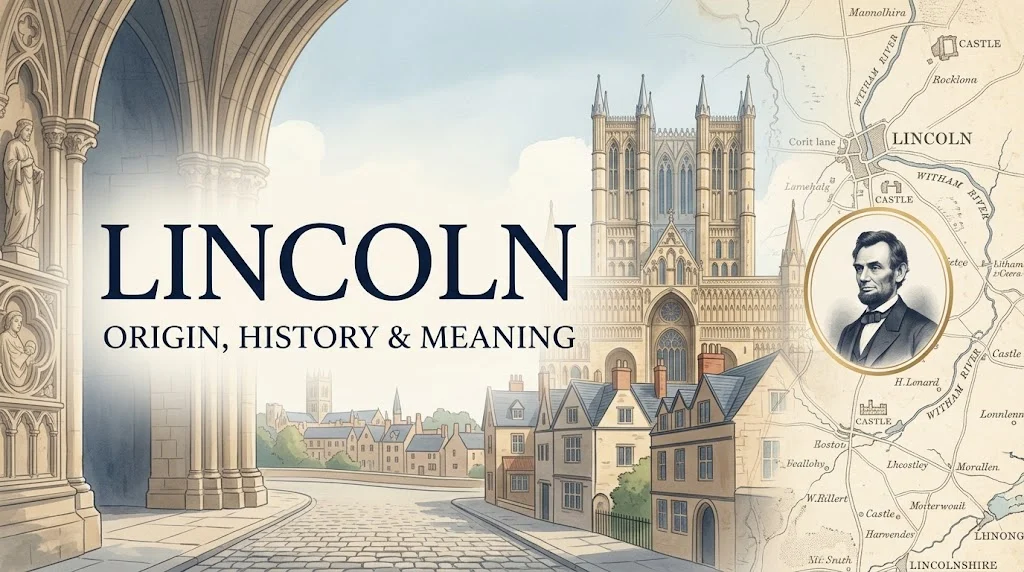
Lincoln means “town by the pool” or “settlement by the lake.” It comes from the Old English place name Lincoln, which developed from the Roman name Lindum Colonia. The name has traditionally been used for boys and is widely associated with Abraham Lincoln, the 16th president of the United States.
Some names stand out because of their sound, while others carry a rich history that makes them memorable. The name Lincoln offers both qualities, combining an established English heritage with a strong association with leadership and integrity. Its roots trace back to the historic English city of Lincoln, whose name developed from an earlier Roman settlement.
Parents exploring the Lincoln name meaning often want to know more than its definition. They may also be curious about its origin, pronunciation, cultural significance, and popularity as a baby name. Lincoln is traditionally masculine, although modern naming choices can vary. Its connection to Abraham Lincoln has also helped give it lasting recognition in English-speaking countries.
This guide explores the meaning and history of Lincoln, explains its linguistic roots, and examines its pronunciation, nicknames, popularity, and related names. These details will help you decide whether Lincoln is the right choice for your baby or simply understand the story behind this distinctive name.
What Does the Name Lincoln Mean?
Lincoln is primarily a geographical name derived from the name of the English city of Lincoln, located in Lincolnshire. Its traditional etymology is associated with the Celtic element Lindon, often interpreted as referring to a pool or lake, combined with the Latin name Lindum Colonia, used during the Roman period.
As a personal name, Lincoln is often associated with heritage, strength, dignity, and leadership. These associations come largely from its historical use and famous bearers rather than from a literal translation of the modern name.
Here are the essential facts about Lincoln:
- Name: Lincoln
- Origin: English place name, with Celtic and Latin historical roots
- Traditional meaning: Associated with a settlement near a pool or lake
- Pronunciation: LING-kuhn
- Common gender association: Masculine
- Name type: Place name and surname used as a given name
- Familiar nickname: Link
- Famous namesake: Abraham Lincoln, the 16th U.S. president
The exact historical development of the name involves several linguistic stages. Therefore, it is more accurate to explain Lincoln through the history of its place name than to assign it a single, unquestionable literal translation.
Lincoln Name Meaning and Symbolism
The Lincoln name meaning has both a geographical foundation and a broader cultural significance. Its original roots relate to a place, while its modern associations reflect the people, institutions, and traditions connected with the name.
The Traditional Meaning of Lincoln
Lincoln’s etymology traces back to the ancient name of the settlement that became the English city of Lincoln. The early Celtic name is generally reconstructed as Lindon, which is commonly associated with a pool or lake. The Romans later used Lindum Colonia for the settlement.
Over time, the place name developed into the modern English form, Lincoln. The name therefore reflects the history of a location rather than a personal characteristic or occupation.
Some baby-name sources simplify Lincoln’s meaning to “lake settlement” or “town by the pool.” These descriptions can help communicate the traditional association, but they should not be treated as exact word-for-word translations of the modern name.
What Does Lincoln Symbolize Today?
Although the name does not literally mean “leader” or “strength,” many people associate it with these qualities because of its historical and cultural connections.
Common modern associations include:
- Leadership: Abraham Lincoln’s presidency strongly influences the name’s public image.
- Integrity: His reputation for honesty contributes to the name’s association with principled conduct.
- Tradition: The name’s long geographical and family-name history gives it a classic quality.
- Confidence: Its firm opening sound and clear pronunciation can make it feel strong.
- Heritage: Its English roots connect it with place-based naming traditions.
These are interpretations rather than official meanings. Parents may choose Lincoln because of its history, sound, family connections, or personal significance without attaching any symbolic meaning to it.
Is Lincoln a Religious Name?
Lincoln is not primarily a religious name. Its established origin is geographical, and it is not traditionally identified as a biblical name.
Families from different religious and cultural backgrounds may still use it. If parents want a name with a specific religious meaning, they should distinguish Lincoln’s English place-name origin from names whose meanings come directly from religious texts or traditions.
Lincoln Name Origin and Etymology
Lincoln has a long history that connects Celtic language, Roman Britain, and the development of English place names. Its evolution helps explain why the name has a geographical meaning rather than a direct personal translation.
Celtic Roots and the Name Lindon
Before the Romans established their settlement in the area, the place was associated with an earlier name generally reconstructed as Lindon. Linguists commonly connect this name with a Celtic word for a pool or lake.
This connection provides the foundation for the traditional interpretation of Lincoln’s name. However, ancient place names can be difficult to interpret with complete certainty because languages change, written records vary, and later speakers adapt older names to their own pronunciation.
The name’s early geographical association is therefore the most useful starting point for understanding its meaning.
Roman Influence: Lindum Colonia
During the Roman period, the settlement became known as Lindum Colonia. The Romans established a significant settlement there, and the Latin form incorporated the earlier place name.
The word colonia was associated with a Roman colony or settlement. The historical name reflects the Roman presence in Britain and the development of the settlement that later became Lincoln.
As the region changed linguistically and politically, the name evolved. The modern English spelling emerged through this longer process rather than from a single naming event.
How Lincoln Became a Personal Name
Lincoln first had a geographical identity. Like many English place names, it eventually became associated with people who lived in or came from the area.
Place-based surnames developed throughout England as communities needed ways to distinguish individuals. Someone connected with Lincoln might acquire the name as a surname, although the exact circumstances varied by family and historical period.
Later, English-speaking families began using surnames as first names. This naming practice helped establish Lincoln as a given name.
Its development follows a recognizable pattern:
- Ancient place name: The settlement was associated with the early name Lindon.
- Roman period: The form Lindum Colonia reflected the Roman settlement.
- English place name: The name developed into Lincoln.
- Surname tradition: Geographic associations helped establish Lincoln as a family name.
- Modern given name: Parents began using Lincoln as a first name, especially for boys.
This history illustrates how a name can retain its identity while moving between different naming categories.
History and Cultural Significance of Lincoln
Lincoln’s history includes its development as an English place name, its adoption as a surname, and its growing recognition as a personal name. Its associations differ depending on whether people encounter it through geography, family history, or public figures.
Lincoln as an English Place Name
The city of Lincoln stands in Lincolnshire, England. Its history extends through pre-Roman Britain, Roman occupation, and later English periods.
The city’s name has remained recognizable across centuries, even as its spelling and linguistic context developed. This continuity gives Lincoln a strong connection with English geographical heritage.
For people researching family ancestry, Lincoln may indicate a historical connection to the city or the surrounding region. However, a person with Lincoln as a surname does not necessarily have a direct or documented family connection to the city.
Surnames can spread across regions through migration, marriage, and changing family circumstances. The name alone cannot establish a person’s ancestry.
Abraham Lincoln and American History

One of the strongest cultural influences on the name is Abraham Lincoln. Born in 1809, he served as the 16th president of the United States from 1861 until his assassination in 1865.
Lincoln led the country during the American Civil War. His presidency is closely associated with preserving the Union and the movement toward ending slavery, including the Emancipation Proclamation and the passage of the Thirteenth Amendment.
His historical legacy gives the name Lincoln associations with leadership, perseverance, public service, and freedom. These connections explain why some parents choose the name in admiration of the president or the values they believe he represents.
Still, a child’s name does not determine personality or character. These symbolic associations reflect cultural interpretation, not a prediction about the person who bears the name.
Lincoln as a Modern First Name
Lincoln has become familiar as a first name in English-speaking countries, particularly in the United States. It fits the wider tradition of using surnames and place names as given names.
Parents may find it appealing for several reasons:
- It sounds traditional without feeling overly old-fashioned.
- It has a recognizable spelling and a straightforward pronunciation.
- It offers short nickname options, particularly Link.
- It carries historical significance without being exclusively religious or mythological.
- It works well with many styles of middle and last names.
Lincoln also fits comfortably alongside other surname-style first names, such as Harrison, Hudson, Carter, and Bennett. Each has a different history, but all can appeal to parents who prefer established names with a contemporary feel.
Is Lincoln a Boy’s Name or a Girl’s Name?
Lincoln is most commonly used as a masculine given name, especially in the United States and other English-speaking communities.
Some parents may use traditionally masculine names for girls, and naming conventions continue to evolve. However, Lincoln remains predominantly associated with boys.
Families choosing the name should consider their own preferences, local naming customs, and how they want the name to be understood in their community.
How to Pronounce Lincoln
The standard English pronunciation of Lincoln is LING-kuhn.
It contains two syllables:
- Ling: The first syllable receives the main stress.
- Kuhn: The second syllable sounds like “kuhn,” with a reduced vowel.
The written letters do not correspond to a fully pronounced “col” sound. In ordinary English pronunciation, the middle sequence is simplified, so speakers say LING-kuhn rather than pronouncing every written letter separately.
Common Pronunciation Mistakes
People unfamiliar with the name may try to pronounce each letter or give the second syllable too much emphasis. The standard pronunciation keeps the name short and places the stress on the first syllable.
Because Lincoln is also the name of a well-known American president and several cities, many English speakers already recognize its pronunciation.
In multilingual households, family members may naturally adapt the sounds to their native languages. That does not change the name’s standard English pronunciation.
Lincoln Nicknames and Variations
Lincoln has a distinctive sound, but it also offers several shorter forms that work in family, school, and social settings.
Popular Lincoln Nicknames
- Link: A short, modern nickname that preserves the opening sound.
- Linc: A simple spelling variation of Link.
- Lin: A softer, shorter option.
- Linky: An informal, affectionate nickname that some families may prefer.
- Lenny: A less direct option that could develop through family preference rather than established linguistic tradition.
Link and Linc are the most straightforward choices because they come directly from the name’s opening sound.
Not every Lincoln needs a nickname. The full name is already relatively compact, so many people may simply use Lincoln in everyday conversation.
Spelling Variations
Lincoln has a stable, familiar spelling in English. Unlike names that have multiple established spellings across languages, it does not have a widely accepted set of equivalent English forms.
You may encounter creative spellings or family-specific adaptations, but these should not automatically be treated as traditional variants.
If simplicity matters, the standard spelling is usually the clearest choice for school records, official documents, and everyday communication.
Middle Names That Pair Well With Lincoln
The name’s two syllables and strong consonant sounds allow it to work with many middle names.
| Style | Middle name examples |
|---|---|
| Classic | Lincoln James, Lincoln Thomas, Lincoln Henry |
| Modern | Lincoln Hayes, Lincoln Carter, Lincoln Mason |
| Traditional | Lincoln Edward, Lincoln Charles, Lincoln William |
| Short and simple | Lincoln Jack, Lincoln Cole, Lincoln Reid |
| Nature-inspired | Lincoln River, Lincoln Forrest, Lincoln Rowan |
These combinations are suggestions based on sound and style, not established historical pairings. Parents should also consider the full name’s rhythm, initials, family traditions, and surname.
Examples of Lincoln in Everyday Use
Understanding how Lincoln works in different contexts can help parents decide whether it suits their family.
Lincoln as a Baby Name
A parent might choose Lincoln because they appreciate American history, prefer English-origin names, or want a name that sounds confident without being complicated.
For example:
“Lincoln James has a traditional sound, while the nickname Link gives him a more casual option as he grows up.”
This example illustrates how the full name can feel formal while a nickname provides flexibility.
Lincoln as a Surname
Lincoln also appears as a family name. In this context, it may reflect geographical ancestry or a surname passed down through generations.
For example:
“Her family records showed that the Lincoln surname appeared in documents from several generations earlier.”
This use is separate from the name’s modern role as a first name.
Lincoln as a Place Name
Lincoln can refer to the English city, other places named Lincoln, or institutions and landmarks that use the name.
For example:
“They planned a visit to Lincoln to explore the city’s historic architecture.”
Capitalization and context help readers determine whether Lincoln refers to a person, a family, or a location.
Lincoln in a Sentence
Here are a few additional examples:
- “Lincoln chose a book about American presidents for his history project.”
- “The family named their newborn son Lincoln after a beloved relative.”
- “Link is the nickname Lincoln uses with his closest friends.”
- “The surname Lincoln appears in several historical records.”
These examples show how the same word can function as a given name, surname, nickname-related reference, or geographical name.
Lincoln vs. Similar Names
Lincoln belongs to a broad group of names drawn from surnames, places, and historical figures. Comparing it with similar choices can help parents understand its distinctive qualities.
| Name | Origin or association | Main distinction |
|---|---|---|
| Lincoln | English place name | Strong association with English geography and Abraham Lincoln |
| Harrison | English surname | Traditionally associated with the meaning “son of Harry” |
| Hudson | English surname and place name | Often associated with the meaning “son of Hugh” |
| Carter | English occupational surname | Historically associated with someone who transported goods by cart |
| Logan | Scottish surname and place name | Traditionally associated with a small hollow |
| Bennett | Medieval English form derived from Benedict | Associated with the meaning “blessed” |
| Anderson | English and Scottish surname | Traditionally means “son of Andrew” |
Although these names share some stylistic similarities, their etymologies differ. Lincoln is especially distinctive because its roots connect a modern given name with a historic English settlement.
Lincoln vs. Harrison
Lincoln and Harrison both have an established surname-to-first-name history. Lincoln may appeal to parents who want a strong connection with American presidential history, while Harrison has a more direct patronymic origin.
Both can work with classic or contemporary middle names.
Lincoln vs. Hudson
Hudson and Lincoln have a similar modern naming style. Both are familiar English-language names that began as surnames or place-related names.
The difference lies in their origins: Hudson is traditionally interpreted as a patronymic surname, whereas Lincoln developed from a place name.
Lincoln vs. Logan
Logan offers a shorter, more compact sound, while Lincoln has two clearly articulated syllables and a particularly recognizable historical association.
Parents may prefer Logan for its simplicity or Lincoln for its place-name heritage and nickname possibilities.
Is Lincoln a Good Name for a Baby?
Lincoln can be a good choice for parents who want a recognizable, historically connected name with a confident sound. Its familiar spelling and pronunciation make it relatively easy to use in many English-speaking settings.
Before choosing it, consider these practical factors:
- Meaning: Its historical roots are geographical rather than directly descriptive of personality.
- Pronunciation: The standard English pronunciation is straightforward for most English speakers.
- Nicknames: Link and Linc offer casual alternatives.
- Cultural associations: Abraham Lincoln is a prominent historical namesake.
- Family fit: The name should sound natural with the intended middle and last names.
- Personal preference: Parents should consider whether they enjoy the full name, not just its historical significance.
It is also worth remembering that a name’s cultural popularity changes over time. If avoiding a fashionable name is important to you, check current official naming statistics for your country or region rather than relying on general impressions.
Ultimately, Lincoln combines geographical heritage, an established surname tradition, and modern first-name appeal. Its meaning may be especially attractive to families who value history and traditional English naming.
FAQs
1. What does the name Lincoln mean?
Lincoln is an English place name traditionally associated with an ancient settlement whose earlier name is linked to a pool or lake. Its meaning developed through Celtic, Roman, and English linguistic history.
2. What is the origin of the name Lincoln?
Lincoln originates from the name of the historic English city in Lincolnshire. Its earlier forms include the Celtic-associated name Lindon and the Roman-period name Lindum Colonia.
3. Is Lincoln a boy’s name?
Yes. Lincoln is predominantly used as a boy’s name in English-speaking countries, although individual families may choose it regardless of gender.
4. How do you pronounce Lincoln?
Lincoln is pronounced LING-kuhn, with the emphasis on the first syllable. The middle letters are not pronounced as a separate “col” sound.
5. Is Lincoln a biblical name?
No. Lincoln is not traditionally classified as a biblical name. Its origin is geographical and connected with the history of an English settlement.
6. What are common nicknames for Lincoln?
Common short forms include Link, Linc, and Lin. Families may also create affectionate nicknames based on personal preference.
7. Is Lincoln an English name?
Yes. Lincoln is an English place name that later developed into a surname and a given name. Its deeper history includes Celtic and Latin influences.
8. Does Lincoln mean strength or leadership?
Not literally. Strength and leadership are modern cultural associations, influenced particularly by Abraham Lincoln. The name’s historical etymology is connected with a place rather than these personal qualities.
9. Is Lincoln a popular baby name?
Lincoln is an established modern given name, especially in the United States. Its popularity can change by year and location, so official national or regional baby-name records are the best source for current rankings.
10. What names are similar to Lincoln?
Harrison, Hudson, Carter, Logan, and Bennett share some stylistic qualities with Lincoln. They offer different origins and meanings while fitting a similar surname-inspired naming style.
Conclusion
Lincoln is a name with historical depth, a recognizable sound, and a lasting connection to leadership. Its origins lie in an English place name with Roman roots, while its traditional meaning relates to a settlement associated with a pool or lake. Over time, the name has developed a strong identity of its own, particularly through its association with Abraham Lincoln.
For parents choosing a baby name, Lincoln offers a balance of tradition and modern appeal. It is easy to recognize, has several friendly nicknames, and carries a meaningful historical background. Understanding its origin and cultural associations can help families appreciate what makes Lincoln distinctive and decide whether it suits their preferences.
