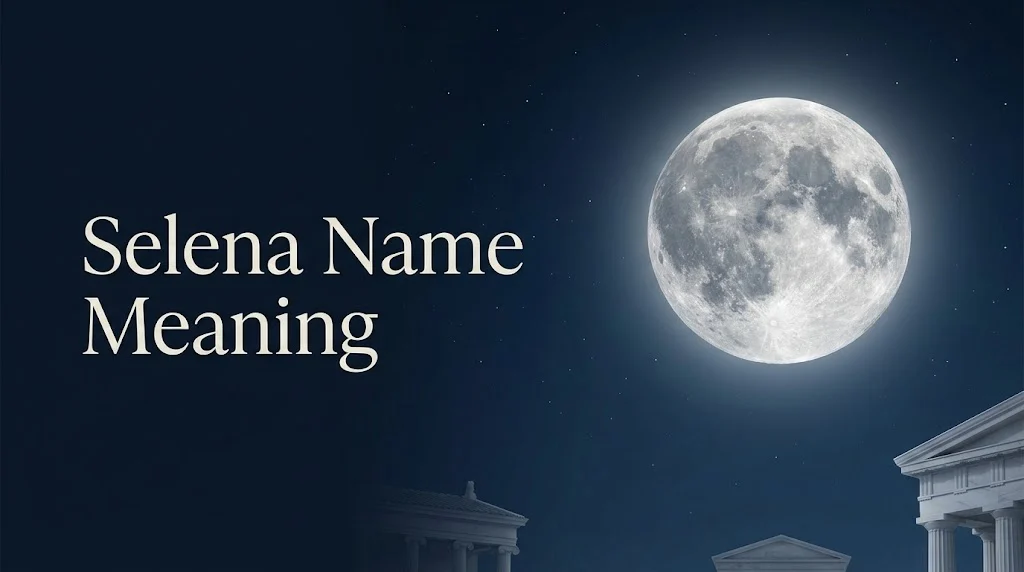
The Selena name meaning is most commonly associated with the moon. The name connects to Selene, the moon goddess of ancient Greek mythology, giving it beautiful celestial associations. Selena is a feminine name used in English- and Spanish-speaking communities. Its melodic pronunciation, elegant spelling, and rich cultural background make it an appealing choice for parents looking for a meaningful baby girl name.
Beyond its connection to the moon, Selena has an interesting history involving Greek mythology, language, music, and modern popular culture. Understanding its origin, pronunciation, variations, and symbolism can help parents decide whether this name suits their family.
What Is Selena?
Selena is a feminine given name commonly associated with the Greek name Selene, which means “moon.” Selene represented the moon in ancient Greek mythology, and this connection gives Selena its well-known celestial meaning.
The name has a graceful sound and a familiar spelling. It works naturally in English and Spanish, making it recognizable across different linguistic communities.
Selena Name Meaning: Key Facts
| Name Detail | Information |
|---|---|
| Name | Selena |
| Gender | Feminine |
| Meaning | Moon |
| Origin | Greek connection through Selene |
| Language | Used in English and Spanish |
| English pronunciation | suh-LEE-nuh |
| Spanish pronunciation | seh-LEH-nah |
| Name type | Feminine given name |
| Symbolism | Moonlight, beauty, mystery, and renewal |
| Related names | Selene, Selina, Celina, Celine |
The moon is the most widely recognized meaning associated with Selena. Some naming references discuss additional historical connections with related names, so it is worth distinguishing the established lunar association from alternative etymological explanations.
Selena Name Meaning and Symbolism
The most common interpretation of Selena is “moon.” This meaning comes from its relationship with Selene, the ancient Greek lunar goddess.
The moon has inspired people for centuries. Its changing appearance, gentle light, and presence in the night sky have made it a powerful symbol in art, mythology, literature, and storytelling.
The Moon and Its Symbolism
The lunar connection gives Selena several beautiful symbolic associations.
- Beauty: Moonlight has inspired countless descriptions of natural beauty and elegance.
- Mystery: The night sky often represents curiosity, imagination, and the unknown.
- Peace: The moon’s soft glow can create a feeling of calm and quiet.
- Renewal: The lunar cycle can symbolize change, growth, and new beginnings.
- Brightness: The moon’s light offers a natural association with radiance and hope.
These qualities are symbolic interpretations rather than personality traits. A person’s character develops through individual experiences, relationships, and choices, not simply through their name.
Does Selena Mean Light or Brightness?
Selena is primarily associated with the moon. Some explanations of the related Greek name Selene discuss a possible linguistic connection with the Greek word selas, meaning “light” or “brightness.”
However, “light” and “brightness” are better understood as related linguistic or poetic associations than as universally accepted direct translations of Selena.
For parents choosing the name, “moon” provides the clearest traditional interpretation. Words such as “moonlight,” “radiance,” and “celestial beauty” can help describe the feelings the name evokes.
Is Selena a Spiritual Name?
Selena has spiritual and mythological associations through its connection to Selene, a goddess in ancient Greek religion. This background may appeal to families who appreciate mythology, nature, or celestial symbolism.
Other parents may simply enjoy the name’s sound or cultural familiarity. Selena does not belong exclusively to one modern religion, and families can give it personal significance according to their own beliefs and traditions.
Selena Name Origin and Etymology
The name Selena is commonly explained as a Latinized form of Selene, the ancient Greek name associated with the moon. This connection links the modern name to Greek language and mythology.
Over time, related names developed different spellings and became established in various languages. Selena is now recognized as a personal name in its own right.
Greek Roots of Selena
In ancient Greek, Selene referred to the moon and was also the name of its divine personification. Greek mythology portrayed Selene as a goddess associated with the moon’s movement across the night sky.
The related Greek word selas means “light” or “brightness.” Although this word is relevant to discussions of the name’s linguistic background, its relationship to Selene should not be treated as proof that every related name has the same literal meaning.
Selena developed from a related naming tradition and became a distinct spelling used for girls.
Is Selena a Spanish Name?
Selena is widely recognizable in Spanish-speaking communities, but its historical connection is generally traced to Greek Selene rather than an exclusively Spanish origin.
This is common with personal names. A name can begin in one language, develop through related forms, and become popular in several cultural settings.
In Spanish, Selena is pronounced with clear vowel sounds: seh-LEH-nah. English speakers commonly use suh-LEE-nuh. Both pronunciations preserve the familiar spelling while reflecting the sounds of each language.
Does Selena Have a Latin Origin?
The name’s history includes some nuance. While Selena is most commonly connected to Greek Selene, some naming references discuss possible influence from Selina and Latin-derived names associated with the meaning “heavenly.”
The Latin word caelum means “sky” or “heaven,” and the related adjective caelestis means “heavenly” or “celestial.” These connections appear in explanations of certain related names, but they do not establish a single origin for every form of Selena.
The most widely recognized interpretation remains the name’s association with the moon through Selene.
History and Cultural Significance of Selena
Selena’s story combines ancient mythology with modern culture. Its lunar connection gives it historical depth, while its use in music and entertainment has made it familiar to many contemporary audiences.
Selena in Ancient Greek Mythology
Selene was the personification of the moon in ancient Greek mythology. Greek stories portrayed her as a divine figure whose presence illuminated the night sky.
Mythological accounts identify Selene as a daughter of Hyperion and Theia. Her brother Helios represented the sun, while her sister Eos represented the dawn in traditional Greek accounts.
Artists have often portrayed Selene with lunar imagery, including the moon itself and objects associated with the night sky. These representations helped establish her connection with celestial beauty and the changing lunar cycle.
The Roman counterpart of Selene was Luna, the Latin personification of the moon. This relationship explains why Selene, Selena, and Luna frequently appear together in discussions of moon-inspired names.
Although Selena draws on this mythological tradition, it is important to distinguish the modern personal name from the ancient goddess’s original Greek name.
Selena in Spanish-Speaking Communities
Selena is familiar to many Spanish-speaking audiences, particularly because of the legacy of Selena Quintanilla.
Known professionally as Selena, Quintanilla was a Mexican-American singer who became an influential figure in Tejano music. Her success helped bring Tejano music to a broader audience and established a lasting cultural legacy.
For some families, the name Selena carries a connection to her music, cultural influence, and personal story. Others appreciate it for its traditional lunar meaning or its pleasant sound.
These associations vary from person to person. A name can carry different meanings for families depending on their cultural background, memories, and personal experiences.
Selena in Modern Popular Culture
Selena Gomez, an American singer and actress, is another widely recognized person with the name.
Her career has helped keep Selena familiar to contemporary audiences. The name appears in conversations about music, acting, entertainment, and popular culture.
Celebrity recognition can influence how people discover names, but it does not determine their linguistic meaning or guarantee popularity in every country.
Selena’s appeal also comes from its balanced spelling, flowing pronunciation, and association with the moon.
Selena as a Modern Baby Name
Parents may consider Selena for several reasons:
- It has a familiar spelling and a melodic sound.
- It works in both English- and Spanish-speaking environments.
- It has a traditional connection to Greek mythology.
- It offers a celestial association without using the name of the goddess directly.
- It is recognizable through music and entertainment.
- It pairs naturally with many short and long middle names.
The name can feel classic, romantic, modern, or distinctive depending on the person hearing it. Its overall impression often depends on cultural context and individual preference.
Selena Name Pronunciation and Spelling
Selena is generally straightforward to pronounce once the language is clear. English and Spanish speakers typically place emphasis on the middle syllable, but the vowel sounds differ.
English pronunciation: suh-LEE-nuh
Spanish pronunciation: seh-LEH-nah
The name has three syllables: Se-le-na. English speakers often use a long “ee” sound in the middle, while Spanish speakers generally pronounce the vowels more consistently.
The standard spelling is Selena. Related spellings include Selina, Selene, and Celina, although these names have distinct histories and may have different pronunciations.
Parents should consider how the name sounds alongside their family name and how relatives are likely to pronounce it in everyday conversation.
What Kind of Name Is Selena?
Selena is a feminine given name with Greek mythological associations and established usage in English and Spanish. Its most recognized meaning connects it with the moon, placing it naturally among celestial and mythology-inspired names.
Is Selena a Traditional or Modern Name?
Selena combines an old linguistic and mythological connection with modern familiarity. The related name Selene comes from ancient Greek tradition, while Selena has developed as a recognizable personal name used in contemporary communities.
This combination may appeal to parents who want a name with historical depth that still sounds suitable for a modern child.
Its recognition through music and entertainment also gives it a contemporary feel. Whether someone considers Selena traditional or modern depends on the naming customs of their community.
Is Selena a Rare Name?
Selena is recognizable in popular culture, but its actual frequency varies by country, region, and birth year.
A name can be well known without appearing among the most frequently chosen baby names. Similarly, a name that feels uncommon in one community may be familiar in another.
Parents interested in popularity rankings should consult official birth-name statistics for their country and the relevant year. This approach provides more reliable information than describing Selena as universally rare or popular.
Is Selena a Good Name for a Baby Girl?
Selena may be an appealing choice for parents who want a feminine name with a smooth sound and a meaningful historical connection.
Its main advantages include:
- A recognizable spelling.
- A pronunciation that works in multiple languages.
- A connection to Greek mythology.
- A lunar meaning with poetic symbolism.
- Familiarity through well-known public figures.
Before making a final decision, say Selena aloud with the child’s intended middle and last names. Consider how it sounds in the languages your family speaks and whether you prefer its English or Spanish pronunciation.
The best name is one that feels right to the family, rather than one selected solely because of its meaning or popularity.
Selena vs. Selene, Selina, and Celina
Several names resemble Selena in sound or spelling. Although they are related in some naming traditions, they do not all share the same origin.
| Name | Meaning or association | Main difference |
|---|---|---|
| Selena | Moon | A modern given name associated with Greek Selene |
| Selene | Moon | The ancient Greek name of the moon goddess |
| Selina | Varies by etymological explanation | A related-sounding name with its own naming history |
| Celina | Varies by language and tradition | A similar-looking name with multiple possible origins |
| Celine | Often associated with “heavenly” | A distinct name commonly associated with French usage |
| Luna | Moon | A Latin word for moon and the Roman lunar goddess’s name |
Selena and Selene have a particularly clear mythological relationship. Selina and Celina are similar in appearance, but their etymological histories can differ. Luna is another option for parents who want a direct lunar connection.
Selena or Selene: Which Should You Choose?
Choose Selena if you prefer a familiar name with established use in English and Spanish. Choose Selene if you prefer the more direct ancient Greek form associated with the moon goddess.
In English, Selena is commonly pronounced suh-LEE-nuh, while Selene is often pronounced suh-LEE-nee. Pronunciation can vary, particularly when speakers follow a different language’s conventions.
Both names offer a celestial association, but neither is inherently better. Your preferred sound, cultural background, and personal connection can guide your choice.
Names Similar to Selena
If you like Selena’s sound or meaning, several other names may interest you.
Luna
Luna comes from Latin and means “moon.” It is also the name of the Roman goddess associated with the moon.
Luna is a natural alternative for parents who want a short name with a direct lunar meaning. Like Selena, it has a clear celestial association.
Selene
Selene is the closest mythological relative of Selena. It is the ancient Greek name associated with the moon goddess.
Parents may prefer Selene if they want a name that more directly reflects Greek mythology.
Celina
Celina resembles Selena in both spelling and sound. Its meaning and origin vary across naming traditions, so parents should check the particular interpretation they prefer.
It may appeal to families looking for a similar sound with a slightly different spelling.
Selina
Selina is another close alternative. Its spelling differs by only one letter, but the name has its own historical background and may have different etymological explanations.
It is worth considering if you like Selena but prefer a variation that looks or sounds slightly different.
Stella
Stella means “star” in Latin. It is an appealing choice for parents who like celestial names but want a connection to stars rather than the moon.
Aurora
Aurora is associated with the dawn in Roman mythology. The name suggests morning light and new beginnings, making it suitable for parents who appreciate nature-inspired symbolism.
Although these names share a celestial or nature-inspired feeling, they do not all have the same linguistic origin as Selena.
Examples of Selena in Everyday Use
Examples can help demonstrate how Selena sounds in everyday conversation and how families might explain their choice.
Introducing Someone Named Selena
- “This is Selena, my younger sister.”
- “Selena enjoys reading books about space and astronomy.”
- “Our daughter’s name is Selena because we love its connection to the moon.”
These examples show how naturally the name fits into ordinary sentences. The interests mentioned are illustrative and do not suggest that everyone named Selena shares the same characteristics.
Selena in a Baby Announcement
A family might write:
“Our little Selena has arrived. We chose her name because of its beautiful connection to the moon and the sense of wonder it represents for our family.”
This announcement explains the family’s personal interpretation without claiming that every culture understands the name in precisely the same way.
Selena as a Fictional Character
Selena could suit a character in a contemporary novel, a romantic story, or a fantasy setting.
A writer might choose the name for a character connected to astronomy, the night sky, or a family with Spanish-speaking heritage. The lunar association could also provide a subtle theme in a story involving dreams, discovery, or personal growth.
However, a character’s personality should develop through the story rather than through assumptions based on the name.
How to Choose the Right Meaning for Selena
A name’s meaning can help guide a decision, but other factors also deserve consideration.
If you are thinking about naming a child Selena, consider the following:
- Meaning: Decide whether the traditional moon association appeals to you.
- Pronunciation: Consider how family members and speakers of different languages will say it.
- Spelling: Compare Selena with related forms such as Selene and Selina.
- Cultural background: Think about whether the Greek mythological connection or Spanish-language usage is meaningful to your family.
- Full name: Say Selena with the intended middle and last names to check the overall sound.
- Personal significance: Consider whether the name connects with a family memory, favorite song, or meaningful experience.
There is no universal rule for choosing a baby name. Selena combines historical roots, a melodic sound, and an evocative lunar association. Its greatest significance may ultimately come from the people who choose it and the life of the person who carries it.
FAQs
What does Selena mean?
Selena is commonly associated with “moon.” Its meaning connects to Selene, the moon goddess of ancient Greek mythology.
What is the origin of the name Selena?
Selena is generally explained as a Latinized form of the Greek name Selene. It is now used as a feminine given name in English- and Spanish-speaking communities.
Is Selena a Greek name?
Selena has Greek roots through its connection to Selene, the ancient Greek name associated with the moon. Selena itself is commonly described as a related Latinized form.
Is Selena a Spanish name?
Selena is used in Spanish-speaking communities, although its historical connection is generally traced to Greek Selene rather than an exclusively Spanish origin.
How do you pronounce Selena?
In English, Selena is commonly pronounced suh-LEE-nuh. In Spanish, it is generally pronounced seh-LEH-nah, with clear vowel sounds.
Is Selena a girl’s name?
Yes, Selena is conventionally used as a feminine given name in English- and Spanish-speaking naming traditions.
What is the difference between Selena and Selene?
Selene is the ancient Greek name associated with the moon goddess. Selena is a related form that developed as a personal name and has a different common English pronunciation.
Does Selena mean moonlight?
The traditional meaning is more accurately described as “moon.” Moonlight is a poetic association that follows from its lunar connection rather than a separate, universally accepted literal translation.
Is Selena a popular baby name?
Selena is recognizable internationally, partly because of famous singers and entertainers who bear the name. Its popularity varies by country and year, so specific rankings require relevant birth-name statistics.
What names are similar to Selena?
Similar names include Selene, Selina, and Celina. Luna is another option for parents who want a name with a direct connection to the moon.
Conclusion
Selena is a feminine name most commonly associated with the moon through its connection to Selene, the ancient Greek lunar goddess. Its melodic sound, cultural familiarity, and celestial symbolism give it a distinctive appeal.
For parents seeking a name with historical depth and an elegant modern feel, Selena offers a meaningful choice. Its personal significance can grow beyond its traditional meaning as the person who carries it creates a story of her own.
