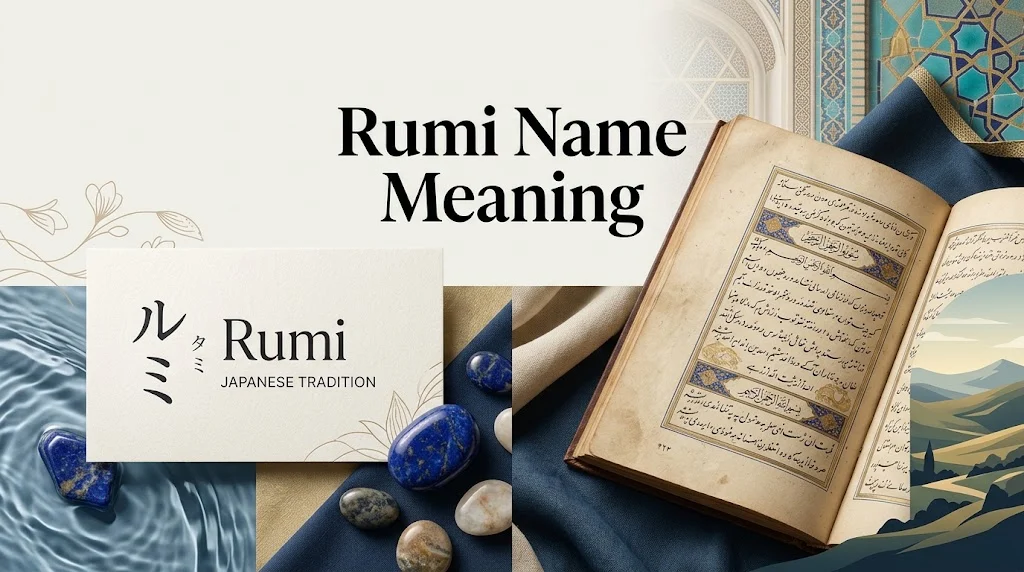
Rumi has more than one established meaning. As a Japanese given name, it can express ideas such as “beauty,” “flow,” or “lapis lazuli,” depending on the kanji used. In Persian and Arabic history, Rūmī means “from Rūm,” referring to Anatolia and the former Eastern Roman world.
The rumi name meaning depends strongly on which linguistic tradition is being discussed. In Japanese naming, Rumi is a feminine given name that can take different meanings according to its kanji spelling. In Persian and Arabic contexts, Rūmī has a separate historical origin and means someone connected with Rūm, the name historically used for Byzantine-controlled Anatolia.
That distinction matters because the modern name brings together two unrelated naming traditions. One comes from Japanese kanji combinations; the other comes from a geographical byname famously associated with Jalāl al-Dīn Rūmī. This article explains both meanings, their histories, pronunciation, variants, examples, and notable people named Rumi.
Key Facts
| Detail | Information |
|---|---|
| Gender | Unisex in modern use; traditionally feminine as a Japanese given name |
| Meaning | Beauty, flow, lapis lazuli; historically “from Rūm” |
| Origin | Japanese given-name usage; Persian/Arabic historical byname |
| Pronunciation | ROO-mee |
| Syllables | 2 |
| Notable association | Jalāl al-Dīn Rūmī, the 13th-century Persian poet and mystic |
What Is Rumi?
Rumi is a short two-syllable name used in several cultural settings. In Japanese, it functions as a given name and can be written with different kanji, so its exact meaning changes with the characters selected.
For example, 留美 can be interpreted through characters associated with “remain” and “beauty,” while 瑠美 combines a character associated with lapis lazuli with 美, meaning “beauty.” Other written forms can produce meanings connected with flow or water.
The historical Rūmī, by contrast, was not originally a conventional first name. It functioned as a geographical byname. Jalāl al-Dīn Muhammad Rūmī received the designation because of his association with the region known as Rūm in Anatolia.
Rumi Name Meaning
Rumi carries different meanings depending on the language and written form.
Japanese Meaning of Rumi
Japanese Rumi does not have one fixed dictionary meaning because Japanese given names can use different kanji combinations for the same pronunciation.
One established form is 瑠美, in which 瑠 relates to lapis lazuli and 美 means “beauty.” The result gives the name an elegant association with beautiful lapis lazuli. Another spelling, 留美, combines “remain” with “beauty.” 流美 can connect the sound with ideas of “flow” and “beauty.”
That flexibility is typical of Japanese personal names. The pronunciation alone does not always tell you the precise meaning; the written characters provide that information.
Historical Persian and Arabic Meaning
The older Rūmī has a geographical meaning rather than the Japanese meanings above. It refers to someone “from Rūm.”
Rūm was the historical name used in Islamic and Persianate contexts for territories associated with the Eastern Roman or Byzantine world, particularly Anatolia. The term ultimately relates to “Roman,” but in medieval usage it often identified a geographical and cultural region rather than modern Roman nationality.
This is the sense connected with the famous Persian poet Jalāl al-Dīn Rūmī.
Origin and Etymology
The Japanese and Persian forms of Rumi have separate linguistic histories, despite sharing the same Roman-letter spelling.
Japanese Rumi developed as a personal name through Japanese writing systems and kanji combinations. Sources document forms including 留美, 瑠美, 流美, and other spellings. Each combination can create a different semantic interpretation.
The historical Persian rūmī traces to the word Rūm, a term connected with the Roman or Byzantine territories. Persian and Arabic sources used Rūmī as a geographical descriptor. Persian linguistic evidence connects رومی to an older term referring to Roman, Greek, or Byzantine lands.
So, the Japanese name should not be treated as a translation of the Persian word. They simply happen to share the pronunciation and spelling used in English.
History and Cultural Context
The name Rumi has a particularly strong literary association because of Jalāl al-Dīn Muhammad Rūmī, the 13th-century Persian poet, scholar, and Sufi mystic.
Rūmī was born in Balkh and later lived in Anatolia. His name included Balkhī, referring to Balkh, and Rūmī, referring to Rūm. In other words, Rūmī originally identified geographical association rather than functioning as his ordinary given name.
His poetry later gave the name an enormous cultural presence. In modern English, “Rumi” often immediately evokes Persian literature, mystical poetry, spiritual reflection, and themes of love.
The Japanese Rumi has a different cultural background. It belongs to Japanese naming practice and appears in several kanji forms. Japanese actresses, singers, athletes, and other public figures have carried the name.
Examples
Rumi works as a concise given name because it has a simple pronunciation and familiar vowel pattern.
Here are a few natural examples:
- Rumi Carter — the daughter of Beyoncé and Jay-Z.
- Rumi Hiiragi — Japanese actress and voice actress.
- Rumi Utsugi — Japanese former professional footballer.
- Rumi Ōkubo — Japanese voice actress.
- Jalāl al-Dīn Rūmī — the renowned Persian poet and mystic.
In a naming context, parents choosing Rumi may be drawn to its Japanese associations with beauty or flow. Others may choose it because of its literary association with the Persian poet.
The intended meaning should therefore be checked against the family’s chosen language and spelling.
Variants and Spellings
Rumi has several documented forms, although they do not all represent the same linguistic tradition.
| Form | Context | Meaning or Role |
|---|---|---|
| Rumi | Japanese | Given name with meanings determined by kanji |
| 瑠美 | Japanese | Lapis lazuli + beauty |
| 留美 | Japanese | Remain + beauty |
| 流美 | Japanese | Flow + beauty |
| Rūmī | Persian/Arabic | From Rūm; historical geographical byname |
| Rumie / Rumey / Rumy | Modern variant spellings | Alternative Latin-script forms |
Japanese can also write Rumi in hiragana or katakana, while kanji allows parents to attach a specific semantic meaning to the name.
The forms Rumie, Rumey, and Rumy appear as alternate modern spellings, but they should not automatically be treated as traditional Japanese equivalents.
Famous People Named Rumi
Several real people have carried Rumi as a given name.
- Rumi Hiiragi — Japanese actress and voice actress, known internationally for voicing Chihiro in Spirited Away.
- Rumi Utsugi — Japanese former professional footballer who represented Japan internationally.
- Rumi Ōkubo — Japanese voice actress known for numerous anime roles.
- Rumi Shishido — Japanese singer and voice actress.
- Rumi Carter — daughter of Beyoncé and Jay-Z, whose name brought additional international attention to Rumi as a modern personal name.
- Jalāl al-Dīn Muhammad Rūmī — the 13th-century Persian poet, scholar, and Sufi mystic whose historical byname became widely known simply as Rumi.
Rumi vs. Related Terms
| Term | Meaning | How It Differs |
|---|---|---|
| Rumi | Japanese given name with several possible kanji meanings | Modern personal name with Japanese usage |
| Rūmī | “From Rūm” | Historical Persian/Arabic geographical byname |
| Rum | Roman/Byzantine lands in historical Islamic usage | Refers to the region rather than the person |
| Romy | A separate personal name | Similar sound, but not the same etymology in every naming tradition |
| Rumiko | Japanese feminine given name | A longer Japanese name that is related in sound, not simply another spelling of Rumi |
The most important distinction is between Japanese Rumi and historical Rūmī. They look identical when written in English, yet their linguistic histories differ.
Frequently Asked Questions
Is Rumi a Japanese name?
Yes. Rumi is an established Japanese given name, especially feminine in traditional usage. Its exact meaning depends on the kanji chosen, with documented associations including beauty, flow, and lapis lazuli.
What does Rumi mean in Japanese?
There is no single fixed meaning. Depending on the kanji, Rumi can express meanings connected with beauty, flow, water, or lapis lazuli. The spelling must be known to identify the intended meaning precisely.
What does Rumi mean in Persian?
The historical Persian Rūmī means “from Rūm.” Rūm referred to territories associated with the Eastern Roman or Byzantine world, particularly Anatolia. The term became famous through Jalāl al-Dīn Rūmī.
Is Rumi a boy’s or girl’s name?
Rumi is unisex in modern use, although Japanese Rumi has traditionally been used as a feminine given name. The famous historical Rūmī was male, while many modern Japanese bearers of Rumi are women.
How do you pronounce Rumi?
Rumi is commonly pronounced ROO-mee, with two syllables. The first syllable sounds like “roo,” followed by “mee.”
Is Rumi named after the poet?
Not necessarily. Some people choose Rumi because of its association with Jalāl al-Dīn Rūmī, while Japanese Rumi can have an entirely independent origin based on kanji. The intended meaning depends on the family’s naming tradition.
Is Rumi a rare name?
Its use varies considerably by country and culture. It remains much less common than many established Western names, while modern usage has gained visibility through public figures and popular culture. Current U.S. records show Rumi being used for both childrens.
Conclusion
Rumi is a compact name with two distinct cultural histories. In Japanese, its meaning depends on the kanji and can evoke beauty, flow, or lapis lazuli; in Persian and Arabic history, Rūmī means “from Rūm” and carries the literary legacy of Jalāl al-Dīn Rūmī. Its appeal comes from that combination of simplicity, cultural depth, and flexibility.
